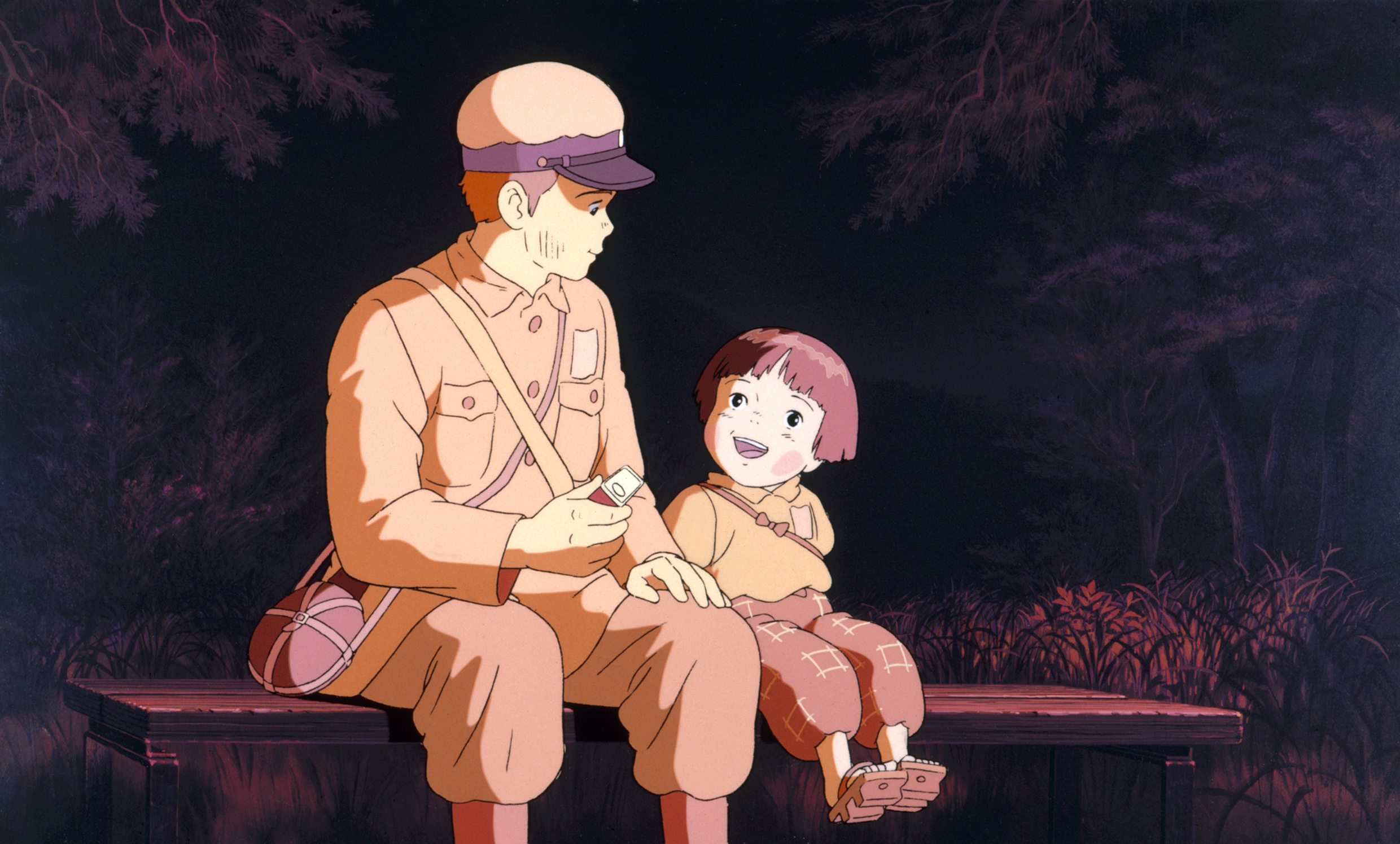
Grave of the Fireflies
Our Grave of the Fireflies Christian review and parents’ guide discuss symbolism, content flags, characters, plot, age appropriateness, and more.
Our goal is to answer the question: Is Grave of the Fireflies safe for Christians and families?
Quick Facts about Grave of the Fireflies
Creator: Isao Takahata (Studio Ghibli)
Rating: Not Rated
Year: 1988
Runtime: 1h 28m
Quick Grave of the Fireflies Content Guide
Sex and Nudity: Mild. No sex scenes or romance. On multiple occasions, Seita and Setsuko are visible naked or shirtless (such as bathing together non-sexually, swimming, Seita wearing a thong-like garment, etc.). Sensitive areas are covered other than butt cheeks.
Violence, Gore, and Frightening Scenes: Severe. Emotionally heavy. Both siblings die (not a spoiler), maggoty corpses, burned corpses, bomb raids, etc. occur/shown. Children lose their mother. Malnutrition, death, etc.
Language: Mild (Based on Japanese language version with English subtitles) One use of b*stard. Some insults (brat, pests, etc.), a use of shut up, etc.
Substance Abuse: Mild. A character smokes.
Spiritual: Very little. Some Japanese cultural things (praying at a grave, mention of a temple, etc.)
My Rating
Is Grave of the Fireflies Appropriate for Kids?
No, Grave of the Fireflies is not appropriate for children.
What Age is Grave of the Fireflies Appropriate for?
Grave of the Fireflies may be unrated, but it’s known for its heartbreaking premise. Common Sense Media recommends the Studio Ghibli film for ages 15+, and that’s a valid age recommendation.
Mature 14-year-olds may be able to appreciate it, but once you see it, you can never go back to a world before Grave of the Fireflies.
Is Grave of the Fireflies Safe for Christians?
Yes, Grave of the Fireflies is safe for mature Christians with wisdom and discernment. However, it could leave you pleading with God against the injustices civilians of war face, and it is not for the faint of heart.
Synopsis: What is Grave of the Fireflies About?
After siblings Seita and Setsuko lose their mother during the bombing of Kobe, the two must survive by any means necessary. With the constant threat of bombs, malnutrition, and an aunt who makes life difficult, Seita must step up and protect his sister.
“…[T]his just might be the saddest movie ever made.” Ben Sherlock, ScreenRant
Grave of the Fireflies Christian Review: A Christian Perspective on Studio Ghibli’s Most Heartbreaking Film
Grave of the Fireflies, also known as Hotaru no haka, is one of two Studio Ghibli films released in 1988, and it is one of the heaviest and most mature Studio Ghibli films by far. The film’s impact is still discussed today.
At the very beginning, audiences learn that neither sibling survives, but that doesn’t make the film any easier to watch.
Let me just drive this home: you will not be the same person you were before you watched Grave of the Fireflies. The film will change you.
Grave of the Fireflies is a Heartbreaking War Film
There are few things that almost everyone can agree on, and this is one of them: Grave of the Fireflies is a beautiful, masterful animated film.
Rotten Tomatoes ranks it #3 on its “100 Best Anime Movies of All Time, Ranked by Tomatometer” list.
Variety includes Grave of the Fireflies in its “The 30 Greatest War Films” list.
Renowned critic Roger Ebert calls it “an emotional experience so powerful that it forces a rethinking of animation,” and claims that Grave of the Fireflies “…belongs on any list of the greatest war films ever made.“
Grave of the Fireflies is both one of the greatest war films ever made and one of the greatest animated films ever made. The animation, bringing war-torn Japan to life, is as hauntingly beautiful as it is relentlessly bleak. It’s an unbearably heartbreaking wartime nightmare, but it’s also a movie that everyone needs to see. You’ll only ever want to watch it once, but you owe it to yourself to brave that first viewing and discover this masterpiece.
It’s true that many people struggle to rewatch it, but I’ve seen the film twice now, and I think it’s a masterclass in symbolism.
Yet, the heavy tone of Grave of the Fireflies makes things rather bizarre when you realize it was released as a double feature with another, more tonally traditional Studio Ghibli film.
One of the Wildest Double Features of All Time
Both Grave of the Fireflies and My Neighbor Totoro were released on April 16, 1988, as a double feature in theaters.
The unrated Grave of the Fireflies is known for its somber, emotionally heavy content that starkly contrasts with the G-rated My Neighbor Totoro, a very lighthearted film about childhood whimsy and family.
It’s a very odd pairing of films as a double feature, but both films are masterpieces in their own right.
To acknowledge this double feature, we will be releasing our reviews of My Neighbor Totoro and Grave of the Fireflies back-to-back.
Our My Neighbor Totoro post is already released and is available here.
Grave of the Fireflies Cast (Japanese + English Dub)
Grave of the Fireflies Japanese Cast
I first watched Grave of the Fireflies in Japanese, and I highly recommend it if you are open to subtitles. The main voice cast includes Tsutomu Tatsumi as Seita Yokokawa and Ayano Shiraishi as Setsuko Yokokawa.
Grave of the Fireflies English Cast
However, multiple English dubs exist for Grave of the Fireflies. The 2012 version by Sentai Filmworks stars Adam Gibbs (Natsume’s Book of Friends) as Seita and Emily Neves (Reborn as a Vending Machine, I Now Wander the Dungeon; Clannad, Steins;Gate 0, Spy X Family) as Setsuko.
Other voice actors include Luci Christian (Assassination Classroom, Link Click, Romeo x Juliet) and David Matranga (Sweet Reincarnation, Orange, The Saint’s Magic Power is Omnipotent, Yona of the Dawn).
Seita: Mature and Responsible, But Still a Child
The film quickly establishes Seita as a responsible fourteen-year-old.* Before the bombing of Kobe, he ascertains that his mother has her medicine before she heads to the bomb shelter, buries their rations, and takes care of his four-year-old little sister* Setsuko.
Seita is clearly a fantastic big brother, as he cares for Setsuko without a second thought. He desires to protect her from the pain of war, and he’s the person Setsuko clings to in the aftermath of the bombing.
(Spoiler) When she’s crying, he does gymnastics to try to distract her. He even lies to her, leading her to believe their mom is still alive when she has already passed away.
He gives his aunt most of their rations, does his and his sister’s laundry, and tries to keep her as upbeat as possible, even taking her to the beach.
(Spoiler) He is also selfless, giving Setsuko the last few fruit drops and all of their special fruit drop water.
Despite Seita being responsible for his sister, his aunt makes things very difficult for them.
Seriously, What is Wrong With Their Aunt?
Seita and Setsuko’s aunt takes them in after their home is destroyed.
She feeds them and offers them a place to live, but she prioritizes her own family, giving them better food. For example, she sells Seita’s mom’s kimonos for rice (with his permission). She does give them their own ration and shares rice with them, but then she becomes even harsher.
One day, she makes rice balls for her husband and daughter and refuses to give any to Setsuko, Seita, or herself, insisting that they eat porridge. She says, “You loafers expect to eat the same as those working for our country?” According to her, they aren’t sharing any of their own rice and want more of their aunt’s. Setsuko correctly notes that the rice is theirs to begin with. So, the aunt decides to make the kids eat on their own.
She complains when Setsuko cries in the night and wants Seita to calm her down. So even though it’s a full-time job to care for his sister, she wants him to do that plus help in the war effort?
Yes, Seita could be helping out more (although he did share most of his rations with them and even provided the rice to begin with), but he’s spending all of his time caring for Setsuko. Plus, he’s still a literal child himself; he’s only around fourteen, barely a teenager!
Even though he is responsible, he still makes poor decisions.
The Consequences of Pride: A Grave Mistake (Spoiler)
Seita chose to move out of his aunt’s house, and he took Setsuko with him, refusing to return to his aunt’s. Japanese and Western audiences view Seita’s choice to continue living alone differently:
From my Western perspective, Setsuko’s death from malnourishment was fairly avoidable.
Seita had every opportunity to care for his sister well, and he failed. He took her away from his aunt because she was difficult to live with. His decision was foolish, as he ultimately chose starvation over a nagging aunt.
Madeline from Medium notes, “Effectively, it is Seita’s pride in the final third that causes the tragedy of Setsuko’s death.”
Even an older man encourages Seita to apologize and return home, but he refuses to listen to the elder’s wisdom.
Instead, he resorts to crime. He steals crops, gets caught, and receives a lenient sentence from the kind police officer, but then steals from people during the bomb raids.
He turned to crime as though he had no other option, but he did. He was just too proud to apologize.
Proverbs 18:12 (ESV) says, “Before destruction a man’s heart is haughty, but humility comes before honor.” Humility is not easy, but it’s much more honorable than pride.
To a significant extent, Seita caused the death of him and his sister:
It makes sense to place the majority of the blame on Seita because his pride is ultimately what caused their deaths, but Seita is not the only problem by any means.
The Bombing of Kobe: Wrestling with the Morality of War
Takahata, the director of Grave of the Fireflies, may not have viewed the film as an “anti-war film,” but there’s no denying the consequences of war.
(Spoiler) Without war, Seita’s parents would have been alive, meaning he’d never have had to live with his aunt to begin with.
And it’s hard to detach the war from the film, even if it’s more of a contributing factor than the cause of the siblings’ untimely deaths.
Grave of the Fireflies is set during and after the Kobe Bombing (WWII). The bombers who caused so much tragedy were the Americans.
As an American myself, it’s sometimes hard to see your country as antagonistic, but in this film, we were the ones who attacked Seita’s home. Historically, this was post-Pearl Harbor, but that doesn’t give us the right to attack innocent civilians like four-year-old* Setsuko.
Neither side made great choices, and Grave of the Fireflies reminds us that war has consequences, not just for those directly instigating it, but those caught in the middle. It’s important for us to value and treasure life and care for the less fortunate.
Symbolism in Grave of the Fireflies: Fireflies & Fruitdrops (Spoiler)
Grave of the Fireflies uses symbolism to pile tragedy on top of happy moments, refusing to let us forget the brutal reality the siblings face.
“The fireflies,” according to ScreenRant, “symbolize this glimmer of hope: a little flicker of light glowing through the overwhelming darkness.”
And then there’s the fruit drops, which CBR notes “…[e]mbody [d]espair and [h]ope” :
Indeed, the fruit drops, along with the fireflies, are two key symbols in the film. Here are a few examples:
When Setsuko first catches a firefly, she accidentally squashes it with her hands, a symbol of her coming death.
The first time Setsuko tastes one of the fruit drops, she excitedly dances around saying, “Fruit drops!” as fireflies paint the sky. However, the moment is interrupted when she nearly swallows the fruit drop whole. It’s a haunting reminder that childhood innocence can be interrupted at any moment. Although she’s able to hold onto the fruit drop a little bit longer, we know that it’s destined to fade.
There’s another lighthearted moment when Seita and Setsuko play together on the beach and then enjoy another fruit drop. Although Setsuko still struggles with a heat rash, for a moment, everything seems normal. However, things turn dark once again when she finds a crab and follows it, saying “snip” in a singsong voice. If anything, you’d think she’d get pinched, but that’s not what happens. The crab leads her to a dead body. She thinks the person is merely sleeping, failing to understand the gravity of what she’s just uncovered. Seita steps in, redirects her, and reminds us once again that he’s the only person protecting her from the brutal world around her.
Another moment involves Setsuko during a temper tantrum. Seita, ever the attentive brother, hands her the can of sweets, which seems empty. This adds to her distress, but Seita proves once again that he’s the only one protecting her from the sadness of the world. He hits the bottom, loosening the remaining three fruit drops. Later, he adds water to the now-empty canister and shakes it, creating a sweet drink. But now the fruit drops are gone. As CBR notes, “This would be Setsuko’s last taste of happiness, as shortly after this scene, they are thrust out into the streets of Kobe to fend for themselves.“
After the siblings move into their final home, they catch fireflies for light. However, they all die, and the next morning, Setsuko buries them in the ground. This is the moment when she admits she knows that her mom is dead (thanks to her aunt).
However, things grow increasingly darker when Setsuko becomes malnourished. In her final days, she becomes delirious and sucks on the marbles from her change purse (a possession worthy of being kept with her money and mother’s ring), thinking that they are fruit drops. Her childhood is gone. The reality of the world has to set in. There are no more fruit drops, the fireflies are dead, and now both of their parents are, too.
What’s most heartbreaking is that Seita had just pulled out the rest of their funds. He bought them nourishing food like watermelon. But Setsuko didn’t make it long enough to benefit from this nutrition. Her final words? “Seita…Thank you.” The brother who lost everything, who gave up everything to protect his little sister, has now lost everything.
Ultimately, it’s not the bombs that kill them, or even the fighting. No human kills them. The war is over. It’s malnourishment from a broken wartime system where the civilians suffer most.
What to Take Away from Grave of the Fireflies
At the beginning, Seita is depicted in his final moments. He’s sitting there, barely moving. Most people pass him by, noticing him, commenting about him (one even says “So disgusting!”) but no one stops to help the child who is starving to death. They view him as an inconvenience, not a poor human child who needs care. Finally, someone does leave something for him (probably food), but unfortunately it’s too late.
How often do we, as believers, pass by someone who needs help, failing to be their Good Samaritan?
Luke 10:25-37 tells the story of the Good Samaritan. A Jewish man was attacked, beaten, and ignored by a Jewish priest and a Levite. But, thankfully, that’s not the end of the story:
Seita needed help, and most people ignored him. If anything, this parallel serves as a reminder to help those in need. If you take away anything from this film, it’s that you should care for the less fortunate.
FAQs for Grave of the Fireflies
Is Grave of the Fireflies based on a true story?
The inspiration for Grave of the Fireflies (the anime) is a semi-biographical story written by Akiyuki Nosaka in 1967.
Is there a live action Grave of the Fireflies?
Why is Grave of the Fireflies so sad?
The imminent death of Seita and Setsuko, the constant threat of war, and the slow dissipation of Seita and Setsuko’s bodies and minds all make Grave of the Fireflies so devastating.
(Spoiler) Why did Seita leave his aunt?
Seita left his aunt because she was unkind to him and Setsuko.
(Spoiler) Why didn’t Seita go back to his aunt?
Seita never went back to his aunt’s house because he and Setsuko were not happy there. Additionally, he struggled with pride, as he refused to apologize for his own mistakes.
Is Grave of the Fireflies anti-war?
According to director and screenwriter Isao Takahata, Grave of the Fireflies is not an anti-war film.
Is Grave of the Fireflies appropriate for a 13-year-old?
Common Sense Media recommends the film for 15+. The film is extremely dark and heavy emotionally, so generally, you might want to avoid showing the film to a 13-year-old unless you prescreen it first. It could make for an interesting history/ethics lesson, however, for mature viewers.
Grave of the Fireflies Parents’ Guide
Sexual Content, Romance, and Nudity in Grave of the Fireflies
- Part of a man’s stomach is visible (he’s wounded and covered in bandages on most of his chest).
- Seita and Setsuko take a bath together. Upper body nudity. Not sexual (Japanese parents often bathe with their kids; this even happens in My Neighbor Totoro).
- Seita and Setsuko go swimming at the beach. She strips to her underwear. He takes off his shirt.
- Seita swims shirtless in a flashback. He’s barely covered, wearing a thong-like fundoshi that shows his butt cheeks (it does cover his genitals).
- Setsuko goes potty; her butt cheeks are visible.
- Both siblings shirtless.
- Setsuko lifts up her shirt so the doctor can listen to her chest.
- Setsuko shown shirtless in her underwear.
- Setsuko shown totally naked, running with a blanket cape. She’s visible from a bit of a distance, and she’s not super detailed.
Language & Insults in Grave of the Fireflies
- “So disgusting!” (about a wounded, dying child). “Such a disgraceful sight.” “Don’t want Americans to see this!”
- Brats.
- Loafers.
- You pests.
- You b*stard.
- Shut up.
Intense Scenes & Violence in Grave of the Fireflies
- The opening lines have Seita telling about his death. We see him dirty, his clothes torn, and his chest moving. He falls over, and a fly lands on him. He’s very thin, and he passes away.
- Other children in similar conditions are near death. Someone notes that the look in their eyes indicates their death.
- A bomb siren plays.
- Setsuko notes her distaste for the bomb shelter, and Seita asks her, “You want to get blown to bits?”
- Fiery bombs fall from the sky, causing fires and houses to burn.
- Citizens panic and run for their lives during the bomb attack. A horse also panics.
- Setusko shakes with fright and clings to Seita, clearly beyond frightened.
- Dead bodies shown.
- Citizens surrounded by fire and destruction shown.
- The air is filled with ash and smoke.
- A completely destroyed town (where Seita and his sister once lived) shown.
- Black (from being burned) corpses shown. They’re disturbing.
- A wounded woman is carried on a stretcher in the aftermath of the bomb attack. Other people on stretchers/wounded on cots shown.
- Mention of someone receiving “a direct hit.” Another person mentions other “direct hits.”
- Dead bodies shown lying on the ground.
- A wounded man shown in the makeshift hospital. Blood and bandages visible.
- Wounded people with blood shown in the makeshift hospital.
- Seita’s mother is shown covered in blood and bandages. Her entire chest/head/face/arms are covered in bandages. She looks lifeless, and even her eyes look like they are gone from their sockets. She’s still alive but is not in good shape. Most viewers will likely find this very disturbing.
- (Spoiler) Seita’s mom is later shown dead, with maggots and flies around her.
- People burn a mass pile of dead bodies.
- Setsuko stumbles across a dead body. We can see his feet, which are swarmed by flies, and his hair.
- Throughout the film, multiple air raids happen, announced by the sirens.
- When Setsuko’s aunt tries to take her mother’s kimonos to sell them for rice, she throws a temper tantrum.
- (Spoiler) A flashback shows their mother being thrown in a grave.
- A plane shoots at civilians. Seita and Setsuko have to hide.
- Seita squishes a louse. Blood.
- Both siblings’ backs are covered in bites/rashes. His sister has struggled with heat rash before.
- Seita has bruises from being beaten up.
- A police officer threatens someone because they assaulted a minor.
- Another bomb raid occurs. People duck for cover. Shooting, explosions.
- (Spoiler) Setsuko becomes ill.
- Another raid with panicked civilians, fire, smoke, ash, etc.
- (Spoiler) Setsuko is passed out on the ground; an ant crawls on her, and she seems sick.
- Setsuko’s chest has many bites or a rash.
- (Spoiler) Seita becomes panicked and grabs a guy when he realizes his father is likely dead.
- (Spoiler) Setsuko becomes delirious and sucks on marbles, believing she’s eating fruit drops.
- (Spoiler) Setsuko passes away in her bed.
- Setsuko pokes herself with a needle and bleeds.
- (Spoiler) Seita places Setsuko in a box with her doll and other possessions and then cremates her.
- (Spoiler) Seita carries a box, likely of his mother’s remains.
Substances in Grave of the Fireflies
- A man smokes.
Spiritual Content in Grave of the Fireflies
- Seita and Setsuko are shown post-death as if their ghosts are traveling to the afterlife (at least, that’s my interpretation). Their ghosts show up at various points during the story.
- Mention of luck.
- A child prays at the fireflies’ grave.
- Mention of divine wind.
- Mention of a temple.
- Cremation.
Conclusion: Grave of the Fireflies Christian Review
Grave of the Fireflies is a beautiful, emotionally heavy film about war, family, and loss. It’s a great anime film option for older children and adults who want to think deeply about the impact of war on the average person, but if you’re sensitive, it’s best to avoid it and watch something more lighthearted like Ponyo.
Can Christians watch Grave of the Fireflies? Yes, with wisdom and discernment. I think Grave of the Fireflies is one of the best Studio Ghibli films for (mature) Christians to watch due to its grounded, non-magical tone and lessons about caring for the least of these. However, it’s sad beyond belief, so be forewarned.
Ultimately, Grave of the Fireflies is a Studio Ghibli masterpiece, but it is not for everyone.
Recommended Posts
Cover Photo: © ©Akiyuki Nosaka / Shinchosha, 1988. From GKids Press Room
*Although I don’t recall their ages mentioned in the film, the Ghibli Wiki places Seita as 14-years old and Setsuko as 4-years old. These ages are also supported here.


One Comment
Comments are closed.