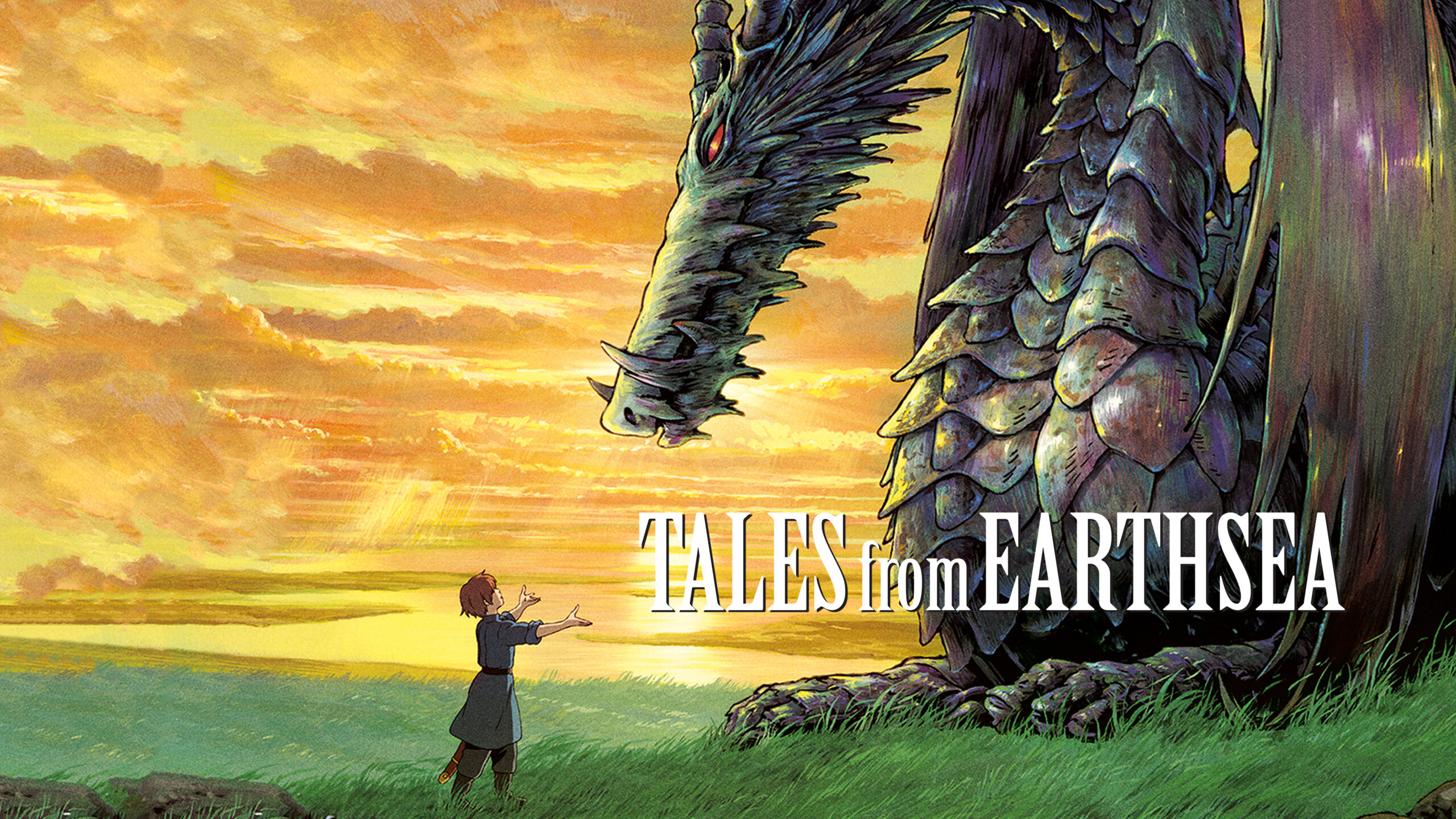
Tales from Earthsea Parents Guide & Christian Review
This review and parents’ guide is about Tales from Earthsea, a 2006 film by Studio Ghibli. The anime film is rated PG-13 and recommended for older children and adults due to its mature themes and scary content.
This post is extremely long because there’s a lot to unpack with this film. Our table of contents is here for your convenience.
Quick Facts about Tales from Earthsea (Anime Film)
Creator: Studio Ghibli
Rating: PG-13
Year: 2006
Runtime: 1h 55m
Quick Tales from Earthsea Content Guide
Sex and Nudity: Men plan to sexually assault a girl but are interrupted; suggestive, not explicit. A character shows cleavage. Some hugging.
Violence & Gore: Blood, fighting, abuse, etc. Plenty of violence.
Frightening Scenes: Some scenes/characters are extremely frightening. Cob, the villain, is especially scary.
Language: Insults and expressions like “my goodness,” “fool,” “maggot,” “what the devil…”, etc.
Substance Abuse: Some smoking, drugs, and alcohol.
Spiritual: Magic and spiritual themes throughout.
See our Tales from Earthsea content guide at the bottom of this review for more details.
My Rating
What Age is Tales from Earthsea (Film) Appropriate for?
Tales from Earthsea is appropriate for teenagers, with discernment. It’s rated PG-13, and Common Sense Media recommends the film for ages 12+.
Is Tales From Earthsea (Studio Ghibli) Safe for Kids and Families?
Tales from Earthsea is not the safest option for kids and families. It’s a PG-13 film that contains many scary scenes, violence, gore, slavery, near-sexual assault, etc., plus mature themes including parricide (the killing of a parent).
Earthsea is one of the Studio Ghibli films that families with young or sensitive children should generally hold off on.
Ponyo, The Secret World of Arrietty, My Neighbor Totoro, or From Up on Poppy Hill would be much safer options for families.
Our list of Family-Friendly Anime offers additional alternatives with much tamer content.
Is Tales from Earthsea Dark or Scary?
Yes, Tales from Earthsea is dark and scary. The film is one of only five Studio Ghibli movies with a PG-13 rating from the MPAA/MPA (there are 24 Studio Ghibli movies as of 2026, and, aside from the unrated Grave of the Fireflies, every other Studio Ghibli movie is rated either G or PG).
Because of this rating, Tales from Earthsea earns its place among the non-family-friendly Studio Ghibli films.
Synopsis: What is Tales from Earthsea (Film) About?
Tales from Earthsea follows Arren, a prince with an uncontrollable inner darkness. After Arren murders his father, he goes on the run, pursued by a frightening presence.
When a wise and experienced wizard saves him from certain death, Arren decides to join forces with him.
However, Sparrowhawk is not just a wandering traveler; he’s concerned about the increasing imbalance in the land, which is leading to widespread illness, death, agricultural struggles, dragons, and the loss of magic.
To make matters worse, Sparrowhawk’s archenemy, Cob, is on the rise, and he’s determined to conquer death itself. Does he have anything to do with the imbalance, and why is he so afraid of death?
Studio Ghibli’s Tales from Earthsea Review: A Christian Perspective
Tales from Earthsea, also known as Gedo senki, is a 2006 anime film created by Studio Ghibli. The film was directed by Goro Miyazaki, who also directed From Up on Poppy Hill.
Tales from Earthsea English Dub
Overall, Tales from Earthsea has a really solid English dub. In particular, Sparrowhawk’s voice actor, Timothy Dalton, does an excellent job. Arren’s voice actor, Matt Levin, also does a great job.
The renowned Willem Dafoe (who also appears in another Studio Ghibli film, The Boy and the Heron) portrays Cob’s creepiness very accurately, down to the calm and quiet whisper. And, Cheech Marin lends his iconic voice to Hare, the head slaver, and truly makes you despise the character.
Personally, I think Mariska Hargitay has the right voice for Tenar, but some of her delivery fell flat. Therru’s voice actress, Blaire Restaneo, adds a young cadence.
Other voice actors include Tress MacNeille, who’s provided voices for eight Studio Ghibli films, including Nausicaä of the Valley of the Wind, and Karen Strassman (The Rose of Versailles).
Why Tales from Earthsea Is Considered One of Studio Ghibli’s Weakest Films
Studio Ghibli is a renowned Japanese animation studio. Hayao Miyazaki, Goro Miyazaki’s father, is one of the studio’s founders and one of the largest reasons Studio Ghibli is so well-known. Two of their films, Grave of the Fireflies and Spirited Away, are listed in Rotten Tomatoes’ “300 Best Films of All Time” (Spirited Away is number 52 and Grave of the Fireflies is number 44*).
On Rotten Tomatoes’ “100 Best Anime Movies of All Time, Ranked by Tomatometer” list, out of the 25** Studio Ghibli movies, 22 of them appear on this list. 15 of them are in the top 50, and the first three on the list are all Studio Ghibli movies*).
So, only three are missing: My Neighbors the Yamadas, Earwig and the Witch (directed by Goro Miyazaki), and Tales from Earthsea.
Tales from Earthsea may offer adventure and beautiful visuals, but, as Common Sense Media rightly notes, “Stylish animation isn’t enough to save violent adaptation.”
It doesn’t have a great Rotten Tomato score, and Beneath the Tangles ranked it dead last in their ranking of Studio Ghibli films.
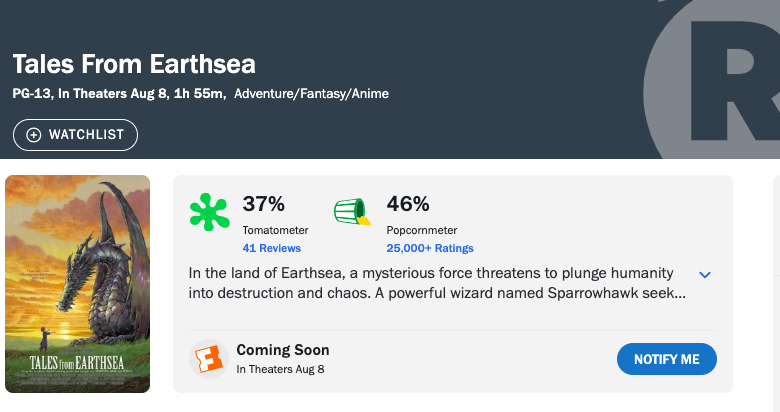
This is a shame, because it could have been a fantastic adventure movie.
Tales from Earthsea was Goro Miyazaki’s first film. To his credit, for an inexperienced director, it’s a decent first film.
However, considering the high standard Studio Ghibli has set for its films, Earthsea falls flat.
The Source Material
Tales from Earthsea is based on the first four installments of Ursula K. Le Guin’s Earthsea novel series and Shuna’s Journey, a graphic novel by Hayao Miyazaki.
However, the story did not really follow Le Guin’s novels. When the director asked her about whether she liked Tales from Earthsea, she stated, “Yes. It is not my book. It is your movie. It is a good movie.“
Le Guin wasn’t completely negative about the film, however, despite it not following her books:
Much of it was beautiful. Many corners were cut, however, in the animation of this quickly made film. It does not have the delicate accuracy of “Totoro” or the powerful and splendid richness of detail of “Spirited Away.” The imagery is effective but often conventional.
Much of it was exciting. The excitement was maintained by violence, to a degree that I find deeply untrue to the spirit of the books. (source).
Ultimately, Tales from Earthsea had the opportunity to be a good movie, but it didn’t meet expectations.
Arren: A Complex Protagonist
When we first meet Arren, the prince of the land, he’s murdering his father. His father is a good king who cares about his people. There’s been plenty of illness and drought in the land, and the king tries to send assistance to his people.
Despite all this, Arren still murders him.
Arren is a sort of Jekyll and Hyde: he has a good side and a bad side.
When Arren’s bad side takes over, his face looks like this:
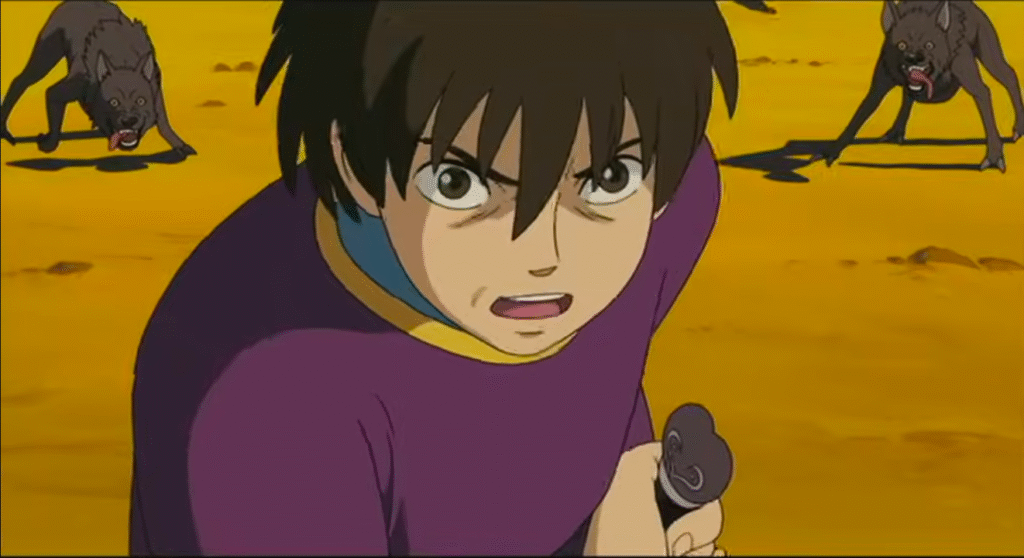
He looks rather harsh, mean, and almost villainous.
When he’s not taken over by his evil side, Arren looks like this:
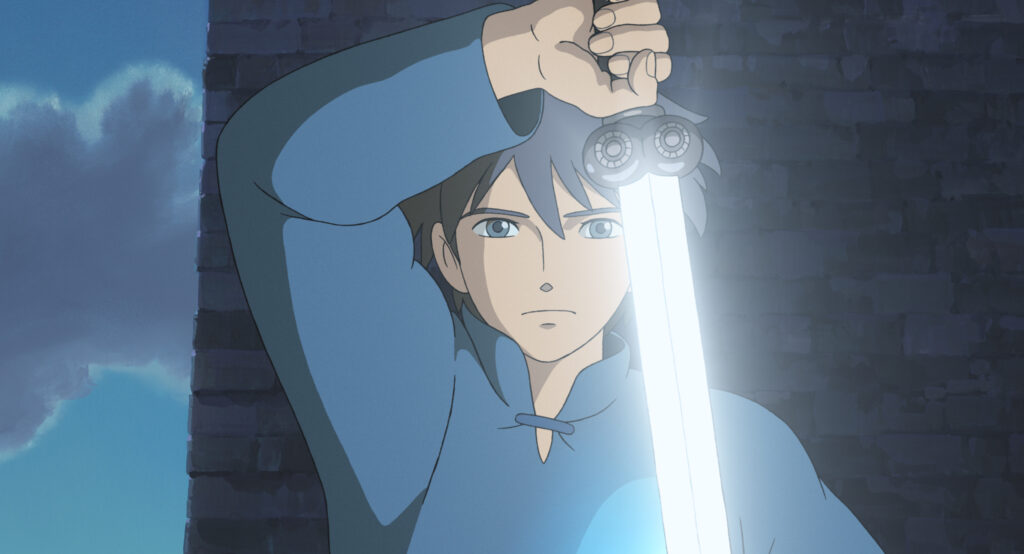
His face appears much softer and gentler, a stark contrast to his evil side.
Arren’s Repentance (Spoiler)
Arren starts to show a bit of repentance after Sparrowhawk saves him from the slavers, and eventually he admits the murder to Therru. He admits that he had no reason to kill his father, calling him a “great man.” He doesn’t know why he murdered him, and acknowledges the uncontrollable rage inside of him.
This leads us into the storyline.
Tales from Earthsea Review: The Storyline
The storyline is chaotic, and it’s easy to miss important information. I’ve watched the film twice, and I still needed to look up some things about the story because it didn’t make sense.
I haven’t read the source material, but based on the differences, I’m not sure if it would have helped much.
Sparrowhawk’s Role is Anticlimactic & Convenient
Sparrowhawk is seeking the source of the imbalance, but his search is very anticlimactic. He journeys with Arren at the beginning and saves him from wolves, drugs, and slavers.
(Spoiler) Then, they end up at the farm run by Tenar and Therru, where they all farm together. After a brief solo trip to Hort Town, Sparrowhawk must go to Cob’s castle for a showdown between wizards—and he’s not even the one who ultimately saves the day.
(Spoiler) It’s a bit too convenient that the source of the imbalance, Cob, falls in his lap because he is seeking out Sparrowhawk for revenge.
Arren is (Mostly) Useless
Then there’s Arren, who is relatively useless until the end. He does save Therru once, but besides that, he’s always getting saved by another person or running from his shadow.
(Spoilers) At the end of the film, he does awaken his full potential, but it takes a very long time.
Where are the Dragons?
You’d also expect, based on the cover, that dragons would be more important than they are. They appear at the beginning and the end, but that’s about it.
The author of the Earthsea books, Ursula K Le Guin, has expressed her own concerns with the film’s storyline.
Ursula K Le Guin’s Perspective on Earthsea’s Storyline
Le Guin, as the author, didn’t get the story. She criticized the film as “incoherent,” noting that it abandoned the original story in favor of something entirely different while reusing character names. While she acknowledged that adaptations require change, she argued the film lacked faithfulness to the characters and core narrative, treating the books as a source of ideas rather than a story to honor. As a result, its themes felt unearned and came across as “heavyhanded” [sic] (source).
She also notes,
The moral sense of the books becomes confused in the film. For example: Arren’s murder of his father in the film is unmotivated, arbitrary: the explanation of it as committed by a dark shadow or alter-ego comes late, and is not convincing. Why is the boy split in two? We have no clue. (source).
This critique is fair. After all, Arren’s story is extremely weak. His parricide is explained as a random urge to murder his father. He chooses parricide for no reason at all.
(Spoiler) As a result, the film implies that Arren’s “good” side leaves him and becomes his doppelgänger. Allegedly, “fear filled his [Arren’s] heart with desperation and darkness” and that “the darkness stole his body and ran away with it.”
(Spoiler) The “good” is portrayed for most of the story as an ominous, scary character, not unlike a villain, yet somehow, he’s (probably?) the good part of Arren.
(Spoiler) After he leaves Therru’s, he meets the doppelgänger again. It’s an eerie scene (the music, wind at twilight, and the presence of the doppelgänger make it intense), and he runs in fear. For this doppelgänger to actually be the good in him, it’s a little odd that the scene is so eerie.
I know this is confusing. Tales from Earthsea is confusing, complicated, and problematic.
(Spoiler) It’s possible that Arren is running away from the good because they are in polar opposition, but that would lead us to one of the largest plot holes. Without the “good,” he realizes he murdered without cause. He willingly chooses to leave Therru’s because otherwise, the doppelgänger will come back. He’s carrying a heavy burden, yet he’s still helpful and asks for forgiveness. He certainly hasn’t mastered all of his issues, but he’s not “evil” without his good side.
Although this is poor craftsmanship from an artistic standpoint, it reminds me of some Biblical truth, although most likely not on purpose.
A Christian Perspective on Arren’s Two Personalities
If you’re a born-again Christian, you have the Holy Spirit inside of you. John 14:26 (ESV) says:
But the Helper, the Holy Spirit, whom the Father will send in my name, he will teach you all things and bring to your remembrance all that I have said to you.
The Holy Spirit is a wonderful gift to believers. He is God, dwells within us, and guides us. He convicts us of sin and guides us toward righteousness.
But not everyone has the Holy Spirit. Most people in the world are not believers and do not have the Holy Spirit inside of them.
Non-believers often know that murder is wrong and that it’s important to apologize when you make mistakes. They often work hard, help others, and may even donate or volunteer for charitable causes.
Arren, even without his “good” side, sometimes made decent choices, but those decent choices weren’t enough to make him “good.”
Mark 10:18 (NIV) says,
“Why do you call me good?” Jesus answered. “No one is good—except God alone.
Christ is God, so He is good. However, humans make mistakes and sin even when we don’t want to.
Repentance is more than “I’m sorry,” and even “good” people have told a lie, been rude to someone, lashed out in anger, or failed to do something they should have. Doing some good things doesn’t make us good people because we make a mix of both good and bad choices.
However, the difference is that believers trust in Jesus for salvation, repent, and live their lives for Him. When we make a mistake, we turn to Jesus. We ask Him for help and turn away from our sins. Over time, He helps us become better people. His Spirit dwells in us and helps teach us how to honor God. Good deeds don’t erase sin; Christ does.
Arren’s “good” side and the Holy Spirit are not the same, but for believers, the Holy Spirit distinguishes us from unbelievers.
The Other Tales from Earthsea Characters
Ged/Sparrowhawk
Sparrowhawk is a kind character who saved Arren from certain death. Despite his meager rations, he shares them with Arren.
Sparrowhawk is also a very reliable ally. He goes after Arren when Arren is in trouble, forgives him for his mistakes, and stays loyal even though Arren inadvertently complicates things on a regular basis.
Sparrowhawk is wise and is extremely powerful, yet he’s not the one who ultimately saves everyone. He serves as a reminder that even the most powerful and seemingly wise humans make mistakes, which is very consistent with a Christian worldview—only Christ was a perfect human.
Tenar
Tenar cares for Arren after he’s been rescued from slavery. She willingly gives up her bed for him and opens her home to both Sparrowhawk and Arren.
She’s a bit interesting, however. Arren was literally saved from slavery the night before, and she puts him to work seemingly the next morning. After he and Sparrowhawk plow, she gives them what she calls “a decent lunch”: a single piece of bread, cheese, and onions. At least she asks Arren if he is feeling better after she’s sent him to plow the fields.
I’m being a bit sarcastic here. I love Tenar, but this interaction is wild. If she doesn’t think Arren is fully better, why is she sending him to plow in the fields? And the “decent” meal she prepared? Well, Sparrowhawk is able to finish about half of it in a single bite. I just find it a bit…mediocre and unfair considering what Arren went through.
However, despite this, she’s a great character. She’s very reliable and maternal. She even adopted Therru as her own, which is a very loving and kind thing to do.
Once, Arren puts his hand out to protect Tenar from the slavers, but then she does the same thing. She’s a pretty strong female character and a bit feisty, too.
Therru
Therru is a very interesting character. She’s resilient and determined.
When we first meet her, she’s nearly sexually assaulted by slavers. Arren steps in to save her (and does successfully). But, he says, “Life is nothing to me” during the rescue, which harms his reputation with her.
When they reunite shortly thereafter, she says, “I despise anyone who doesn’t care about life.” She isn’t a fan of his perspective on life, and that makes sense.
As a child, she was abused by her parents. Her parents even burned her (which is why she has a scar on her face).
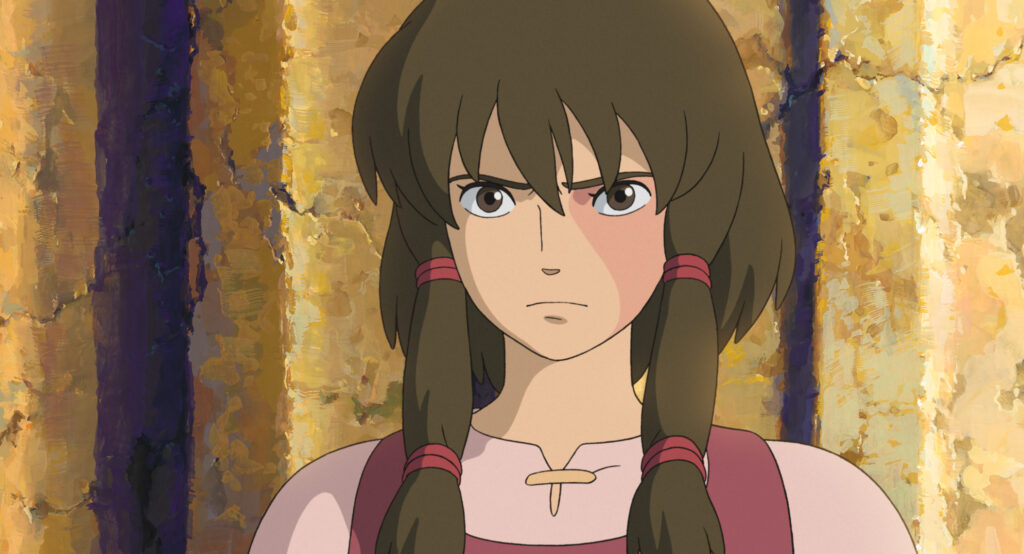
Tenar takes in Therru after her parents abandon her. Despite all that she’s gone through, she treasures life deeply and fights for the good of others.
Cob: The Evil Wizard & Antagonist of Tales from Earthsea (Spoilers)
Cob is a very powerful, evil wizard who’s behind the slavery in the world.
Cob desires eternal life, and his motivation is rooted both in his fear of death and a desire for revenge. He says that he is “almighty,” so he clearly struggles with pride.
Cob tries to convince Arren that Sparrowhawk is the true villain and falsely claims that Sparrowhawk wants eternal life.
He claims that Sparrowhawk is “proud” and that Sparrowhawk wants to kill Arren because Arren is “the chosen one” and will be able to achieve eternal life.
Cob wants to join forces with Arren and promises eternal life. He says they will “conquer…fear and suffering.” Sound familiar?
Cob’s slippery words remind me of the serpent in the Garden of Eden. The serpent deceived Eve and spoke lies with slivers of truth. Eve chose to listen to the serpent over God.
Cob’s claims are untrue, of course, but Arren decides to trust Cob enough to accept a drink from him. This drink causes Arren to drop his guard and tell Cob his “true name.” Knowing someone’s true name gives you control over them, so Arren turns against Sparrowhawk.
This is really sad, of course, but thankfully, things turn out all right in the end.
Cob’s Scariness
I’ve seen about 12 Studio Ghibli movies so far, and Cob is probably the creepiest Studio Ghibli villain. He’s even creepier than No Face from Spirited Away, and No Face is rather intense, too.
Cob’s appearance changes multiple times throughout the film. He starts out as an odd, humanlike wizard. However, he can turn into a monster resembling black tar, abruptly age with hollow eyes, and appear in other ways that are just absolutely frightening and disturbing.
Click to view image of Lord Cob (warning: disturbing)
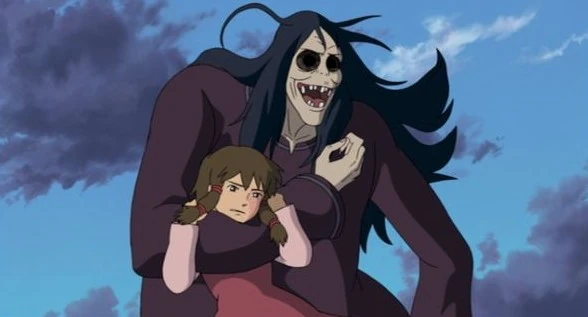
Cob’s creepiness isn’t just based on his looks, either. He speaks in calm, whisper-like slithering tones, which adds to his uncomfortable nature.
Watch Mojo listed Cob’s transformation as #7 on their list of “Top 10 Scariest Studio Ghibli Movie Moments”:
It’s a super creepy moment, but unfortunately, this isn’t every terrifying thing that Cob does.
Another Scary Tales from Earthsea Moment
Although Cob is undoubtedly one of the creepiest villains in Studio Ghibli, Watch Mojo gives another moment in Earthsea an honorable mention in their video: Arren’s nightmare. It’s also extremely creepy and deserves a highlight. Here’s the clip:
Tales from Earthsea Themes
Slavery in Tales from Earthsea
Slavery is a major theme in the anime film. When Arren and Sparrowhawk visit Hort town, there are plenty of people in chains. Arren wonders if they are criminals, but unfortunately, they are slaves. According to Sparrowhawk, “Here, people are goods to buy and sell.”
This is a really sad reality.
(Spoilers) Both Arren and Therru are captured by slavers in the film. Arren is saved by Sparrowhawk, and Therru is saved by Arren.
Arren’s Capture and Rescue (Spoilers)
When Arren is captured by slavers, Sparrowhawk goes after Arren, determined to save him. This scene reminds me of biblical themes of rescue and liberation.
At this point, the cattle pulling the cart stop and refuse to move. Then, a bright light appears, and Sparrowhawk releases Arren from his chains.
Sparrowhawk doesn’t just save Arren, either. He says, “I left no one bound. What happens now is up to them.” Sparrowhawk gives the others the opportunity to go free too—they just have to take it.
I am NOT equating Sparrowhawk with Christ. To equate someone with Christ or treat them as His equal would be blasphemous. However, fictional stories and characters can remind us of God’s truth, and truth is even better than fictional stories.
Arren’s situation reminds me that before we are in Christ, we are slaves to sin and bound by our flesh. John 8:34 (ESV) says, “Jesus answered them, ‘Truly, truly, I say to you, everyone who practices sin is a slave to sin.'”
Christ is the one who sets us free. John 8:36 (ESV) says, “So if the Son sets you free, you will be free indeed.”
Christ offers us grace, forgiveness, and mercy, calling us to respond in faith. We have the opportunity to take true freedom from sin and death through Christ.
Christ chose to die on the cross for us instead of leaving us with our sins. What an amazing act of love and mercy.
Magic and Spirituality in Tales from Earthsea
Magic and spiritual concepts appear throughout Tales from Earthsea.
Magic & Sorcery
Sparrowhawk is a wizard who can use his voice to open gates. He’s able to undo chains and even change his appearance with magic.
Cob is also a wizard.
True Names
Cob asks Arren for his true name. Arren is under the influence of a drug, so he gives it to him, thus coming under Cob’s control. True names, in the world of Earthsea, have power.
The Balance
The Balance in Tales from Earthsea is imperative to the world’s function. When the world is unbalanced, terrible things happen: illness, disease, death, and a loss of magic. Sparrowhawk is determined to fix this and bring balance back to the world.
Arren’s Sword
Arren’s sword is magic.
Arren’s Doppelgänger
Arren is chased by a doppelgänger throughout most of the film who is connected to him spiritually.
The Theme of Life in Tales from Earthsea
Cob seeks eternal life and is scared of death. In contrast, Sparrowhawk sees the importance of both life and death.
When Therru is nearly sexually assaulted by slavers, Arren steps in to save her, but says, “Life is nothing to me,” at that moment. Later, when they reunite, she says, “I despise anyone who doesn’t care about life.”
Life is important to Therru, as it is to Sparrowhawk.
Arren acknowledges near the end of the film that we’re “all going to die someday” and wonders why “we should fight to preserve life.”
Near the climax of the film, Therru says, “Life is precious because we know we’re going to die,” and acknowledges that Arren is afraid of life, not death. Therru mentions giving life to another, which is “the only way we can live forever.”
Therru helps Arren understand the importance of life, which is essential to the film’s conclusion.
FAQs for Tales from Earthsea
Is Tales from Earthsea appropriate for children?
Tales from Earthsea is not appropriate for young children due to mature content and themes.
Is Tales from Earthsea safe for Christians?
With discernment, Christians may be able to watch Tales from Earthsea.
Does Tales from Earthsea contain magic or spiritual content?
Yes, Tales from Earthsea contains magic and spiritual content.
Does Tales from Earthsea contain mature themes?
Yes, Tales from Earthsea contains mature themes.
Why is Tales from Earthsea such a bad film?
Tales from Earthsea isn’t “bad,” but in comparison to almost any other Studio Ghibli film, it certainly has its problems.
The chaotic storyline, pacing issues, and inconsistencies with the source material are a few reasons why Tales from Earthsea is one of Studio Ghibli’s weakest films. However, it’s still a decent epic adventure movie—it just could have been much better.
Is Tales from Earthsea confusing?
Yes, Tales from Earthsea can be confusing.
Is Tales from Earthsea faithful to the books?
No, Tales from Earthsea is not faithful to the books.
Ursula K. Le Guin, the author of the Earthsea novels, notes, “Both the American and the Japanese film-makers treated these books as mines for names and a few concepts, taking bits and pieces out of context, and replacing the story/ies with an entirely different plot, lacking in coherence and consistency. I wonder at the disrespect shown not only to the books but to their readers.”
What is Tales from Earthsea actually about?
Tales from Earthsea (the anime film) follows Arren, a prince who murders his father, and his travels with the archmage Sparrowhawk.
Sparrowhawk is concerned about the world’s imbalance, and Arren is concerned because a mysterious shadow continues to follow him wherever he goes.
The two, along with Sparrowhawk’s friend Tenar and her adoptive daughter, Therru, fight against the evil sorcerer Cob.
Sound confusing? That’s because it is.
Tales from Earthsea alternative movies
Tales from Earthsea may be best for teenagers and adults, but there are plenty of family-friendly fantasy adventure movies out there.
Some films we suggest, with discernment, include The Chronicles of Narnia: The Lion, the Witch, and the Wardrobe (ages 9+), The Spiderwick Chronicles (ages 8+), and The Secret of Moonacre (ages 8+). All the listed films contain magic and fantasy elements, but they are much less intense than Earthsea.
Alternative Studio Ghibli films to Tales from Earthsea
Ponyo, The Secret World of Arrietty, or My Neighbor Totoro are a few family-friendly Studio Ghibli film options.
Nausicaä of the Valley of the Wind, From Up on Poppy Hill, or When Marnie was There are additional options for slightly older audiences.
Tales from Earthsea Parents Guide
Sex, Nudity, and Romance in Tales from Earthsea
- A merchant has some cleavage.
- Slavers capture a girl. They insult her looks and don’t think they will get much money from her, but say that they “can still have a bit of fun” and grab her face. She fights back, and he says that she has “spirit” and that he “thinks he’s going to enjoy this” and grabs her shirt.
- A woman hugs a man.
- Arren hugs Therru.
- A male and a woman hold each other as they walk.
Language in Tales from Earthsea
- Ugly
- “Lazy animals.”
- Insulting a girl’s face.
- “What the devil is wrong?”
- Fool
- Characters call Tenar a witch.
- “My goodness.”
- “Old hags.”
- “You swine.”
- Animals.
- “Stupid old man.”
- Maggot
- Chickenhawk (a misuse of Sparrowhawk to insult them).
- “Miserable girl.”
- “Witless fool.”
- “Insignificant little worms.”
- “Little fool.”
Gore and Violence in Tales from Earthsea
- Two dragons fight; there is a lot of blood. One falls in the ocean; it most likely dies.
- A boy murders his father with a dagger. Blood.
- A girl bites her attacker, and he slaps her.
- Arren and the slavers fight.
- A girl slaps Arren.
- Slavers kick Arren.
- Whipping cattle over and over again.
- Mention of how Therru’s parents burned, abused, and abandoned her.
- Therru hits the slavers with a fire poker.
- Therru is tied to a post, and her hands are bruised from it.
- A character fights Sparrowhawk with a sword.
- A character nearly stabs someone with a sword.
- A character steps on someone’s head to subdue them.
- Cob is able to use magic to attack others—it’s as though he’s attacking their heart.
- A character chops off a villain’s hand. There’s blood, and the hand goes flying.
- Cob captures Therru and takes her into his tar-like substance.
- Cob seems to kill someone—the’re okay, but he thinks he killed her and says “she’s dead” a few times.
Scary & Intense Scenes in Tales from Earthsea
- Cob is one of the scariest and most frightening Studio Ghibli villains.
- Characters are on a ship during a storm.
- A character is chased by frightening wolves. He seems to accept his death before someone saves him.
- A character nearly vomits.
- A girl is captured by slavers.
- Arren has a dream with tar-like liquid. It contains a character who turns into a creepy version of his father with black eyes, and a creepy version of himself with black and then hallow eyes. The tarry water also gets him. It’s very creepy, and will likely be too intense for young viewers. A clip showing part of the scene is available here.
- Arren’s doppelgänger appears and Arren runs away from it. He nearly drowns in the process.
- In the dungeon, there are a couple of creepy and fairly realistic corpses.
- After Sparrowhawk gets to Cob’s castle, things go downhill fast. Cob turns into a very creepy, tar-like monster.
- Cob uses his magic on Arren to hurt him. It’s intense.
- A creepy, evil character ages significantly.
- Cob turns into a tar-like monster again with just his head (an old, aged head). It’s extremely creepy and intense, even for adults.
- A character nearly gets hit by falling bricks.
- Cob laughs and shows his teeth in a very frightening way. Then his eyes go away and he’s showing black, empty sockets, like the character in Arren’s dream.
- A character burns and falls to his death.
- Sometimes, Arren doesn’t care if he dies.
Substance Abuse in Tales from Earthsea
- In Hort Town, a man smokes. Shown briefly.
- A merchant tries to sell Arren “Hazia” which will help him get rid of sorrow/fear. It causes euphoria and causes your spirit to leave your body—you need more and more hazia, and then you die.
- Cob gives Arren a drink that “will soothe” him.
- The slavers drink wine.
Spiritual Content & Magic in Tales from Earthsea
- A character wants to curse the weather.
- “The gods protect us” is said.
- Multiple dragons appear.
- A character is supposed to use magic on the storm, but he cannot remember the true names.
- Spells aren’t working.
- “The light of the balance that sustains the world” is dimming.
- Dragons and humans were once one.
- Lucky
- Arren’s sword was made with magic.
- A former sorceress doesn’t sell real items anymore because people do not believe in magic anymore.
- Pestilence means the balance is trying to “right itself.” Someone is probably trying to destroy the balance.
- A female character is thought to be a witch.
- Sparrowhawk summons a finding spell to find Arren.
- “Things are desperately out of balance.” Art magic is going away, too.
- A character is an archmage.
- “Magic is the power to command.”
- Mention of True Names. These give someone power over another.
- Therru is apparently bad luck.
- Tenar makes healing potions.
- “Spare us from evil” said.
- Cob has a skull in his castle.
- Mention of eternal life.
- Mention of the cycle of death and rebirth.
- A summoning spell used on someone.
- A character uses verbal magic to “unbind” stones.
- A character says “Shadow, return to darkness.”
Conclusion: Tales from Earthsea Christian Review
Tales from Earthsea is certainly one of the darker Studio Ghibli movies. It’s not the studio’s best film, but it is a decent fantasy adventure film.
We don’t recommend the anime for children or families due to the film’s content (Tales from Earthsea is rated PG-13, after all), and we recommend Christians use discernment when considering it.
*As of 28 April 2026.
**Including The Red Turtle
Photo Credit: © 2006 Ursula K. Le Guin/Keiko Niwa/Studio Ghibli, NDHDMT. From GKids Press Room.


This is so comprehensive, I feel as though I have everything I need to make a good decision about watching or not. I guess it comes down to whether the adventure elements sound interesting enough since it is not one of Studio Ghibli’s best work. If one of my older children heard about it from another friend and wanted to watch it, I would definitely feel confident to join them. The slithering description in Willem Defoe’s voice character, I could see this in my mind and it already frightens me. I really like how you frame your reviews with faithful Christians in mind when most media that isn’t specifically christian based completely leaves it out of the discussion. Thank you for your hard work on this.