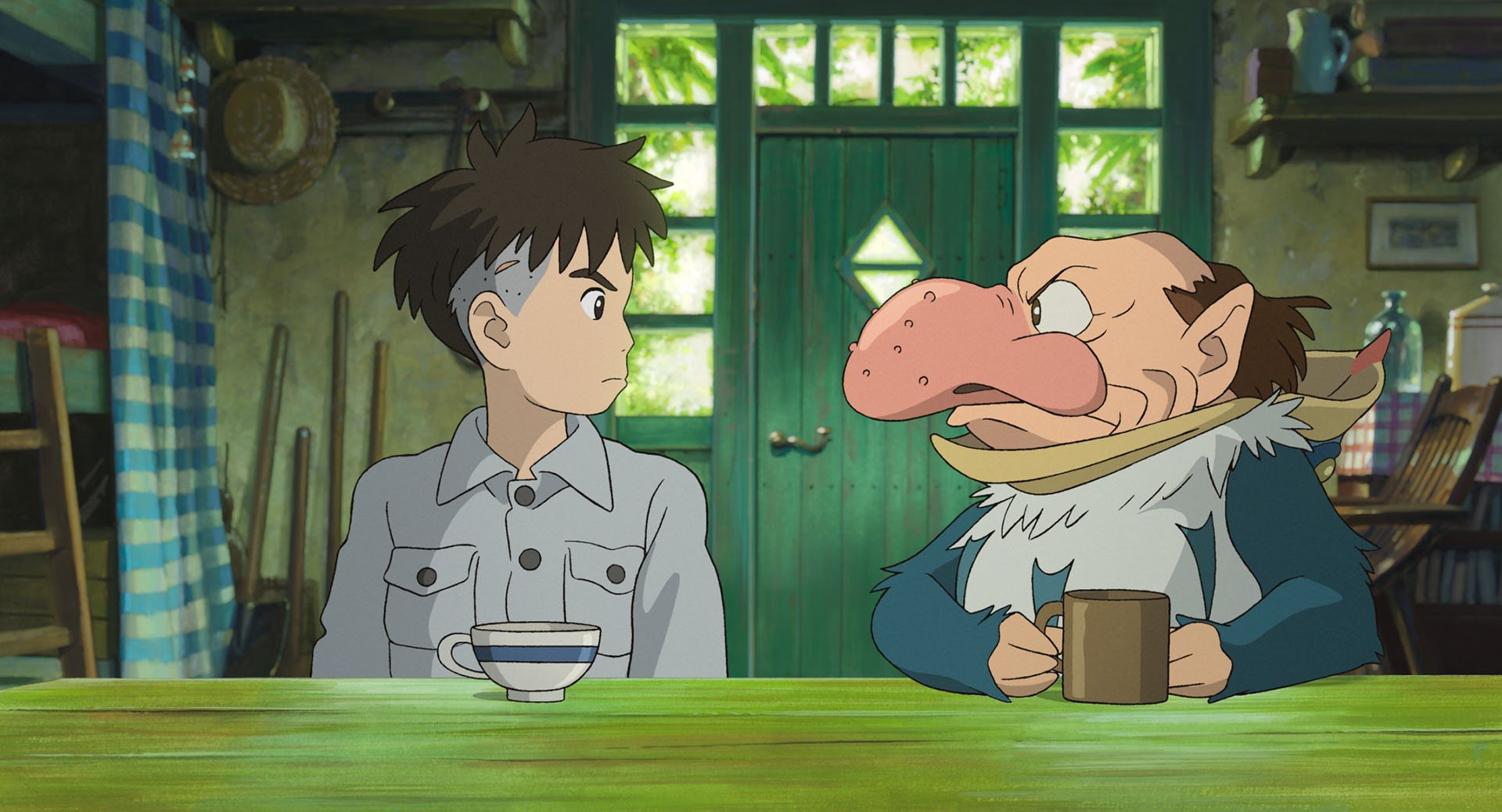
The Boy and the Heron Christian Review & Parents’ Guide
Our Christian review of The Boy and the Heron discusses the film, its characters, themes, and magic from a Christian perspective. We also provide a parents’ guide to The Boy and the Heron.
We aim to answer the question: Can Christians watch The Boy and the Heron?
Quick Facts about The Boy and the Heron
Creator: Hayao Miyazaki (Studio Ghibli)
Rating: PG-13
Year: 2023
Runtime: 124m (2h 4m)
Quick The Boy and the Heron Content Guide
Sex and Nudity: Very minimal. Mahito is shown in boxers. Part of his chest is visible at one point. One character’s naked back is visible; another wears a loincloth.
Violence and Gore: Self-harm, blood, weapons, and violence/attempted violence.
Frightening Scenes: Many. The heron is very disturbing. Parakeets try to eat humans. Plenty of other disturbing and frightening scenes occur.
Language: D*mn used a time or two, “How the hell,” heck, and darn it among other lesser insults/exclamations.
Substance Abuse: Cigarettes/smoking/tobacco shown or mentioned multiple times. A child steals cigarettes to convince an older man to help him.
Spiritual: Magic and spiritual concepts throughout.
My Rating
Can Christians Watch The Boy and the Heron?
With wisdom and discernment, Christians may be able to watch The Boy and the Heron. It depends on personal judgment and sensitivity to topics related to the loss of a family member, self-harm, magic, and violence.
Is The Boy and the Heron Appropriate for Kids?
No, The Boy and the Heron is not appropriate for kids. It is rated PG-13 and is one of the more mature Studio Ghibli films.
What Age is The Boy and the Heron Appropriate For?
The Boy and the Heron is rated PG-13, so it is more appropriate for older audiences. Common Sense Media rates it 10+.
One reviewer on Common Sense Media, Deborah S, writes:
Truly beautiful film, but too intense for tweens.
This was a truly beautiful, affecting, and breathtaking film. That said, parts are very intense and sometimes quite violent and rather grotesque. It’s a lovely film in the tradition of Miyazaki, but as with certain other Miyazaki films (e.g., Princess Mononoke), it’s better suited to more mature children and adults. It was a bit much for my younger two children, and I regret having ignored the MPAA rating in favour of the Common Sense Media suggestion. I think the MPAA had this one right.
Ultimately, there are plenty of intense scenes in The Boy and the Heron that make it inappropriate for younger viewers. Other Studio Ghibli films like Ponyo, The Secret World of Arrietty, or My Neighbor Totoro are much more family-friendly.
Is The Boy and the Heron Scary?
Yes, The Boy and the Heron contains some scenes that sensitive viewers may find scary. Some rather frightening scenes include Natsuko getting angry at Mahito, pelicans swarming Mahito, and Mahito’s nightmares. Even the grey heron is scary at times.
Is The Boy and the Heron Family-Friendly?
No, The Boy and the Heron is not particularly family-friendly. It’s a rather intense film with some scary moments and heavy themes (self-harm, loss of a mother) that make the film less family-friendly than the lighter Studio Ghibli films.
Synopsis: What is The Boy and the Heron About?
The Boy and the Heron Christian Review
The Boy and the Heron, also known as Kimi-tachi wa dô ikiru ka, is the most recent film by master storyteller Hayao Miyazaki, one of Studio Ghibli’s founders. It’s one of only five Studio Ghibli films with an MPAA PG-13 rating, and it certainly deserves it.
It’s fairly intense, with plenty of frightening characters and scenes, and even contains self-harm, so we do not recommend it for young audiences or families.
However, the film has some positives, including the music, animation, and cast.
The Boy and the Heron English Dub Cast
The Boy and the Heron‘s English dub stars Luca Padovan (Code Geass: Rozé of the Recapture) as Mahito Maki.
Other voices include Robert Pattinson, Florence Pugh, Gemma Chan, Karen Fukuhara, Dan Stevens, and Dave Bautista.
The Studio Ghibli English dubs often rehire actors, so you’ll hear the same voices throughout the catalogue. Some of The Boy and the Heron English dub actors who appear in other Studio Ghibli films include Willem Dafoe (Tales from Earthsea), Christian Bale (Howl’s Moving Castle), Debi Derryberry (Kiki’s Delivery Service, Porco Rosso), and Mark Hamill* (Nausicaä of the Valley of the Wind, Castle in the Sky).
The Boy and the Heron doesn’t just have a great dub cast; the film was very well received by critics.
Critical Reception for The Boy and the Heron
The Boy and the Heron is one of only two Studio Ghibli films that won an Academy Award for Best Animated Feature; the other is Spirited Away.
The Boy and the Heron boasts a 96% Tomatometer score and an 88% Popcornmeter score on Rotten Tomatoes and is #10 on Rotten Tomatoes’ “100 Best Anime Movies of All Time, Ranked by Tomatometer” list.
And, in Rotten Tomatoes’ “All Studio Ghibli Movies Ranked by Tomatometer” list, The Boy and the Heron is #6. The only Miyazaki films rated higher than The Boy and the Heron are Spirited Away (#5) and Kiki’s Delivery Service (#4). The other three films are by Isao Takahata, who created Grave of the Fireflies (#3). So, The Boy and the Heron beat out almost every Studio Ghibli movie, including Totoro and Ponyo, which feels like a travesty.
The Boy and the Heron Really Isn’t Miyazaki’s Best Work
Although the anime film was received positively by critics and many audiences, it’s a chaotic, “surreal fever-dream” that I’m not the biggest fan of.
The Boy and the Heron was one of my first Studio Ghibli films. It’s possible that the only Studio Ghibli film I had seen before The Boy and the Heron was Ponyo (and honestly, I wasn’t a big fan of Ponyo, either).
It’s rather confusing; one Film Obsessive reviewer calls it “surreal, grotesque, unfocused, disjointed, audacious, experimental, horrifying and hilarious fever dream to date.“
I’m not sure that I would call the anime film “hilarious,” even if there are a few humorous moments, but it is very “experimental” and “disjointed.” I have seen the film twice now, and I find the Grey Heron’s character disjointed. He shows up, acts super creepy, leads Mahito to the tower, and shows him a horrifying clone of Mahito’s mother. Then, he’s told to help Mahito, but disappears, then reappears, only to disappear again. In The Boy and the Heron, the heron is frequently absent, and his character is undeveloped. And, that’s just one of my problems with the film.
Honestly, The Boy and the Heron is not a good introduction to Studio Ghibli films. Despite winning an Academy Award, it doesn’t showcase Miyazaki’s masterful storytelling very well.
As Film Obsessive notes, “…I think it may be more “one for the fans” than for the casual viewer.“
The Boy and the Heron may not be my favorite Studio Ghibli film by any means, but it’s still a film worth watching at least once.
Our next section will dive into the main character, Mahito’s, character.
The Loss of One Mother…And the Gaining of a New One
Mahito loses his mother during the war after her hospital catches on fire. He’s only around 10 or 11 years old when his mother dies.
This loss haunts him (for good reason), and he frequently has dreams or visions of this event. This trauma and grief follow him everywhere, and it’s only made worse when his father marries Natsuko, Mahito’s aunt, a year after Mahito’s mother dies.
Natsuko doesn’t help matters. She tells Mahito nonchalantly, “So, Mahito, I’m going to be your new mother from now on. Sound good?”
Mahito lost his mother, is forced to move, and now his mom’s sister is pregnant with his sibling and claims she’s his new mother. That’s a lot to take in, and even though Natsuko is very kind, her actions at the beginning seem insensitive.
Despite this, she is a very kind stepmother/aunt. She legitimately cares about Mahito and even apologizes, emphasizing that she “should have taken better care of you.” When she’s out looking for Mahito, he purposefully ignores her, and although he’s not totally against her, he does not treat her as a mother. I understand why—he went through a lot—but for her part, she really tries to be a good mother to him.
(Spoiler) Over the course of the film, Mahito never stops loving his biological mother. However, he learns to let go of the past and embrace his new mother, Natsuko. He has the chance to leave Natsuko behind and return home, but he doesn’t.
(Spoiler) He begins as a character who cannot let go of the past and move forward, and ends as one who can. One of the most powerful moments of the entire film is when he finally calls Natsuko his mother.
This growth reminds me of a lesson taught in From Up on Poppy Hill, a film dedicated to exploring the interconnected past and future: “What do we keep, and what do we let go?“
In the Bible, Paul never forgot where he came from, but he knew that dwelling in the past wasn’t wise. Instead, he writes in Philippians 3:13-14 (ESV): “Brothers, I do not consider that I have made it my own. But one thing I do: forgetting what lies behind and straining forward to what lies ahead, I press on toward the goal for the prize of the upward call of God in Christ Jesus.”
We need to focus on what’s ahead of us, not what’s behind us. That doesn’t mean losing the love we have for those in our past, but it does mean that we don’t let the past hinder us from our calling. For Mahito, that meant embracing his new life and his new mother. For believers, that means following Jesus and making disciples.
Mahito’s Violence
Mahito is initially a very violent character, but his violence isn’t always directed at others. One day, after fighting with a classmate, he hits himself on purpose with a rock, causing him to bleed. He claims that he fell, but of course that is untrue. There are plenty of reasons why he committed self-harm, but it’s clear that he is carrying a heavy burden due to losing his mother. This is a burden that even Mahito’s father, who remarried fairly quickly after his wife’s death, doesn’t seem to carry.
Mahito also tries to take out his anger towards the Grey Heron, who taunts and irritates him. He purposefully crafts a bow and arrow, using the Grey Heron’s feather to decorate the arrow, and plans to kill the heron. However, over time, the Grey Heron proves to be a helpful—albeit bizarre—ally, and the two put aside their differences.
The film itself critiques Mahito’s malice; he learns to identify it and put it behind him, even if it means rejecting the opportunity to keep the alternative realm alive, a realm of his own. This is extremely important to his character growth:

He ultimately realizes his scar from his injury is from his malicious tendencies. Niki Florica writes:
“…[Mahito] is also wise beyond his years, wise enough to recognize that the malice he carries with him—the ingrained selfishness of sin—will destroy the world even if he tries to save it. Not even his fantasy is pure, because he isn’t. And that is why he returns to reality, because messy as it is, painful as it is, goodness can only coexist with truth. And given the choice between a true, complicated world and a false, simple one, he chooses the reality that promises more pain while also promising deeper meaning, relationship, and love.” (source).
Indeed, we cannot fully evade malice—a concept Mahito seems to understand. However, through Christ, we can replace it with love.
Magic and Spirituality in The Boy and the Heron
The Boy and the Heron contains plenty of magical and spiritual content that may make Christians wary. The mysterious realm Mahito travels through contains dead people who seemingly live on. The warawara, albeit super adorable, are technically predecessors to humans (basically, they become human babies). Himi, Mahito’s ally, utilizes fire magic.
Kiriko, one of Mahito’s allies, performs a ritual to ward off something seemingly negative or dangerous. She also has little dolls to protect Mahito.
A list of the various magical and spiritual concepts is included in the parents’ guide. If you’re sensitive to magical themes, I’d recommend watching a Ghibli film like Arrietty instead.
It’s up to each Christian to decide whether these elements are a dealbreaker for them.
The Gate & Knowledge
“All of those who seek my knowledge shall die.”
One of the first things Mahito does after entering the realm is visit a golden gate guarding a graveyard. He finds a warning: “All of those who seek my knowledge shall die.”
The warning comes from Mahito’s great-granduncle, “…a hoarder of knowledge who, like Don Quixote, lost himself by reading ‘too many books.’ This is at the crux of Miyazaki’s metafiction: it is not artistry or curiosity that are harmful, but gatekeeping the worlds they create.“
Sound familiar? In Genesis, the Tree of Knowledge came with a warning: “but God said, ‘You shall not eat of the fruit of the tree that is in the midst of the garden, neither shall you touch it, lest you die.’” (Genesis 3:3, ESV).
Sometimes, seeking knowledge and understanding is good—reading our Bibles and seeking God, learning about the world around us, etc.—but other times, it only leads to danger and heartbreak. In the case of Genesis, God’s warning made sense—once Adam and Eve ate of the fruit, they chose sin over God and had to face the natural consequences of that.
And although Mahito himself has to face his own natural consequences (ex., he purposefully bashes a rock into his head, leaving him with a permanent scar, Mahito doesn’t seek knowledge.
The Boy and the Heron is allegedly making a statement about fiction and artistry through the great-granduncle, but to be honest, the graveyard’s warning doesn’t feel particularly connected to Mahito’s personal journey, and the claims about creating fiction are easily lost.
The Warawara, Souls, Life, and Death
A beautiful line in The Boy and the Heron is, “Children’s souls are precious.” The film is awash with reminders of life and youth: Natsuko is pregnant, the Warawara fly away to become babies, Mahito and Himi are both still children, and Kikiro is a youthful sailor in the alternate world.
But at the same time, the film is rife with reminders of death and age: Granduncle is aged, the alternate world is nearly falling apart, the Warawara are eaten by pelicans (one of which dies himself), Mahito’s own mother is dead, Himi’s existence is plagued by the knowledge that she will die young, and even the other version of Kiriko is old and grey. Indeed, all of the servants at Mahito’s new house are elderly.
What does this teach us, other than that life isn’t permanent? That life is worth it, no matter what happens, and every single part of life, including death, is meaningful: “[T]he film celebrates youth while delivering a film that is celebratory of all stages, a film that begs questions from the young and seeks answers for past days lived.”
Biblically, every single stage of life is meaningful. Psalm 139:13 (ESV) says, “For you formed my inward parts; you knitted me together in my mother’s womb.” Clearly, even in the womb, we have value. And Proverbs 23:22 (ESV) says, “Listen to your father who gave you life, and do not despise your mother when she is old.” So old or young, we all have intrinsic value.
Mahito even treats the noble pelican, one of the creatures eating the warawara, as valuable. He buries him after he passes, which shows respect for others.
The Boy and the Heron: Nods to Other Studio Ghibli Films
There are plenty of moments in The Boy and the Heron that are reminiscent of past Studio Ghibli films. Here are some that I noticed:
- Mahito’s mother melts away. This is similar to the dark tarry substance in Tales from Earthsea.
- Mahito dreams of his inner turmoil (losing his mother), reminiscent of Arren’s dream of his own inner turmoil in Tales from Earthsea.
- The paper in the delivery room seems to have a mind of its own, much like the paper that attacks Haku in Spirited Away.
- The way the heron struggles to fly while carrying Mahito is reminiscent of the mouse and bird from Spirited Away.
- And, of course, the whole “moving from one place to another at the start of the film” is a common Studio Ghibli trope present in films like My Neighbor Totoro, Spirited Away, When Marnie Was There, Kiki’s Delivery Service, etc.
The Boy and the Heron and Grave of the Fireflies (Spoilers for Both Films)
One of the most obvious connections is between The Boy and the Heron and Grave of the Fireflies.
The clothing is one of the more obvious signs of connection. In The Boy and the Heron, Mahito wears a kokumin-fuku, which is what Seita from Grave of the Fireflies also wears. It may be historical, but it feels intentional. And, knowing Miyazaki, it probably is.
But the kokumin-fuku is far from the only similarity to Grave of the Fireflies. In Grave of the Fireflies, Seita loses his sister, his mother, and his father to the war. Like Seita, Mahito loses his mother during the war, too. However, unlike Seita, who loses everything, Mahito’s story has a much happier conclusion. He gains a sibling through his stepmother; his father not only survives but is very active in his life, and he gains a mother.
Seita and Mahito both move in with their aunt during the war, but with vastly different outcomes. Seita’s aunt drives him and his sister away, and they eventually die. Natsuko, on the other hand, is kind and caring (despite her initial nonchalance). She never treats Mahito as anything other than a son, and she cares for him immensely. And, unlike Seita, Mahito never goes without food.
FAQs for The Boy and the Heron
Does The Boy and the Heron contain magic?
Yes, The Boy and the Heron contains magic.
Is The Boy and the Heron Hayao Miyazaki’s last film?
No, The Boy and the Heron is not Miyazaki’s last film. He is currently working on another anime film.
Where to watch The Boy and the Heron
The Boy and the Heron Parents’ Guide
Sexual Content, Romance, and Nudity in The Boy and the Heron
- Mahito doesn’t have a shirt on under his robe, so part of his chest is visible. Then, when he gets dressed, we see his naked back, but he has his boxers on.
- Mahito is seen in his underwear on multiple occasions.
- Natsuko takes Mahito’s hand and puts it on her belly to show him that she’s pregnant with his sibling.
- When people are in the river searching for Natsuko, someone’s bare back is visible, and another wears a loincloth-style garment, but the scene is brief.
Language & Insults in The Boy and the Heron
- “Thank goodness” on multiple occasions.
- “Heck no.”
- “Why you sneaky little no good liar!”
- “Wrinkly old prune.”
- “For goodness sake.”
- “Darn it.”
- “..Skewer that little yapping turkey.”
- “Foolish bird.”
- “Godspeed.”
- “Damn” x2.
- “How the hell…”
- “Hellscape.”
- “Arrogant little turd.”
- “I’m pooped.”
- “Shut up” x2.
- “Monsters.”
- “Brat.”
Scary & Intense Scenes in The Boy and the Heron
- The film starts with air raid sirens (or something similar), and Mahito’s mom is stuck in a burning hospital.
- Characters resembling shades appear as Mahito runs to the visibly burning hospital. It’s very intense.
- Mahito’s mother dies.
- The Grey Heron is off-putting in appearance.
- Mahito has a nightmare about the night his mom dies in the fire.
- Mahito has a vision of the fire and his mother asking him to save her.
- The Grey Heron speaks in a creepy voice.
- The Grey Heron is an unsettling character. He is present in several intense scenes, and his design is off-putting (namely, his teeth).
- Animals swarm Mahito, wanting him to join them.
- Natsuko is unwell due to morning sickness.
- Mahito sees someone who looks like his mother, but she melts away.
- Pelicans swarm Mahito and whisper creepily.
- Mahito almost drowns.
- The pelicans eat the Warawara.
- While building the tower, people die and get injured.
- The Grey Heron pretends to be hurt and falls.
- Throughout the film, parakeets want to eat humans.
- Natsuko tells Mahito that she hates him and gets after him. She seems very angry and scary, very much unlike herself.
- Semi-sentient paper attacks Mahito.
- Natsuko lies on the bed, appearing dead.
- Himi appears to be on fire and passes out.
- Metal rods fall from the sky and hit parakeets on their heads.
- Mahito nearly falls from the rafters, but he recovers.
- The parakeet king causes the wooden stairs to fall, leaving Mahito and the Heron to get out of the rubble.
Gore & Violence in The Boy and the Heron
- Tanks visible.
- Mahito gets into a fight with another boy.
- Mahito hits himself with a rock on purpose, causing him to bleed a significant amount.
- Mahito tries to whack the Grey Heron with a stick.
- An arrow is shot near the Grey Heron.
- Mahito pulls a knife out to threaten the Grey Heron.
- Mahito sharpens his knife and uses it to make a bow. He also makes an arrow.
- The Grey Heron talks about ripping someone’s heart out.
- Mahito tries to shoot the Grey Heron.
- An arrow goes through the Grey Heron’s beak, and he falls from the sky, struggling to fly.
- Kiriko goes after the pelicans by using a fiery weapon to scatter them.
- A dead fish (caught by Kiriko) leaves a trail of blood on the ground. Kiriko and Mahito have to slice it up, showing orange liquid, blood (that splatters Mahito), and guts.
- Mahito hits his head on the table.
- Lady Himi uses fire to stop the pelicans from eating the Warawara, but she burns some of the Warawara, too.
- A wounded pelican is covered in blood and asks Mahito to kill him.
- Mahito rips out one of the Grey Heron’s feathers, and the Grey Heron pushes Mahito towards a hole in the floor.
- The parakeets try to eat Mahito, but Himi burns them.
- Parakeets are hit and attacked.
- The parakeet king tramples the heron.
- Several characters must run for their lives as the alternate world falls apart around them.
Substances in The Boy and the Heron
- A woman gets cigarettes.
- A man smokes on some leaves, and one of the grannies thinks it’s tobacco.
- Mahito swipes cigarettes to bribe an elderly employee. This employee smokes, and one of the grannies gets upset because tobacco is a rare commodity.
- Granny tries to convince Mahito to give her cigarettes in exchange for a real bow and arrows.
Spiritual Content in The Boy and the Heron
- Translation of Japanese flags: “May your luck last long in battle.”
- Paintings of mythological creatures appear on the walls.
- The grannies discuss the possibility of Mahito getting “taken” when they find him crawling in a tower that was supposed to be closed off.
- The Grey Heron’s feathers disappear mysteriously.
- The Grey Heron claims he can bring Mahito to his deceased mother.
- Natsuko asks her deceased sister to forgive her.
- Only people with Mahito’s blood (so, his direct relatives) can hear the voice from the tower.
- A golden gate holds a warning and allegedly leads to the graveyard.
- Allegedly, the “buried” can wake up.
- Kiriko makes a magic fire circle and quietly whispers something (an incantation, maybe?) before saying “it’s gone” and encouraging Mahito to “walk backwards” without looking back.
- The pelicans can’t eat Mahito because he has an arrow with the Grey Heron’s feather (so the feather seemingly wards them off/has special meaning/protective power).
- Mahito smells like death, apparently.
- Dead people are visible, but they are portrayed as pitch-black phantoms.
- Mahito sleeps surrounded by doll versions of the grannies for protection.
- The Warawara are born as people.
- Lady Himi uses fire magic.
- The sea is apparently cursed.
- Kiriko gives Mahito a Kiriko doll to bring him good luck.
- Allegedly, the tower was built around “something that fell out of the sky”.
- A magic stone exists, and it has a contract with the great uncle.
- Mention of fate.
- Mahito must make a tower of stones to help the world.
Conclusion: The Boy and the Heron Christian Review
Despite critical praise, The Boy and the Heron is one of Miyazaki’s weaker films. However, the anime film includes themes of life, love, and family that some viewers may appreciate. Plus, the music and animation are beautiful, fitting for a Studio Ghibli film.
But can Christians watch The Boy and the Heron? Yes, with discernment, although the magic, spiritual themes, and intensity may turn off some viewers.
Always use wisdom and discernment when choosing which films to watch.
Cover Photo: © 2023 Hayao Miyazaki/Studio Ghibli. From GKids Press Room.
*Yes, that Mark Hamill. Luke Skywalker is indeed in multiple Studio Ghibli English dubs.