The Good Place Christian Review: Parents’ Guide, Theology, and Biblical Concerns (Seasons 1-4)
This Christian review of The Good Place looks at the show’s themes, content, and theology from a biblical perspective. We’ll cover the language, sexual content, spiritual concerns, and major worldview issues in our The Good Place parents’ guide and answer the bigger question: is The Good Place a show Christians should watch?
Quick Facts about The Good Place
Creator: Michael Schur
Rating: 16+ (Peacock); TV-14 (Prime)
Year: 2016-2020
Quick The Good Place Content Guide
Romance, Nudity, & Sexual Content: Frequent suggestive language. Multiple post-sex scenes (characters in bed together), at least one example of two characters getting very frisky while clothed. Male genitals and m*sturbation are mentioned multiple times, p*rn is mentioned, sex toys appear, an audio clip of people having intercourse is played, etc.
Gore, Frightening Scenes, & Violence: Frequent discussion of torture, especially in later seasons.
Language: Moderate language throughout.
Substances: Frequent drinking (and drunkenness) occurs. Controlled substances appear/mentioned.
Spiritual: The story follows a non-Biblical version of the afterlife, so spiritual concerns are high.
My Rating
Can Christians Watch The Good Place?
Mature Christians may be able to watch The Good Place with wisdom and discernment, but be aware: a non-biblical afterlife is central to the plot. Other than the spiritual concerns, there are plenty of suggestive comments and situations, profanity, and other content flags that will likely make many believers uncomfortable.
Our review will offer a Christian perspective on The Good Place, so if you’re on the fence, we hope our deep dive assists your decision-making.
Is The Good Place Clean?
No, The Good Place is not clean. It contains frequent suggestive material/language, plenty of profanity (not just sanitized heavenly versions, but legitimate swearing), frequent mention of torture/torturing methods, morally questionable main characters, alcohol and drugs, etc.
What is the Age Rating for The Good Place?
Prime Video gives The Good Place an age rating of TV-14. In contrast, IMDB rates it TV-PG (which is also the rating listed on Rotten Tomatoes). Peacock puts it as 16+, and Common Sense Media gives an age recommendation of 12+.
So, which is it? Due to the language and frequent suggestive content, we lean closer to Peacock’s 16+ rating.
Synopsis: What is The Good Place About?
The Good Place follows Eleanor Shellstrop, a rude and self-centered person. Upon her death, she finds herself in The Good Place, a seemingly perfect afterlife. Eleanor knows that she doesn’t belong there, but she’s determined to stay rather than be sent to The Bad Place.
To help her stay in The Good Place, she turns to her predestined “soulmate,” a former ethics professor named Chidi. But leaving her selfish nature behind is very difficult, and her past catches up to her when the allegedly perfect neighborhood starts malfunctioning.
Things take a turn when the architect of The Good Place, Michael, tries to figure out what is causing The Good Place to fall apart. But if he does, Eleanor will never get a second chance at her afterlife.
Can Eleanor find redemption, or will she be sent to The Bad Place for all eternity?
The Good Place Christian Review: A Biblical Perspective on the Themes, Theology, Characters, and Content Flags
What is The Good Place?
The Good Place is a comedy show starring Kristen Bell and Ted Danson as Eleanor Shellstrop and Michael, respectively. Co-stars include Jameela Jamil, Manny Jacinto, William Jackson Harper, and D’Arcy Carden as other major players in the series.
The Good Place is a complete and cohesive story told through 53 episodes across four seasons. There is a short web miniseries titled The Selection set near the end of Season 3 that follows some minor characters, but it is not essential to the main plot.
Is The Good Place Worth Watching?
Personally, I found the show difficult to get into at first, but eventually, I was hooked. I loved the characters, who are very endearing and experience plenty of redemption and character growth. It’s a very interesting storyline with plenty of plot twists that make the story compelling.
Some viewers may find The Good Place worthwhile, but I don’t think the show is for everyone (especially those sensitive to spiritual themes, suggestive content, or language).
The Good Place Story and Plot Problems
The storyline had enough intrigue to get viewers invested, and the plot twists were creative, but in my opinion, the major plot beats were rather repetitive.
The main premise revolves around Eleanor proving she’s capable of redemption, and by the end of the first season, she’s made considerable progress. However, from there, the plot becomes a repetitive cycle of trying different tactics to get into The Good Place, learning ethics, and helping to redeem all mankind.
The concept itself is interesting, but when a four-season show centers around the same core problem, it can become rather tedious. Even when the characters try to approach it from different angles, it’s still the same story.
For example (Spoilers):
- Characters seem like they’re finally going to stay/enter the Good Place.
- Something happens and now…
- They have to go through another experiment, OR
- They have to prove their redemptive abilities, OR
- They have to prove that humanity as a whole is redeemable.
Every time it seemed like they were finally going to enter the Good Place, they had to go through another experiment, or prove their redemptive abilities, or prove that humanity as a whole is redeemable. There are only so many times you can repeat the same basic story beats before it starts to weaken it.
Critical Opinions about The Good Place
From an outside perspective, The Good Place is wildly celebrated for its storyline. According to Wikipedia, “The Good Place received critical acclaim for its originality, writing, acting, setting, and tone.”
The show was also nominated for a Primetime Emmy Award fourteen times (twice for Outstanding Comedy Series) and it has a 97% Tomatometer and 90% Popcornmeter* on Rotten Tomatoes. It also boasts a Peabody Award, among other accolades and nominations.
*As of July 2026
The Good Place’s Ending (Major Spoilers)
The Good Place‘s ending is not nearly as problematic as some of its other content, but I personally have some qualms with it.
It’s not that the ending is bad from a storytelling standpoint, per se, but it could have had a more satisfying conclusion—the ending is somewhat depressing and final.
Somehow, despite The Good Place being completely perfect with thousands of things to experience, many characters suffer a sort of “mid-afterlife crisis,” and find heaven unfulfilling. Multiple main characters decide to walk through a special doorway that lets them simply cease to exist. After fighting for their chance at paradise for most of the show, they give it up.
The Good Place’s ending demonstrates an atheistic or pantheistic concept of the afterlife, not a Christian one. Having characters become “one with the universe” suggests that heaven isn’t enough for us, and that ceasing to exist is a valid decision. Although I do find myself worrying about whether I’ll be bored in heaven, I know it isn’t a valid worry because God knows exactly what I need.
I think the ending would have been near perfect if it had ended with Chidi and Eleanor snuggling and watching the sunset, finally in the place they had fought so hard to enter, but it doesn’t end that way.
However, thankfully, some characters don’t choose the final door. (MAJOR SPOILERS) Tahani chooses to become an architect and help others live out their perfect afterlife, whereas Michael chooses to become a human instead. It’s kinda sweet that he finally fulfilled his dream of becoming human, but it comes with another can of theological worms.
The ending is melancholic, and in some ways, that is beautiful. A bittersweet ending can be right for some stories, but there’s certainly a part of me that wishes it had ended differently.
Ultimately, I know many people loved the ending of The Good Place, and the show as a whole is very well-loved, but I wish it had ended on a happier note.
Ethics and Philosophy in The Good Place
The Good Place is, at its core, a philosophical show that explores a hypothetical, non-biblical afterlife. Philosophical ideas and ethics are central to the show’s plot, including influence from Sartre, Scanlon, Aristotle, the trolley problem, Kant, Parfit, Locke, Dancy, and Singer.
Here are some helpful articles explaining the connection between The Good Place, philosophy, and ethics:
- A Good Place for Philosophy (APA Online)
- Kantian Comedy: The Philosophy of The Good Place (The Conversation)
The Good Place from a Christian Perspective: Theology, The Afterlife, and Salvation
This section is going to be long because, quite frankly,
From a Christian perspective, The Good Place raises many theological concerns. As previously stated, I do enjoy the show, but I recommend exercising considerable caution when considering whether to watch it. So, this section will seem rather heavy theologically (and rather critical).
But first, let’s start with things The Good Place gets (partially) right before segueing into the theological problems.
What The Good Place Gets (Partially) Right About Moral Change
Redemption in The Good Place
One of the best things about The Good Place is the redemption. Eleanor Shellstrop starts out as a pretty terrible person, but as her character progresses, she turns her life (ahem, afterlife) around and becomes a much better person.
A big reason Eleanor improves is because of Chidi, an ethics professor introduced as Eleanor’s soulmate. Despite getting nothing in return, he dedicates his time to helping Eleanor improve herself so she can (hopefully) stay in The Good Place.
(Spoilers) Over time, she gains other allies, like Tahani, who also tries to keep Eleanor in The Good Place. Tahani’s soulmate, Jason, also joins the group and reveals that like Eleanor, he was meant for The Bad Place.
(Spoilers) Along with Eleanor, Chidi, Jason, and Tahani all become better people. More than that, they selflessly help others improve themselves, too, even when doing so doesn’t help their own chances to get into the Good Place. That’s very admirable.
Motivation
Another notable thing that The Good Place gets somewhat right is having the right motivation.
(Spoiler) For example, Tahani didn’t make it to The Good Place because she had poor motivation. She, “realizes she was sentenced to the Bad Place because her charitable deeds weren’t motivated by genuine altruism, but by a selfish desire for attention and to outdo her sister.“
Tahani was outwardly focused about everything she did, and she cared more about what people thought than what was in her heart. Matthew 6:16-18 (ESV) says,
“And when you fast, do not look gloomy like the hypocrites, for they disfigure their faces that their fasting may be seen by others. Truly, I say to you, they have received their reward. But when you fast, anoint your head and wash your face, that your fasting may not be seen by others but by your Father who is in secret. And your Father who sees in secret will reward you.”
We shouldn’t do good deeds so that others pay attention to us, or for other wrong reasons. We should do good deeds because we love God and want to honor Him with our actions.
1 Corinthians 13 is by far the most popular chapter on love in the Bible. It defines what love is, but it also tells us that good choices are meaningless without love:
“If I speak in the tongues[a] of men or of angels, but do not have love, I am only a resounding gong or a clanging cymbal. 2 If I have the gift of prophecy and can fathom all mysteries and all knowledge, and if I have a faith that can move mountains, but do not have love, I am nothing. 3 If I give all I possess to the poor and give over my body to hardship that I may boast,[b] but do not have love, I gain nothing.”
Indeed, The Good Place makes a good point about motivation and redemption, but it also makes some problematic points.
Moral Improvement Is Not the Same as Salvation
Works-Based Salvation
When Eleanor arrives in the Good Place, she goes through orientation and learns how people are deemed “worthy” enough to enter:
Basically, how well you live your life determines your eternal destination. Living your life “well” is determined by the total amount points you earn for each good action.
The photo below outlines some examples of what gets you points:
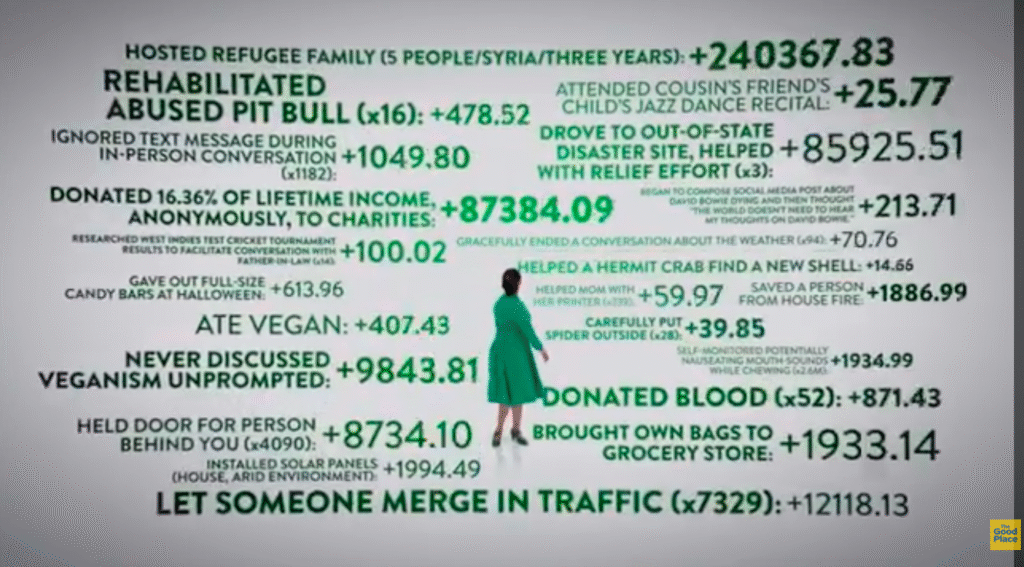
This points-based system is what Christians would call a “works-based” salvation. It implies that salvation is based on how well you do in your life. If you’re good, you make it to heaven. If you’re bad, you go to hell.
This is deeply unbiblical and puts a lot of pressure on us. Ephesians 2:8-9 (ESV) says:
“For by grace you have been saved through faith. And this is not your own doing; it is the gift of God, not a result of works, so that no one may boast.”
Salvation is based on Christ’s work on the cross; it’s not based on our performance. I know that no matter how much I try, I am going to make mistakes. But I still get to go to heaven because Christ died for my sins. Of course, we are called to do good works because we want to honor God, but our salvation is based on Christ’s finished work on the cross. I don’t have to hit a certain point level because Christ paid for my sins already. I don’t have to carry the burden of sin anymore. How wonderful is that?
Some people struggle with the concept of believing in Jesus for salvation, wondering how it’s fair that murderers can make it to heaven. They almost treat belief in Jesus as some magic spell, where as long as you say “I believe in Jesus” before you die, you’re good.
But that’s not actually how it works.
Matthew 7:21 (ESV) says:
“Not everyone who says to me, ‘Lord, Lord,’ will enter the kingdom of heaven, but the one who does the will of my Father who is in heaven.”
It’s about the heart, not just saying the “right words.”
Romans 10:9 (ESV) tells us:
“Because, if you confess with your mouth that Jesus is Lord and believe in your heart that God raised him from the dead, you will be saved.”
It’s about the heart, about repentance, and realizing that you need Jesus to make it. We can not make it to heaven on our own. Even Doug Forcett (a character from the show), who not only figured out how the points system works, but actively lived his life in order to ensure his salvation, was unable to make it on his own merit.
Although a works-based salvation is certainly a key theme, there are plenty of other spiritually muddy themes that believers will want to be aware of.
The Good Place Replaces Final Judgment With Ongoing Self-Improvement
Improving Yourself in the Afterlife
Another serious worldview concern is the idea of improving yourself after you die. The Bible makes it abundantly clear that we do not have the opportunity to change ourselves or our eternal destination after death.
Hebrews 9:27-28 (NIV) tells us:
“Just as people are destined to die once, and after that to face judgment, so Christ was sacrificed once to take away the sins of many; and he will appear a second time, not to bear sin, but to bring salvation to those who are waiting for him.”
We die once and then face judgment. However, if you are reading this right now, you still have the chance to accept Jesus. God promises to forgive us for our transgressions, and offers salvation as a free gift because He loves us.
The Medium Place & Unfairness
The Good Place also touches briefly on the idea of a “middle ground” between heaven and hell. One character lives in a place known as The Medium Place. She lived a mostly terrible life, but at the end of her life, she made one good choice that made her eligible for a place better than The Bad Place but worse than The Good Place.
This idea of a “middle ground” is spiritually misleading from a Christian perspective. Matthew 25:31-32, 46 (NIV) says:
31 “When the Son of Man comes in his glory, and all the angels with him, he will sit on his glorious throne. 32 All the nations will be gathered before him, and he will separate the people one from another as a shepherd separates the sheep from the goats.
46 “Then they will go away to eternal punishment, but the righteous to eternal life.”
There is no Medium Place. We die and face either eternal punishment or eternal life. We only have one shot, which is why it’s important to place our faith in Jesus (click here to learn more about faith).
The Good Place’s inclusion of The Medium Place is certainly notable from a faith-based perspective, but the show doesn’t just promote the existence of a neutral afterlife.
An Endless Cycle (Major Spoilers)
Indeed, The Good Place takes everything a step further; by the end of the show, the afterlife has been entirely reworked. A deceased person takes a test: if they pass, they are allowed into The Good Place, and if they fail, they get another shot, and another, and another. It’s an endless cycle until they succeed.
Once you enter tTe Good Place, you also have the option to choose to cease to exist.
Ironically, by offering this endless cycle of trying to get into The Good Place, there is no real reason to become better (other than just wanting to treat people right) because the worst that happens is you get reborn once again. There is no risk of eternal torture.
From my understanding, there isn’t even an option to be born into a lesser situation (such as being an animal), so you really have nothing to lose.
The Show Trivializes Ultimate Spiritual Authority
God Can “Make Mistakes”
The Good Place introduces us to an afterlife where mistakes are not only possible, but they also happen more than once. Eleanor did not live a life worthy of The Good Place while on earth. Her presence, therefore, appears to be a clerical error or some error that led to her unearned presence there.
That’s far from biblical. Although God doesn’t appear in the show, the show suggests (in my opinion) that it’s possible for God to make mistakes. Biblically, God does not make mistakes, and He would not allow a human in heaven who is not supposed to be there.
“As for God, his way is perfect:
The Lord’s word is flawless;
he shields all who take refuge in him.” (2 Samuel 22:31 NIV)
(Spoilers for the end of Season 1) Yes, it’s true that this concern doesn’t hold up once Season 1 ends since we learn that the characters are actually in The Bad Place, but for most of the season, the storyline implies that it’s possible for someone who shouldn’t be in heaven to accidentally show up there. And that’s just not possible from a Christian perspective.
The Judge
Through it all, who is the one reviewing this points system? Enter Maya Rudolph, who portrays the Judge. She has the ability to change the fate of Eleanor, her friends, and even the whole universe.
You’d expect an eternal judge to be serious, but this judge is very much not. She’s obsessed with binge-watching TV shows, clearly has a crush on Chidi, and acts like a teenager most of the time.
As fun as her character is, that’s actually problematic from a theological standpoint. Yes, God is good and loving, but He is also just. Psalm 111:10 (NIV) tells us:
“The fear of the Lord is the beginning of wisdom;
all who follow his precepts have good understanding.
To him belongs eternal praise.”
God is all-powerful and all-knowing. It’s healthy to have fear of Him, not because we have a spirit of fear, but because we understand how awesome and mighty God is.
The Judge isn’t God, but as the divine judge, she has the power to pardon or even change the entire afterlife, so trivializing her character is risky.
However, the judge isn’t the only spiritual being portrayed unbiblically. In the show, every spiritual being deviates from the Bible, including demons.
(Spoilers) Redemption and Demons
The Good Place does not try to represent a Christian version of heaven, hell, angels, or demons. Satan doesn’t even appear (although some characters, like Shawn or Trevor, certainly feel like Satan). God also doesn’t appear. Demons and angels, however, are frequently present and play a big part in the story.
I love a good redemption arc, and there is plenty of redemption in the show. However, The Good Place doesn’t leave redemption solely for the humans; it brings demonic beings into the mix, too.
From a Biblical perspective, Satan and demonic beings are not redeemable. They’ve already chosen to rebel against God, and they actively work against Him in the present.
Yet The Good Place gives a redemption arc to Michael, a demonic being, and he’s not the only demon with some level of redemption.
Personally, I do really like Michael’s character. He’s sweet, rather adorable at times, and he sincerely goes through a redemption arc.
But he’s still a demonic being, and we have to be careful as believers when secular media presents the demonic as anything less than evil. It risks lowering our guard against the enemy’s schemes. The enemy wants us to believe that evil isn’t truly evil; he wants to soften sin and make it desirable.
So, when watching The Good Place, it’s imperative that we keep our guards up and remember that realistically, demons can never be good. It also reminds us to pray for the salvation of the other people in this world.
(Spoilers) The Minimizing of Torture
Another concern is The Good Place’s minimizing of torture. Sometimes, the torture sounds absolutely terrifying, but other times, it doesn’t sound that bad.
For example, Michael’s attempt at torturing Eleanor, Chidi, Tahani, and Jason involves creating a seemingly perfect afterlife that is designed for the four of them to torture each other.
Although it does work to an extent, there are still a lot of fantastic things in this place: flying, soulmates, frozen yogurt, delicious foods, stunning homes, plenty of people to hang out with, etc.
And, honestly, this idea of torture doesn’t sound that bad in comparison to the Biblical view of eternal punishment, which minimizes eternal damnation.
This minimization is another risk from a Biblical perspective because being sent into torment for all eternity is not a trivial matter. There is no way out of it, and minimizing torture can encourage us to lose our guard and forget how awful hell truly is.
FAQs about The Good Place
Where to watch The Good Place
Is The Good Place safe for my child?
The Good Place is not safe for children due to profanity, violence, and sexual content.
Is The Good Place okay for Christians?
The Good Place may be okay for some Christians to watch with discernment, but there are a lot of theological and content concerns that will likely make many believers uncomfortable.
The Good Place Parents’ Guide (Christian Perspective)
My parents’ guides of mainstream shows (such as Young Sheldon) often look different than my traditional guides, and this The Good Place parents’ guide is no exception.
Language: Does The Good Place contain foul language and profanity?
Yes, The Good Place contains profanity and foul language. Common Sense Media notes, “In the show’s heaven-like setting, it’s impossible to curse. ‘Somebody royally forked up,’ says Eleanor before being told she can’t curse. ‘That’s bullshirt,’ she says. One woman insults a tall rival by calling her a ‘cartoon giraffe’ and a ‘butthead.’ A character insults larger people by calling them ‘chunksters.’ A use of ‘badass.’”
Common Sense Media is often a great resource, but I think they missed the mark on this one. There is far more cursing than just heaven-approved profanity, minor insults, and a single use of a curse word.
The show switches back and forth between the characters’ lives on earth and their lives in The Good Place. On earth, there is real cursing, and there are plenty of other moments where cursing becomes much more commonplace.
Examples include, but are not limited to:
- Heavenly versions of curse words, including, “forked up,” “bullshirt,” “what the fork,” “motherforker,” “ash hole,” “son of a bench,” and “ah, shirt!”
- “Fat dink,” multiple times.
- “Fat b*stard” (seems like the name of a person).
- “Royally effed”/”effed” (multiple times).
- “Mofos.”
- “Dumb*ss (multiple times)/”*ss” (multiple times)/”*ssface”/”weird *ss”/”kick their *ss”/”*sswipes.”
- “Son of a b*tch”/”naughty b*tch”/”b*tchin'”/”b*tch” or similar (multiple times).
- “I’ll be d*mned”/”d*mn”/”d*mn it” (multiple times).
- “P*ss”/”p*ssed.”
- “Hell”/”What the hell?”/”What the hell is that?”
- “Hells yeah!”
- “My God”/”God”/”Oh my God” (multiple times).
- “Idiots”/”Idiot” (multiple times).
- “Jerk”/”Disloyal jerks.”
- “Dork.”
- “Holy crap” (multiple times)/”Crap”/”Oh crap.”
- “Geez” (multiple times).
- “Shut up” (multiple times).
- “Sucks” (multiple times).
- “Darn it.”
- “Dang it”/”Dang.”
- “You d*ck.”
- “Dummy” (multiple times)/”Dum dum.”
- “What the heck?” (multiple times).
- “Freakin’.”
- “Butthead(s)” (multiple times).
- “Chunksters.”
- “You sly devil.”
- “Oh my gosh.”
- “Stupid” (multiple times).
- “Dirt bags.”
- “Moron.”
- “Doof.”
- “Dweeb”.
- “Geez Louise” (multiple times).
- “Dingus” (multiple times).
- “Fart plum” and other uses of fart.
- “My goodness”/”Goodness.”
Sex, Romance, and Nudity in The Good Place
Although there aren’t any sex scenes, viewers should expect suggestive comments and content throughout. There are plenty of suggestive comments, at least one example of two characters getting very frisky while clothed, and multiple scenes that clearly indicate sex has occurred (aka characters in bed together). In addition, the show mentions male genitals, p*rn, and masturbation multiple times. There’s also an audio clip of people having intercourse, and a scene where there are sex toys appear.
Characters who tend to be more over the top with sexual stuff include Mindy and Derek.
On a lesser note, there are also some kissing scenes. Examples of sexual content in The Good Place include, but are not limited to:
- Suggestive/sexual terms used include
- “Shagged.”
- “Dong bait.”
- “P*rn”/”p*rnos”/”hardcorn p*rn” (multiple times).
- “Horny.”
- “Bone down.”
- “Smash.”
- “D*ck.”
- “P*nis.”
- “Horndog.”
- “*rgasm” (multiple times).
- “Ding dongs.”
- “Bang it out.”
- “Whale humper.”
- “Pervs”/”perv.”
- “Pound town.”
- “Pork the dork.”
- “Dad’s salty nuts.”
- “We’re going streaking.”
- “Put stuff in each other” (suggestive).
- “Sexy.”
- “Sunburn fetish p*rn site.”
- “Dry humps books.”
- “Poppycock.”
- “Met mom halfway last night.”
- “Eat butt, you ding dongs.”
- “Hot and sexy.”
- Mentions of a sexual erectile drug truck.
- Mentions of erectile dysfunction.
- Representation of homosexual characters.
- Mentions of homosexuality (including Eleanor, the main character, who acts interested in Tahani and seems very open to the idea of being in a same-sex relationship).
- A character abandons her friends to sleep with a bartender.
- A character likes to “drip dry in the nude.”
- Mentions of groping.
- Mention of being “turned on.”
- In a video, a male touches a girl’s breasts. The video is shown from her perspective, so it’s more of an implication.
- A character suggestively flirts with someone.
- Many suggestive jokes/comments throughout the entire show.
- Mentions of m*sturbation on multiple occasions. Specifically, a character named Mindy mentions it many times, along with other sexual things, which can be very uncomfortable.
- Mention of downloading nudes.
- Mention of an orgy.
- On occasion, female characters wear clothing that shows cleavage or are immodest.
- Some suggestive posters appear on occasion, showing females who are dressed provocatively/in lingerie-style clothing. On another occasion, a motorcycle with a provocative woman on the side appears.
- Mention of swinging on a couple of occasions.
- Mention of sex or being “sexy.”
- Mention of an erotic massage.
- Characters attend a couples’ massage. They are clearly shirtless, but the towel helps cover.
- Mentions of genitals.
- Mention of a giraffe trying to hump someone.
- Mention of a vibrator.
- A character named Mindy is naked when we first meet her.
- Mention of a stripper.
- Poorly drawn diagrams show different sexual positions.
- Multiple mentions of a form of torture involving flattening male genitals, where the word “p*nis” is said on multiple occasions.
- A character takes off his shirt frequently. On other occasions, males are shown shirtless.
- A character uses rocks to spell out “boobs.”
- On occasion, characters are shown in bed and clearly implied they had sex.
- A character tapes two characters having sex, although we only see the aftermath (lying in bed). This tape appears on multiple occasions.
- A mother tries to flirt with her daughter’s boyfriend.
- A character makes a person, named Derek, who has wind chimes where his genitals should be.
- Episode 21, titled “Derek”: A character and his girlfriend get frisky and act sexually. They are clothed, but it’s very uncomfortable.
- There are dirty magazines.
- Mention of teacher/student sex.
- Someone is given a humanoid creature who basically functions as a sexual partner.
- The first person who allegedly sent an inappropriate picture of his privates is shown/represented in a museum.
- Extremely suggestive audio clips are played.
- A woman’s boss asks her for her panties.
- Mentions of gay and bi characters.
- In a theoretical simulation, Eleanor and another woman seem into each other.
- Derek speaks suggestively when he helps Janet create humanoid creatures. (They don’t have intercourse to do so, but the way he speaks, and the way they act, is very suggestive of that.)
- Mentions of humping.
- Jason mentions/implies liking boobs.
- Sex toys and a sex diaper are visible.
- Mention of condoms.
- Eleanor and Chidi sneak off to have sex (not explicitly shown, but it’s discussed before and after).
- Mention of a sex game.
- Mention of guys hooking up.
Spiritual Content & Morality in The Good Place
There are plenty of religious and spiritual references in the show (many of which we’ve discussed in our lengthy theological section above). Some examples include, but are not necessarily limited to:
- Suggestions that popular religions got some things right, but a random man who got high was more right about the truth.
- Soulmates are brought up on multiple occasions.
- Eleanor was a terrible person in her life. She actually took advantage of the sick/elderly by selling fake medicine.
- Multiple characters resembling Buddhist monks appear. Several are under a “vow of silence” seemingly for spiritual reasons. Other characters act mystically or religiously at times.
- Suggestions that it’s possible for people to appear in the wrong place in the afterlife.
- What makes someone a good person is based on works.
- The concept of a Medium Place is introduced/discussed/shown.
- Eleanor wants to “earn” her place in The Good Place by becoming a better person.
- Eleanor is a very selfish person.
- Eleanor lies to her friends.
- A character suggests that strength is internal, and that someone “can overcome any obstacle.”
- Mention of pears being bad luck in Chinese beliefs.
- Magic, a magical assistant, magical amulet, human magic (i.e. sleight of hand/magician stuff) all mentioned.
- A character uses a Magic 8 Ball to find answers.
- Mention of trusting in one’s gut.
- Suggestion that “All that matters is what’s in your heart.”
- Mention of Capricorn.
- Mention of ethics, philosophy, moral particularism (suggesting that lying may be okay in certain situations), etc.
- A character visits a Buddhist monastery and searches for enlightenment. They also meditate.
- Mention of Mother Earth.
- “Good luck.”
- Mention of a magical lava stone.
- Mention of the universe.
- Characters have questionable morality, are interested in sex/alcohol, etc.
Substances in The Good Place
Substances occur throughout the show, especially drinking, but smoking and drugs are also shown or mentioned. Examples include, but are not limited to:
- Characters drink, sometimes in excess.
- Characters visit and drink at bars.
- Mention of cigars.
- Mention of cigarettes.
- Mention of “Snorting the concept of time.”
- Mention of cocaine (multiple times).
- Plenty of parties occur.
- Mention of weed, smoking joints, and vaping.
- Mention of smoked salvia.
- A drinking game.
Violence/Gore/Frightening Scenes in The Good Place
Although The Good Place is not known for intense violence, gore, or scary scenes, there are a few moments that may cause viewers to pause (including, but not limited to):
- Michael kicks a dog.
- Mentions of several different kinds of torture.
- Jason tends to throw fiery things and even caused a boat fire.
- Michael gets depressed and wants a sinkhole to swallow him.
- (Spoiler) Characters choose to cease to exist.
- Some characters act or speak a little suicidal.
- Some humanoid characters in The Good Place are basically robots that can be rebooted with the push of a button. They plead with you to not “kill them,” and when you do, they fall to the ground, lifeless, before coming back as an upgraded version of themselves.
- An air conditioning unit falls on Chidi.
- Characters re-enact the trolley experiment, where blood and gore occur.
- Michael draws a graphic picture of people dying with blood.
- A painting appears with monkeys, humans, and blood.
- A creepy pony from a game comes to life.
- A book knocks Chidi out after hitting him.
- Characters describe killing a pony.
- One or more characters blow up; blue goo gets everywhere.
- Chidi and another character fight.
- Torture discussed throughout.
- Characters visit The Bad Place, which is this franchise’s version of hell.
Conclusion: The Good Place Christian Review
So, can Christians watch The Good Place? Maybe, provided they use discernment, but the show will most likely make believers uncomfortable/wary.
The afterlife is a very complicated concept that many different belief systems explore or try to come to terms with. For some believers, the ethical/philosophical parts of the show may help them to understand atheists and philosophers a bit better, and may lead to some interesting conversations.
However, the type and amount of suggestive content and profanity is rather uncomfortable, so we recommend caution, wisdom, and discernment when considering watching The Good Place as a Christian.
If you haven’t placed your faith in Jesus yet, but are interested in learning more about eternity and a relationship with Christ, click here.
Recommended Posts
Photo Credit: Screenshot from The Good Place Official Trailer on IGN YouTube.