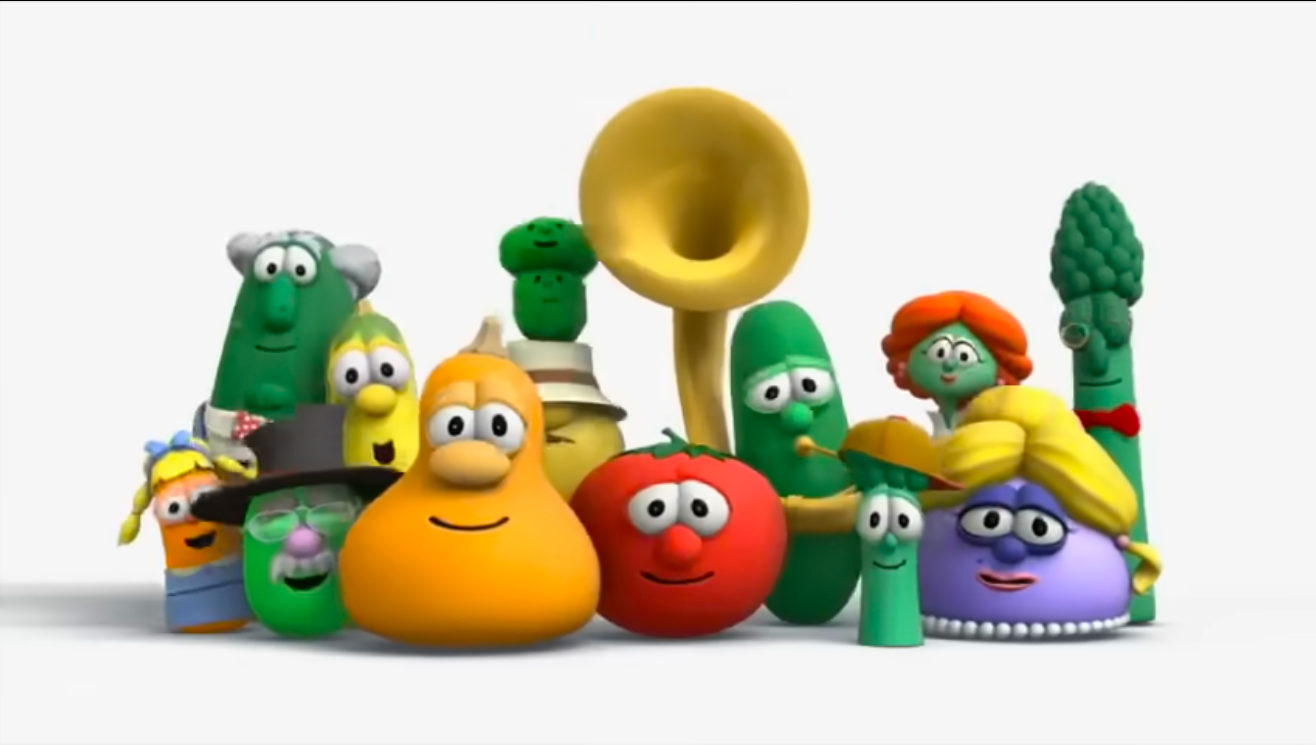
A Reflection on VeggieTales: Why Christian Media Discernment is Necessary for All Media
This post is not a negative review but a discussion of Christian media discernment from a faith-based perspective. Wisdom and discernment are necessary with every form of media, even with shows considered safe, wholesome, and educational.
Christian streaming services often emphasize Christian media and the safety of their content for children and can provide clean, wholesome, and even educational content for the whole family.
Although having family-friendly and faith-based streaming is a great idea—and the risks of your children being exposed to dangerous content from these sources are often far lower than on secular streaming services—family-friendly streaming does not eliminate the need for media discernment.
We should treat every show as a teaching opportunity—but we cannot do this if we are not familiar with what our children are watching.
No show is perfect, and even Christian shows may not align with your family’s beliefs, which is why it is so important to be involved with the media your children consume regardless of whether it is explicitly Christian.
In this article, I want to highlight why we should not blindly trust Christian children’s media without discernment using VeggieTales as an example in order to emphasize why we should look at everything through a faith-based lens.
Christian media can be a helpful tool—but it was never meant to replace intentional, biblical teaching from parents or Scripture. I’m sure most of my readers already know this, but reminders are still helpful for everyone.
This Post is Not Intended as Criticism of VeggieTales
I want to begin by clarifying that this article is not intended as criticism of VeggieTales. I love VeggieTales and have a deep, nostalgic appreciation for it.*
Whenever a new episode was released, my dad would take us to the Christian bookstore to buy it, and then we would watch it together as a family. Over time, my parents built a large collection, and those memories are still very meaningful to me. I even recently told my mother-in-law that I’d like to work on building a collection of my own.
VeggieTales has long been a beloved staple in many Christian homes, including mine. However, as with any form of media, there are still important considerations for parents to keep in mind when deciding what their children watch.
Does VeggieTales Teach Christianity or Just Morals?
There’s nothing wrong with teaching Christian virtues (it’s actually essential), and VeggieTales does this very well. However, there’s far more to Christianity than just behaving morally.
As Phil Vischer notes in an interview with Christian Examiner:
Wait a minute, did I just spend 10 years persuading kids to behave Christianly without teaching them Christianity?…I can’t just tell kids to behave like Christians. I have to teach them the tenants [sic] of the faith. source
Children need to understand what Christianity is, what it teaches, and how those truths shape their lives.
Being a Christian is a whole lot more than just not telling a fib, or spreading a rumor, or using our gifts wisely. It’s about the gospel of Jesus Christ.
John 3:16 (ESV) outlines the Gospel: ““For God so loved the world, that he gave his only Son, that whoever believes in him should not perish but have eternal life.”
Although I grew up on VeggieTales, I can’t think of one time that they actually shared the gospel or taught us how to be saved. Even secular shows emphasize honesty and kindness—but Christianity goes far beyond moral behavior.
Is VeggieTales Biblically Accurate? Concerns with Parody
VeggieTales appeals to a wide audience because of their parodies, which they’ve relied on heavily over the years.
They have parodied Indiana Jones twice with Minnesota Cuke and the Search for Samson’s Hairbrush and Minnesota Cuke and the Search for Noah’s Umbrella. They’ve also parodied Lord of the Rings, Robin Hood, A Christmas Carol, Pinocchio, Hamlet, Star Trek, etc.
That’s a lot of parodies, and their Lord of the Rings and Indiana Jones ones are especially good. However, there’s something that all the listed examples above have: they’re parodies of fictional stories from a Christian perspective. I enjoy parodies, and there’s nothing wrong with satirizing fictional stories.
However, VeggieTales parodies Bible stories, too, and unlike fictional stories, Biblical accounts carry a different level of weight and seriousness from a Christian perspective.
For example, in Moe and the Big Exit, VeggieTales‘ retelling of Moses, instead of water turning into blood, it turns into tomato juice. Their retelling of Joshua involves the Israelites being attacked with slushies from the walls of Jericho. Gideon‘s story involves testing the Israelites with slushies.
And, perhaps one of the biggest changes involves their version of David and Bathsheba. It’s titled King George and the Ducky, and portrays King George (David) as a king with an excessive amount of rubber duckies who steals Thomas’ (Bathshebas) precious rubber ducky.
I understand that people worry about getting too “adult” when it comes to children’s media. Some Biblical accounts are very mature, but that doesn’t diminish their importance in a Christian’s life. Reshaping narratives to fit a younger audience, or adapting serious moments into humor-driven storytelling risks diminishing the weight of the original message.
We need to be careful that we teach the actual, biblical accounts, perhaps by reading them aloud as a family before or after watching the VeggieTales version and discussing how the Biblical account relates to our lives.
Concerns with Depth
2 Timothy 3:14-17 (NIV) says:
But as for you, continue in what you have learned and have become convinced of, because you know those from whom you learned it, and how from infancy you have known the Holy Scriptures, which are able to make you wise for salvation through faith in Christ Jesus. All Scripture is God-breathed and is useful for teaching, rebuking, correcting and training in righteousness, so that the servant of God may be thoroughly equipped for every good work.
And Proverbs 22:6 (ESV) tells us:
Train up a child in the way he should go; even when he is old he will not depart from it.
Children may not have a fully developed understanding yet, but that’s why a parent’s role is so important. Parents should never diminish the importance of teaching their children (or those they interact with) what the Bible actually says.
Phil Vischer expressed concern about depth when teaching children about the Bible:
Christian Examiner: Do you fear that we’re not digging deep enough with children in what we teach them about Christianity?
Vischer: Yes. We’re at an attractional model of children’s ministry — you can land a whole family if you can appeal to the kids. And to appeal to the kids you want to make it as fun as you possibly can, and going deep doesn’t sound like fun. So when I speak to kids ministry workers, the point I’m trying to make from my own experience is that kids can go deeper than you think. source
VeggieTales doesn’t go very deep into theology. There is nothing inherently wrong with watching VeggieTales, but most of the time, the show provides entertainment and moral messaging.
Since their versions of Bible stories are presented in a lighter format, children may be at risk of missing the full meaning of the text. Christian media discernment is key no matter how trusted a source is.
Final Thoughts on Christian Media Discernment for Parents
Christian media discernment remains essential—even when it comes to Christian media. VeggieTales is an enjoyable show for the entire family, but since it doesn’t explore the gospel in depth and presents Bible stories through parody, it would be wise to read the Bible passages referenced in the VeggieTales episode with your children and discuss its meaning as a family. Discernment for Christian parents and children should never be overlooked even with trusted shows.
VeggieTales—and other forms of Christian media—can be a helpful tool, but it should never replace God’s Word.
*With the exception of the updated animation style…which we choose not to discuss.
Photo Source: Screenshot from the VeggieTales opening on VeggieTales Official YouTube. Under fair use for review/commentary/education/criticism. All rights reserved by owners.






Hello RMR! I enjoyed reading this review. Thank you for your time in putting it together.
We tried to have some traditions for our family while the children were growing up. I wasn’t much of a spiritual leader, so I used media to help me out like Veggietales. Those Sunday afternoons were fun, I feel like they were about every 6 months because of the release times of Big Idea. I preordered the discs at the local Family Christian Bookstore (they are gone like Blockbuster? 😢
I can’t say that they were used a ton after the initial purchase. I like fun memories, and Veggietales became a fun memory. A few times when we’re together at Christmas, we’ll pull out a Christmas Veggietales show and watch it on disc (Even though I stream too much, I still believe people should build their disc libraries because once you own the discs you don’t have to pay the subscription fees to see your favorite shows or movies).
As far as the moral discussions of Veggietales? They were definitely in that period of “how do you teach biblical stories in a fun way”? Yet, as culture morphed into the screen screen era, the problem with parenting now is the kids can watch whatever clip/reel of Veggietales on Youtube etc. but the families are not getting together for events like a 6month wait after church to get the latest Veggietales show (and they stopped producing with the original standards of Phil and Mike). Too many corporate hands have made disastrous creative errors (like you mentioned with your * footnote that obviously is about the creepy eye redo of the animation style).
Parenting is hard and everyone gets busy with their own activities/jobs to where we can’t find a moment to get together and watch a family movie like the old days (I am still trying to schedule a time to watch the live action Lilo and Stitch together 😂).
Make the most of the times when your children are young because those days will soon be over. My greatest advice to families is to go to church and get sound teaching, and read your Bible, pray together, even if those times are short.