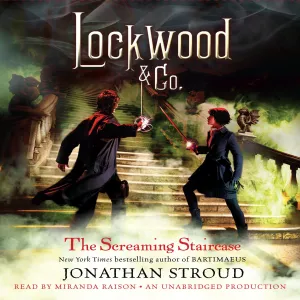
Lockwood and Co. Christian Review & Parents’ Guide: An Exploration of Character Growth and Morality in The Screaming Staircase
In this Lockwood and Co. Christian review, we will explore the first novel, The Screaming Staircase, from a faith-based perspective and provide a parents’ guide.
Since the first volume is a good indicator of what to expect in the rest of the series (including TV series on Netflix) this Christian review can be a guideline for those, too.

Quick Facts
- Author: Jonathan Stroud
- Publication Date: August 29, 2013
- Books in Series: 5
- Pages: 440 (hardcover edition)
- TV Adaptation: Yes, in 2023, first and only season on Netflix
Quick Content Guide
- Language: Frequent use of d*mn and related; some stronger curse words (including bullsh*t).
- Substance: Characters drink and smoke.
- Sex & Nudity: Nudity in a bathroom setting; a character breastfeeds; some nudity for Natsuki in a few scenes.
- Violence/Frightening Scenes: Violence appears online and in person; blood occurs; CPR happens and a character dies.
My Personal Enjoyment Rating
For the content and parent guide, please scroll to the bottom of this post.
Can Christians Watch Lockwood and Co.?
With wisdom and discernment, some Christians may be able to watch Lockwood and Co., which is recommended for ages 11+ on Common Sense Media.
Christians will want to be aware of scariness and ghost content, as well as some language.
Can Christians Read Lockwood and Co.?
Christians may be able to read Lockwood and Co. if they use wisdom and discernment.
The age recommendation for The Screaming Staircase is 11+ per Common Sense Media, who emphasizes the novel’s scariness.
There are other books in the series, and reviews for those can be found on Common Sense Media’s website.
Synopsis: What is The Screaming Staircase (Lockwood & Co. Book 1) About?
London is overridden with ghosts, but somehow Lucy Carlyle, ghost hunter, is out of a job. Desperate for funds and (perhaps) lacking her Fourth Year certificate, she joins forces with the independent agency Lockwood and Co., owned by the charismatic Anthony Lockwood and his clever cohort, George.
After an unfortunate accident, the agency is left with mounting debt. So, Lockwood and Co. take a gamble in hopes of a big payout—solving one of the worst hauntings in England, Combe Carey Hall. Though the hall has a grisly past and an infamous “screaming” staircase that has driven others to madness, what choice do they have? With the agency’s future hanging by a thread, it’s up to Lucy and her fellow agents to survive the night and solve the case before they become ghosts themselves.
Lockwood & Co. Christian Review: The Screaming Staircase
The young adult book series Lockwood and Co. by Jonathan Stroud recently soared in popularity due to the Netflix show, and for good reason. While ghost stories are nothing new—they’re a classic horror staple—Lockwood and Co. contains enough classic horror tropes, steampunk energy, and snarky British humor to draw in a lot of thriller aficionados. But what exactly will you find in this series beyond haunted houses, rapiers, and ghosts? I’ll take you through the first book, The Screaming Staircase, and discuss the main talking points for Christians.
Note: This book review and content guide is about the first Lockwood and Co. book, although it’s a good indicator of what to expect in the rest of the series. The TV series on Netflix contains basically the same elements, so this review can be a guideline for that, too.
The Screaming Staircase: Notes on the Storyline and Writing
The Screaming Staircase is an interesting mix of fast pacing combined with sudden moments of exposition. The first few chapters explore a haunted house and how typical cases go for Lockwood, Lucy, and George, but then the story backtracks to explain Lucy’s history.
For the most part, though, there’s enough action and quippy dialogue to keep the pace going. It does take a long time to get to the haunting at Combe Carey Hall, but the other cases are interesting enough.
As a writer and avid reader, I would say the writing is well done in The Screaming Staircase. Everything feels intentional and significant, which matters because there are some mystery elements to the plot. The storyline contains good twists and turns, unexpected plot points, and the danger feels real. I have no complaints about the author’s skill or delivery of the story, or any complaints about the story itself, to be honest (except for Biblical/moral concerns, which I will address later).
The Characters in Lockwood & Co.
Lucy’s character arc is slow going through The Screaming Staircase, mostly because there’s the rest of a series to continue her growth, but she does learn multiple lessons.
She harnesses her compassion well by the end, learning to balance her sympathies towards death with the reality of the ghosts they encounter. She learns to rely on Lockwood and George initially as partners and later as friends, understanding that teamwork is essential to surviving. She also learns the value of honesty, trust, and humility, even going so far as to admit that she sometimes gets things wrong.
*Spoiler* Lucy also has obvious character flaws. She is mean & snarky to her coworkers, lies about not getting her Grade Four certificate, and conceals her theft of Annie Ward’s necklace, among other things.
She may be brave, smart, hard-working, and talented, but she is not a great role model. I do appreciate that her sense of justice is far stronger than that of her cohorts, however.
Like Lucy, Lockwood and George are not the best role models, but they do have their charm. Lockwood is dashing and disarmingly charming. He is also jaded, ambitious, and blind to danger. George is as personable as a wet rag but brilliant, knowledgeable, loyal, and snarky to a fault.
Lockwood and George both focus on the hauntings as a means to an end, but the “end” differs for them. Lockwood wants money and to be rid of ghosts both figuratively and literally. George desires knowledge about the ghost problem and has mountains of theories about its history and potential solutions. They are both good agents (Lockwood more so), but they both lack a softer side that Lucy displays. By the end, Lockwood and George both embrace Lucy as a teammate and a friend.
Ghosts in Lockwood & Co.: A Biblical Analysis
It’s hard to review a book like this with Biblical principles in mind since the book itself is pretty much watered-down comedic horror with few redemptive themes. There are, as previously mentioned, moral and spiritual concerns that can be a stumbling block for some.
First of all, the book revolves around ghosts. These are the souls of once-living humans that have not yet departed to heaven or hell. Instead, they’re stuck on earth because they have something binding them, usually a truth they’d like to reveal or an injustice to right.
In Lockwood and Co., ghosts are, at best, considered an annoyance, and at worst, a serious threat.
Biblically, in real life, Lockwood and Co.’s idea of “ghosts” don’t exist.
As GotQuestions explains:
Hebrews 9:27 declares, “Man is destined to die once, and after that to face judgment.” That is what happens to a person’s soul-spirit after death—judgment. The result of this judgment is heaven for the believer (2 Corinthians 5:6-8; Philippians 1:23) and hell for the unbeliever (Matthew 25:46; Luke 16:22-24). There is no in-between. There is no possibility of remaining on earth in spirit form as a “ghost.” If there are such things as ghosts, according to the Bible, they absolutely cannot be the disembodied spirits of deceased human beings.
Spiritual warfare exists, and sometimes angels (who work for God) and demons (who work for Satan) make appearances on earth. Sometimes, demons may appear as ghosts to confuse us or lead us astray.
As GotQuestions notes:
Demons are evil, deceptive, and destructive. According to 2 Corinthians 11:14-15, demons masquerade as “angels of light” and as “servants of righteousness.” Appearing as a “ghost” and impersonating a deceased human being definitely seem to be within the power and abilities that demons possess.
In The Screaming Staircase, it’s thankfully clear that humans are fighting against the ghost problem. Regardless of whether the spirit is someone’s loved one, all the spirits are to be eliminated or avoided.
However, there is a casual attitude from the agents about fighting the ghosts; they treat it as a job rather than a righteous calling. Simply put, they’re there for a paycheck. Lockwood and George harp on this point to Lucy several times, that when a case is over, it should be over and done.
There’s also rarely any celebration of the destruction of evil ghosts unless it comes with a hefty sum. However, I do appreciate that the ghosts in Lockwood and Co. are treated as the problem they are.
The tools that agents use to repeal and defeat ghosts aren’t spiritual in nature, although it is mentioned that, “…churches and mosques did excellent business as people sought to save their souls.” Nothing else is mentioned regarding people seeking religious protections, and it’s later mentioned that “none of this actually solved the [ghost problem],” indicating that it was not effective. The agents also didn’t use any religious artifacts or tools to defeat ghosts, instead relying on other sources such as iron, lavender, and salt. These sources have folkloric background claiming protection against spiritual forces; however, Christians know that God’s power is the only true way to defeat evil spirits.
Religion gets a bad reputation right near the end of the novel, since it is revealed that Combe Carey’s main haunting is caused by evil monks. Exactly what they worshipped wasn’t clear, as the only description given is “dark things,” but it was obvious that it wasn’t the Lord. Thankfully, by the end of The Screaming Staircase, the haunting is stopped, but these evil monks are part of the plot later in the Lockwood and Co. series.
Lucy consistently communicates with the spirits of the dead, something the Bible strictly forbids, as mentioned in Deuteronomy 18:10-12.
As believers, we are called to test the spirits. 1 John 4:1 (ESV) says “Beloved, do not believe every spirit, but test the spirits to see whether they are from God, for many false prophets have gone out into the world”. (If you aren’t sure what “testing the spirits” looks like, check out this article from GotQuestions).
Lucy does not do this. Lucy’s talent of speaking with ghosts is often described as a “psychic connection.” By talking with the ghosts, she experiences the emotions and memories of the deceased person’s life as if she’s living them again, which can be hard to stomach, considering they usually show the moment they died.
Lockwood even shows concern at one point that one of the ghosts “controlled” her, which is similar to a possession. Thankfully, that is not what happened, although the listening sessions leave Lucy vulnerable while she waits to hear from the ghost. By listening to them and communicating, she receives auditory or emotional clues about what happened to them. So, despite the dangers and emotional toll, Lucy’s talent is viewed positively by her teammates. Lockwood and George learn to regularly rely on the insights she gleans from listening to help solve cases.
Because of Lucy’s connection with the ghosts, she forges compassion for their lost souls. However, this attitude is often treated as a distraction from her job unless it leads to valuable insights for the case. Sometimes that compassion does drive her to do dangerous things (like stealing an artifact linked to a ghost), but the constant push towards apathetic efficiency is concerning. Moreover, justice is frequently viewed as a sort of side-effect of a “job well done” and not the primary reward.
Speaking of justice, I found that law enforcement and the agencies in this book were given an unjust hand. Inspector Barnes is treated as an annoying busybody rather than a law enforcement professional who just wants to follow the rules and keep everyone safe. Officials from the Department of Psychical Research and Control (DEPRAC) are viewed more positively, as they help clean up after hauntings, but they also are the ones in control of which agencies go after big cases, so they end up being a sore subject in later books.
FAQs for Lockwood & Co.
Is Lockwood & Co. scary?
Is Lockwood & Co. occult?
What age is Lockwood & Co. safe for?
Is Lockwood & Co. appropriate for kids?
Although I do think Lockwood & Co. fits in the young adult demographic, I would caution parents before introducing this to middle schoolers. There are enough frightening moments to spook adults, so younger readers should be wary, particularly if they have vivid imaginations.
Can kids watch Lockwood & Co.?
I would strongly urge caution with the Lockwood & Co. TV show when considering it for sensitive or younger viewers as the scenes are more intense off the page.
Lockwood & Co. Christian Review: The Screaming Staircase Parents’ Guide
This parent guide focuses on The Screaming Staircase, the first novel in Jonathan Stroud’s Lockwood and Co. series. For a content guide focused on the Netflix TV show, visit Common Sense Media (link here), who also provides guides for the other Lockwood & Co. novels.
Language in Lockwood and Co.:
- “Hell” as a swear multiple times.
- “Hellish” as an adjective.
- A few instances of the Lord’s name in vain.
- A few instances of “d*mn.”
- A few instances of “s**t.”
- Multiple instances of “bloody” as a swear.
Sexual Content in Lockwood and Co.: Some mentions of underwear or scandalous dress. One character mentions conducting an experiment where they put a trapped spirit in the bath with them. There is also a singular mention of a character “doing yoga in the nude” (no other details described).
Violence in Lockwood and Co.: Significant violence, gore, and injuries, although most of it is seen in visions of the past or ghostly apparitions. Multiple dead bodies and many explanations of death. One character dies at the end (not one of the three main characters). Also includes classic horror elements including a “bleeding” room, screaming apparitions, bundles of bones, ectoplasm, etc. in addition to rapier fights (which rarely involve people being injured).
Moral Strengths in Lockwood and Co.: Themes of compassion, justice, independence, hard work, and found family.
Moral/Spiritual Concerns in Lockwood and Co.: Child labor (none of the agents are legal adults), dead bodies, physic talents that are sometimes considered “powers,” ghosts, haunted objects/spaces, Lucy speaks with ghosts, and evil monks.
Conclusion: Can Christians Read and Watch Lockwood and Co.?
From a Christian perspective, there are most definitely concerning elements in Lockwood and Co. The number of ghosts, frightening depictions, and overall macabre touches should give Christians pause before reading. There is some swearing and minimal mentions of nudity, as well as plenty of fighting, injuries, and violence.
As a work of fiction, it is a well-written book. The writing is witty, well-paced, and crafted expertly. There’s enough humor and wit to lighten the mood despite the horror tropes throughout.
Because of this, I do think it fits in the young adult demographic; however, I would caution parents before introducing this to middle schoolers. There are enough frightening moments to spook adults, so younger readers should be wary, particularly if they have vivid imaginations. (I also would strongly urge against the TV show for that reason, as the scenes are more intense off the page).
Overall, this is an engaging supernatural horror book that most likely is not the best choice for younger readers due to the frightening story and Biblical concerns.
For older readers, consider this solely for entertainment, and take the opportunity to discuss/consider the difference between how the supernatural is portrayed in Lockwood and Co. versus the Bible.
There are some good themes in Lockwood and Co.,, but there is not much that would support a Biblically based mindset and encourage Christian living.