Anastasia: The Last Grand Duchess, Russia, 1914 by Carolyn Meyer (Christian Review & Parent Guide)
Our review of Anastasia: The Last Grand Duchess explores Carolyn Meyer’s historical fiction novel from a Christian perspective. We also provide an Anastasia Royal Diaries parent guide for your convenience.
Quick Facts
- Author: Carolyn Meyer
- Year: 2000
- Age Range: Middle Grade (9–12)
- Genre: Historical Fiction
- Subject: Anastasia Romanov, The Last Grand Duchess of Russia
- Series: Royal Diaries
- Publisher: Scholastic
Quick Content Guide
Hardly anything of note; see parent guide below for more detail.
My Rating
Synopsis of Anastasia: The Last Grand Duchess
Anastasia Romanov is the fourth daughter of Tsar Nicholas II and Empress Alexandra of Russia. Prior to the start of World War I, she lives happily with her parents, sisters, and younger brother Alexi, who is often ill with haemophilia.
As World War I breaks out, everything changes—her oldest sisters and mother become nurses, and her beloved father leaves to fulfill his role as tsar.
Covering events between 1914 and 1918, Anastasia’s fictional diary explores her thoughts, feelings, and perspectives as Russia changes forever.
Anastasia: The Last Grand Duchess Review (Royal Diaries)
Most history fans have specific events or people in history that particularly interest them, and Anastasia, Russia’s last Grand Duchess, is one of mine.
I remember enjoying many of Scholastic’s Dear America and Royal Diaries books as a child, so I was excited for the chance to reread Anastasia: The Last Grand Duchess by Carolyn Meyer.
Generally, I enjoy rereading stories and usually enjoy children’s media, but honestly, this one wasn’t as enjoyable as I had expected.
Disclaimer
As Anastasia: The Last Grand Duchess by Carolyn Meyer is a historical fiction novel, many of the prominent characters, including Anastasia herself, were real people. Any criticism, unless otherwise stated, is focused on Carolyn Meyer’s portrayal of these historical figures. Any criticism should be considered criticism of the fictional characters, not the real people.
Overall Thoughts on Anastasia
Royal Diaries used to be one of my favorite series, and I love revisiting stories, so I expected to enjoy the novel more than I did.
I know I’m not the intended age or audience for this novel (I’m more than twice the maximum recommended age), and my perspective has changed so much since I first read the book.
As a child, I found myself easily romanticizing problematic historical figures. When you read something from their perspective, it’s easy to assume that they were the victims and misunderstand the complexity of their role. And, although Anastasia was cruelly and mercilessly murdered by the Bolsheviks, I’ve realized that her family made many mistakes—they had misplaced priorities and poor judgement.
Carolyn Meyer does a great job including historical fact within the fictional diary, but I found Anastasia’s character difficult to like overall.
Anastasia’s Character
I know I’m worlds away from Anastasia in age, experience, and worldview, but even so, her character is difficult to relate to.
She’s portrayed as rather immature and very out of touch with what’s going on with her family’s subjects—she talks about parties, jewels, and doesn’t have a sense of what life is like for the common people. She talks about how the Russian people basically “worship” Tsar Nicholas, her father (16) and even writes, after acknowledging that “not everyone adores” her father (17):
There are people who say the peasants are suffering, and blame it on Papa. There are even some people who believe that others should share in the rule of our country!
That’s nonsense, of course. Only the tsar must rule…This is God’s will, so how could it be any other way? (17)
She doesn’t seem to think her father can do anything wrong, and in some ways, seems disconnected with her people’s plight.
Anastasia is still young, and her worldview is still being formed, of course, but her disconnect is very loud. Her oldest sisters and mother become nurses during WWI—both in the book and in real life. However, according to the book, Anastasia wasn’t allowed to become a nurse, but she was allowed to visit the soldiers in the hospital—unfortunately, she complains about not being permitted to wear a uniform (85) which further solidifies her misplaced priorities.
Anastasia is also rather naughty, purposefully searching for her sister’s diaries and reading them.
Yet, despite all the problems I have with her character, she does care immensely about her loved ones and loves fiercely.
Spirituality in Anastasia
Empress Alexandra converted from Lutheranism to Russian Orthodoxy after marrying Tsar Nicholas II—though “she was not required to repudiate Lutheranism.” The novel portrays the empress as a very devout believer, and mentions her praying at the tombs of the former tsars “for guidance” (110) and in front of icons (45).
The Empress is portrayed as a character who puts a lot of trust and belief in the abilities of Father Grigory, more famously known as Rasputin. She believed that he could heal her ill son, Alexei, and she refused to listen to the warnings of others about him.
In real life, she was fiercely loyal to him and believed in his abilities, viewing him as a “faith healer.”
Rasputin’s actual reputation is not a positive one—his alleged immorality and misconduct, as well as his access to the empress, make him an infamous historical figure. He is often considered a “faith healer” and “mystic.” He’s even been portrayed as the villain in fictional retellings of the Romanov’s lives, including in the animated film Anastasia (1997).
However, despite his questionable reputation, the novel keeps things age appropriate.
If your kids end up reading this book, you would have the opportunity to discuss Rasputin from a Christian perspective—how it’s important to look at the fruit of one’s life and not just their claims of faith, and how we shouldn’t just blindly trust someone.
There’s also the opportunity to talk about the difference between relying on God, and finding power from alternative—and dangerous—sources.
Historical Accuracy in Anastasia
Although it’s a given that a historical fiction novel will take some liberties, Anastasia is fairly historically accurate.
The novel highlights many real historical figures; the most obvious, of course, are Anastasia and her family. Grigory Rasputin, Empress Alexandra’s mysterious advisor, also appears, as do many other members of Russian nobility, friends of the royal family, and the Romanovs’ staff.
Something I find rather interesting is the absence of some of the Romanovs’ most loyal staff in the book. There were three servants and a doctor killed with the Romanovs, and the only one highlighted significantly in the novel was Dr. Botkin, the family’s physician.
I don’t remember every single name mentioned in the book, but Carolyn Meyer conveniently gives a character glossary, which oddly omits Anna Stepanovna Demidova, Aloise (Alexei) Yegorovich Trupp, and Ivan Mikhailovich Kharitonov, the three servants killed along with the Romanovs and the doctor.
These servants remained with the family until their death, so it’s notable that most are not included in the glossary.
FAQs for Anastasia: The Last Grand Duchess Royal Diaries
Is Anastasia: The Last Grand Duchess Appropriate?
Anastasia: The Last Grand Duchess is appropriate (with discernment) for the target age group which is middle grade. However, it all comes down to the individual child. We have provided an Anastasia Royal Diaries parent guide below for your convenience.
Is Anastasia: The Last Grand Duchess historically accurate?
Anastasia: The Last Grand Duchess is fairly historically accurate.
Conclusion: Anastasia The Last Grand Duchess Review
Ultimately, Anastasia: The Last Grand Duchess by Carolyn Meyer is a fairly historically accurate novel about Duchess Anastasia, the youngest daughter of the Romanovs. It could serve as an introduction to the Russian revolution—perhaps for homeschoolers, history fans, or even those who enjoy historical fiction.
It certainly is more appealing for its target audience (which should come as no surprise), but adults may enjoy the glimpse into the Romanovs’ lives, too.
And yes, Christians can read this novel, with discernment.
Hopefully, our Anastasia Royal Diaries review was helpful! Let us know if you read the book, and if you think we missed anything!
We hope to cover more Royal Diaries novels in the future.
For further reading, visit our review of The Rose of Versailles, an anime film set during Marie Antoinette’s life.
Anastasia: The Last Grand Duchess (Royal Diaries) Parent Guide
Language
- Clumsy
- Oaf
- Imp (shvibzik)
- Faugh! as an exclamation
- Dratted family/dratted/dratted girl.
- Wicked of her
- Dissolute
- Botheration!
- Comparing someone to “a little barrel.”
- “It’s stinking of her”
- Balderdash
- Pfui=Faugh!
- Fat
- Stupid/stupid rotten
- I swear
- Wretched
- Putrid
- Stupid rotten
- Idiotic
- Crazy man
- “He’s such a bully” (73).
- “Filthy Germans” written.
- How stupid they are.
- Such a beast.
- You idle rich.
Violence/Gore
- In the past, Anastasia threw a snowball with a rock at her sister and nearly knocked her out.
- Anastasia’s sister kicks her under the table.
- Someone shoots Franz Ferdinand (mention of).
- Someone attacks and wounds Father Grigory (mention of).
- A big stone is thrown at someone.
- Characters pretend to shoot a monkey with an arrow during a performance.
- Mention of gore/wounds.
Frightening Scenes
- Anastasia’s brother, Alexei, frequently falls ill, especially when he injures himself.
- Alexei crashes into a table.
- Anastasia pretends to be an officer who steps on the toes of his dancing partners, and she accidentally does step on people’s toes. Of course, the officer did, too.
- In the past, Anastasia nearly drowned.
Sexual Content, Romance, & Nudity
- Anastasia and her sisters dance with officers.
- Some of the Romanov sisters flirt with men.
- Anastasia lacks a “figure” so she doesn’t have a corset. Her older sisters, however, do have “figures.” Anastasia also lacks a “bosom.”
- Rasputin prays with the girls while they are in pajamas.
- Mention of derriere.
- Anastasia’s sister flirts with an officer.
- Anastasia’s sister holds hands with an officer and likely kissed him.
- Soldiers barge in on the royal family while their doctors are treating them.
- Epilogue mentions lewd jokes & being escorted to bathroom.
Substances
- Mention of eating/drinking.
- Anastasia pretends to smoke one of her father’s cigarettes.
- The tsar smokes in distress.
- Epilogue mentions a drunken boor.
Spiritual Content
- Anastasia’s mother is known to be very religious.
- Characters say “Thanks be to God,” and say prayers.
- Thank goodness mentioned on one or more occasions.
- A character named Father Grigory is known as a “holy man.” (He is better known as Rasputin, an infamous historical figure).
- After being prayed over by Rasputin, Alexei gets better (he is often ill).
- Some Russians worship the tsar and think even his shadow is holy.
- Anastasia believes the tsar ruling is “God’s will.”
- Rasputin is “sent by God.”
- Anastasia’s mother was once Lutheran but converted to Orthodoxy. She prays in front of icons.
- Mention of having the kulich blessed.
- Anastasia notes that her brother “has a way of sensing things” (50).
- Mention of Neptune.
- Characters pray in front of icons and tombs.
- Characters pray for guidance at the tsars’ tombs.
- Someone considers green trees a sign of God’s love.
- Mention of fate being in someone’s hands.
- No such luck.
- Thank God.
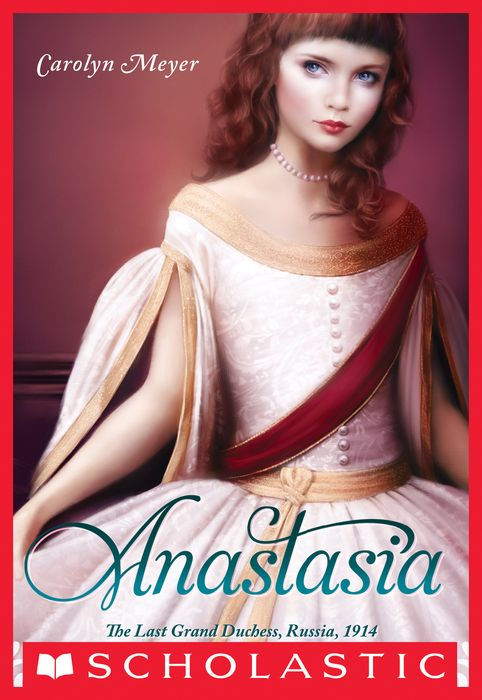
Photo Credit: Cover of Anastasia the Last Grand Duchess paperback by Carolyn Meyer. From Barnes and Noble. Under fair use for review/commentary/education/criticism. All rights retained by owners.