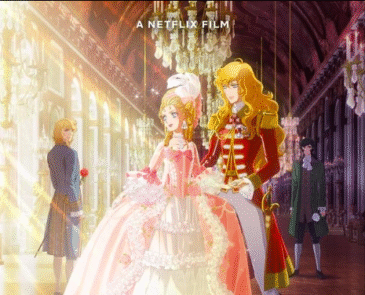
The Rose of Versailles 2025: A Christian Review and Parent Guide on the Historical Anime
In our The Rose of Versailles review, we will explore the historical anime film from a Christian perspective and provide a content and parent guide based on the anime film.
Quick Facts
Genres: Historical Drama, Romance
Director: Ai Yoshimura
Release Date: January 31, 2025 (Japan); April 30, 2025 (Netflix)
Language: English Dub
Rating: PG-13
Runtime: 113 minutes
English Voice Cast: Caitlin Glass, Megan Shipman, Brandon McInnis, Ryan Colt Levy
Quick Content Guide
- Language: Some use of words like b*st*rd, d*mn it, and h*ll; some blasphemous phrasing.
- Sex and Nudity: Some innuendo and suggestive scenes, nude art/sketches, one sex scene (1:27:08–1:28:30), and other romantic elements.
- Violence: Fighting, death, and bloodshed occur; characters shown in danger.
- Substance: Alcohol appears on multiple occasions.
My Rating
Synopsis of The Rose of Versailles (2025)
Lady Oscar de Jarjayes, the daughter of French nobility is raised as a boy by her father. As she matures, Oscar becomes a gifted soldier and serves as the bodyguard to Marie Antoinette, the eventual queen of France. As unrest grows amongst the working class, Oscar notices how detached Marie Antoinette and her husband, King Louis XVI, are to the everyday struggles of their subjects.
While tensions rise and revolution brews, Marie Antoinette and King Louis XVI become symbols of the monarchy’s excess, and France descends into the chaos of the French Revolution.
Christian Review of The Rose of Versailles
The Rose of Versailles, also known as Versailles no bara, is a Netflix remake of the anime Lady Oscar: The Rose of Versailles from 1979-1980.
The Rose of Versailles: Anime and Manga vs. the Film Adaptation
Since I’ve only seen the film adaptation of The Rose of Versailles, I can’t speak in-depth about how it compares to the anime or manga—but I hope to revisit and update this section after exploring the original versions.
That said, even as a newcomer, it’s clear that the film skips several key characters and plotlines. Important figures like Bernard Chatelet, Rosalie, the Duke of Orléans, and Madame du Barry are either missing entirely or only mentioned briefly. The absence of the Duke of Orléans’ betrayal and political scheming is especially odd, considering the high stakes of the story.
The Rose of Versailles English Dub Cast
The film stars Caitlin Glass (Spy x Family) as Oscar François de Jarjayes, Megan Shipman (Spy x Family) as Marie Antoinette, Brandon McInnis as André Grandie and Ryan Colt Levy as Hans Axel von Fersen.
Other notable voice actors in The Rose of Versailles include Alejandro Saab (Link Click), J. Michael Tatum (Summer Wars, Steins;Gate), and Shelby Young.
I had never seen The Rose of Versailles anime or read the manga before, so this film was my first real introduction to the story.
Historical Accuracy in The Rose of Versailles: Real Figures and Events in Revolutionary France
As someone who loves history, I was surprised by how much of the plot had real historical roots.
I found myself pausing the film to research throughout. While much of it is highly fictitious, especially the character of Oscar François de Jarjayes—a woman raised as a man who serves as the personal guard of Marie Antoinette—there are several references to real events and figures.
For instance, King Louis XV, who dies of smallpox in the film, was indeed the predecessor of King Louis XVI, the husband of Marie Antoinette, and in real life, he died of smallpox.
The existence of the French Guard is grounded in reality—some joined the fight against the monarchy.
Then we have Marie Antoinette, who is still remembered for her extravagant spending and detachment from her subjects.
*Spoiler* Marie Antoinette’s relationship with Count Hans Axel von Fersen—a real Swedish nobleman and close friend—is portrayed romantically in The Rose of Versailles. While their connection in real life is speculative, the film leans heavily into the idea of forbidden love.
Reflections on Fact and Fiction in the Story *Spoiler*
Perhaps the most disappointing part was how the film ends. It concludes right after the Storming of the Bastille, with a brief montage during the credits rather than exploring the full revolution or the fate of the royal family in the film itself.
Problematic Themes in The Rose of Versailles
Attempted Murder *Spoiler*
One of the most jarring moments in the film is when André tries to murder Oscar. This felt like a serious turning point that should have had more emotional weight.
However, Oscar appears surprisingly unaffected by it. She quickly embraces André as her future husband, and the narrative moves on as if nothing happened. It’s a strange tonal shift.
Of course, forgiveness is a virtue—and it’s something Christians are called to. “Be kind to one another, tenderhearted, forgiving one another, as God in Christ forgave you” (Ephesians 4:32, ESV), and Oscar’s choice aligns with Biblical values. I celebrate this portrayal of forgiveness.
But from a storytelling perspective, the way this event is handled feels unrealistic and emotionally underdeveloped. The narrative’s lack of reflection on it weakens the moment’s impact; however, it is still beautiful to see Oscar forgive Andres—it was just a bit sudden with little emotional build up.
Plus, in the older iterations of the story, Andres apparently assaults Oscar, and although the 2025 anime film doesn’t show this, it’s still a problematic edition, nonetheless.
Heart Over Truth: Unbiblical Messaging in The Rose of Versailles
The story also leans heavily into modern messages of “following your heart” and “being true to yourself.” These are common in contemporary fiction, but they clash with Biblical teachings. The Bible warns us:
“The heart is deceitful above all things, and desperately sick; who can understand it?” — Jeremiah 17:9 (ESV)
Trusting our heart often leads us away from God’s truth and into emotional decisions that hurt ourselves and others.
*Spoiler* In the film, Marie Antoinette’s love for Fersen hurts her husband and causes tension.
Similarly, the theme of “being true to yourself” is complex. Scripture tells us in Ephesians 2:10 that “For we are his workmanship, created in Christ Jesus for good works, which God prepared beforehand, that we should walk in them” (ESV) which tells us that God created us for specific purposes. The world’s version of this message encourages people to define their identity based on feelings rather than God’s truth and His plan for our lives.
In the context of The Rose of Versailles, “being true to yourself” centers on doing what you feel is right rather than finding your identity in Christ.
The Father’s Betrayal: A Missing Emotional Punch *Spoiler*
A particularly powerful scene occurs when monarchists shoot Oscar. In the film, her father orders the troops to fire on the rebel’s leader—but it felt a bit ambiguous whether he realizes Oscar is the target.
If he knew, he doesn’t really react to it (in my opinion), which seems a bit out of character for a father.
Girodelle: A Flat Character in the Film *Spoiler*
Another character who feels underdeveloped in the movie is Girodelle. He seems to exist only to propose to Oscar, get rejected, and then disappear.
His role is minimal and lacks depth. I strongly suspect that the anime and manga gave him more nuance and presence, and I look forward to seeing how his character arc plays out in the original story if I ever get around to reading it.
Gender and Sexuality in The Rose of Versailles (2025)
The Rose of Versailles (2025) does not depict homosexual relationships. While some modern interpretations may suggest otherwise, the film leans into heterosexuality.
The presence of heterosexuality in all romantic relationships, however, doesn’t mean that the story stays away from topics that, from a Christian perspective, may bring some believers pause.
*Spoiler* Oscar, the protagonist, is an androgynous woman. Her father raised her as a man. She struggles with traditional gender roles and the tension between her duty as a soldier and her identity as a woman. However, she ultimately embraces both her military career and romantic love with a man.
*Spoiler* There are some moments in the film that may visually suggest otherwise to unfamiliar viewers. For instance, Oscar’s masculine appearance leads several female characters to admire her, sometimes expressing attraction based on the assumption she is male. Within the context of the story, these scenes are clearly rooted in Oscar’s biological identity as a woman and are not depictions of homosexual relationships.
It’s easy to see how, through a modern lens, some might read more into these moments—but as portrayed, the film stays within a traditional framework of gender and romance.
Loyalty and Sacrifice in The Rose of Versailles *Spoiler*
“Greater love has no one than this: to lay down one’s life for one’s friends.“
— John 15:13 NIV
This verse emphasizes a beautiful truth about love—sacrificing for others. Although contextually, this verse in John is deeply rooted in Christ’s sacrifice for us, the idea of sacrifice appears in The Rose of Versailles and is worth highlighting.
Oscar’s Sacrifice
When Marie Antoinette’s horse goes wild, Oscar saves her. However, the blame falls on Oscar’s childhood friend and servant, Andres, simply because he took the horse out of the stable.
The king unjustly sentences Andres to execution. Oscar offers to take the punishment in Andres’s place.
Though Oscar is imperfect and isn’t Christ, the moment serves as a reminder to reflect on how Christ stepped in for us, taking the punishment we deserved on Himself.
Andres’ Sacrifice
Andres, who is deeply loyal to Oscar, wants to repay her for her sacrifice.
Romans 10:9 (NIV) reminds us, “If you declare with your mouth, ‘Jesus is Lord,’ and believe in your heart that God raised him from the dead, you will be saved.” We don’t have to earn our salvation or replay Christ—instead, we need to walk with Him, accept Him as our savior, and reflect His love to others.
Andres does, however, repeatedly step in to protect Oscar. He takes a bullet for her, proving his willingness to lay down his life for his friend.
Marie Antoinette’s Sacrifice
Even Marie Antoinette, with her flaws, attempts to save the lives of Oscar, Andres, and Fersen. Marie succeeds in pleading for their lives, demonstrating a form of loyalty and sacrifice in her own way.
Oscar’s Sense of Justice (and Sacrifice)
Oscar, meanwhile, wrestles with her loyalty to Marie, the monarchy, and her desire for justice for the common people. She decides to side with those who are suffering, which comes at great personal cost. By saving the commoners, she betrays her duty to the French nobility and Marie, the woman she was supposed to protect.
In the end, she leaves behind everyone she loves, except for Andres, who remains by her side.
Misogyny and Feminism in The Rose of Versailles
I want to start by noting that I hold traditional values of femininity, so while I’m not discussing this section because I feel it was handled perfectly, I believe it deserves attention due to how central it is to the story.
Initially, Oscar’s gender hinders her, but once she proves herself in sword fighting, people begin to respect her. Over time, her empathy wins them over.
While the film portrays Oscar as fully capable of standing alongside men in battle, she faces complex challenges due to her upbringing as a man. This causes internal conflict, especially as she grapples with her identity as a soldier versus her biological sex as a woman.
*Spoiler* Ultimately, Oscar embraces her femininity, even going as far as to have a physical and romantic relationship with Andres.
I did appreciate was Oscar’s role as Marie Antoinette’s bodyguard. Having a woman in such a key and intimate role for the future queen felt right. We know there’s no risk of Oscar overstepping, and the presence of a woman in such a personal role makes sense.
Affairs, Loyalty, and Biblical Considerations in The Rose of Versailles *Spoiler*
Early on, we see an immediate connection between Marie Antoinette and Count Hans Axel von Fersen. Their mutual attraction sparks Oscar’s concern, as well as Fersen’s. Fersen, worried about the risk to the Queen’s reputation, decides to return to Sweden, especially since no rumors have yet circulated.
This moment stood out to me—it felt like the story was doing things right by showing Fersen’s efforts to protect the purity of Marie’s marriage to Louis XVI.
*Spoiler* However, when Fersen returns, their attraction reignites. They kiss, and it seems that their relationship becomes physically involved. After researching the historical context and watching the scene, I concluded that their relationship grew physical, though Marie denies it. The ambiguity in the film leaves the question open, but the impact of their actions is undeniable.
Marie Antoinette and Louis XVI: Complicated Marriage in The Rose of Versailles
*Spoiler* Once, a letter arrives for the king, claiming that Marie had a child with Fersen. In a tearful moment, Marie admits to her love for Fersen and asks Louis for his forgiveness, denying that they’ve had intercourse. Louis, despite the betrayal, remains calm and loving, showing how deeply he cares for her. His response, though kind, makes watching the situation even more painful. Louis knows he’s not the most physically appealing, but he demonstrates genuine sweetness and forgiveness.
While his compassion is admirable, there’s a fine line. He should have made it clear that her choices were wrong, rather than implicitly suggesting that they were acceptable. Still, his love for her is evident, and we see his raw emotion in a private moment after their conversation.
Oscar and Andres: Marriage and Sexuality in The Rose of Versailles *Spoiler*
Then, we have Oscar and Andres. Before their marriage, there’s a sex scene (starting around 1 hour 27 minutes in to about 1 hour 28 minutes and 30 seconds), marking a pivotal moment in their relationship. Oscar chooses to embrace Andres as her husband, considering him her spouse even though they haven’t formally married yet. She plans to marry him after the fighting ends, but this emotional union raises some biblical concerns.
From a Christian perspective, the question is: Does their emotional and physical union count as a marriage in God’s eyes? Or was it simply a passionate moment?
Oscar’s actions occur on the eve of her decision to abandon her duty to the monarchy in favor of standing with the common people, fighting against the monarchy, another pivotal moment in the film.
The Rose of Versailles‘ Musical Style & Tone
This film had a lot more singing than I expected. The main characters, and even background commoners, frequently broke into song. This added to the story’s emotional tone, even if it made the film feel less realistic and more theatrical.
It reminded me of Les Misérables. The setting, tone, and themes of revolution and tragedy are similar, and at times, it almost felt like I was watching an anime version of Les Mis.
That said, The Rose of Versailles still has its own musical identity. The style of singing is very different—less operatic or dramatic, and more stylized in a way that reminded me of something like My Little Pony: Friendship Is Magic.
I still enjoyed the music overall, but it didn’t have the emotional gravity I associate with classic stage musicals.
It’s not a flaw—just a tonal difference that may surprise viewers going in with different expectations. But honestly, the most shocking aspect of this might be that it’s a musical at all.
Justice and the Value of Human Dignity *Spoiler*
“Your hearts have the freedom of choice. Background has no bearing on who you are. You are human first and foremost. The freedom of your heart is not property.” –Oscar
Justice is a central theme in this story. One moment especially reminiscent of Les Misérables involves a starving child steals bread and nearly dies because of it. Like Jean Valjean, the child is desperate.
While stealing is morally wrong, it’s hard to condemn someone for trying to survive. Situations like this are deeply tragic. From the film’s perspective, they highlight the failure of France’s leaders. The nobility are not serving or protecting the people as they ought to. No matter how inexperienced Louis XVI and Marie Antoinette may be, allowing the public to starve while they live in luxury is inexcusable.
Even the military reflects the kingdom’s failings. Oscar’s soldiers sell their weapons to afford food and medicine for their families. These are choices Oscar understands and sympathizes with. She defends the child caught stealing, supports her soldiers, and begins to fight for justice.
Oscar’s belief is simple: every person should be free to follow their own heart. No one has the right to force someone to live under laws that strip away their dignity. At the same time, she reminds everyone that they are all human—equal in worth—and they deserve to live with that truth at the center of society.
FAQs for The Rose of Versailles (2025)
What is The Rose of Versailles about?
The Rose of Versailles follows Oscar, a female soldier and bodyguard to Marie Antoinette. The anime film blends fiction and historical fact.
What are some good historical animes?
The Rose of Versailles (2025) is an entertaining historical anime.
Where to watch The Rose of Versailles
The Rose of Versailles is available on Netflix as of November 2025.
Conclusion: Christian Review of The Rose of Versailles
The Rose of Versailles is a film that Christians can learn from and watch with discernment.
The biggest content concerns are obviously Oscar’s upbringing as a man, the affairs, and Oscar and Andres’ sex scene. However, for mature viewers approaching it through a Christian lens, you can also reflect on loyalty, sacrifice, justice, and leadership—and learn what not to do when power is abused.
Ultimately, it’s a film with both good and bad, which is why discernment is necessary—now, and with any form of media.
The Rose of Versailles (2025) Parent Guide
Violence & Threats
- A character is blamed for an accident and nearly sentenced to death.
- Characters are injured by a horse and during mob attacks.
- Marie’s horse bolts and nearly harms her.
- Revolutionaries and nobles fight; many scenes end in wounds, bloodshed, and death.
- Characters reference death and sacrifice, such as: “Let my life be the first to atone…”
- Civil unrest increases as the story progresses, leading to looting and chaos.
- Satirical cartoons of Marie appear.
- Fighting is shown; Oscar duels with a soldier, causing the soldier to bleed.
- Oscar slaps her soldiers at one point, then apologizes.
- A character is severely wounded and loses most of his eyesight as a result.
- Oscar accidentally cuts herself with her violin bow.
Sex, Romance & Nudity
- Marie fantasizes about Oscar being a man and says she would fall in love with her if that were the case.
- Characters express longing, devotion, and heartbreak through songs and poetic dialogue.
- Scenes include hand-holding, face-touching, embracing, and kissing hands.
- A statue displays a breast and visible nipple.
- A character reads a tragic romance novel that implies love is only fulfilled through death.
- Oscar wears a low-cut V-neck shirt, though it doesn’t reveal cleavage.
- A romantic scene in the woods shows Marie and Fersen running to each other, embracing closely, singing about love. They are wrapped in a blanket, Marie is in a nightdress, and Fersen’s chest is partially visible.
- They wear Grecian-style outfits, dance, kiss, and Fersen says he wouldn’t regret it even if a sword were at his throat.
- Art throughout includes Renaissance-style statues and cherubs with bare chests or visible nipples (non-sexualized).
- Sketches show cleavage and detailed gowns.
- A statue with visible abs or chest appears around 12:41.
- Oscar and Marie dance and sing in Grecian-style clothing while in close embrace.
- Oscar’s fiancé attempts to hold her hand; she rejects him.
- A doctor examines Oscar; Fersen and André are present before being sent out by André’s grandmother. Fersen makes a remark: “Do you mean to say French nobles are unable to show their bodies to other men?”
- Marie says that if Oscar had been born a man, she would be in love.
Sexual Scenes in The Rose of Versailles
- Strong romantic tension between Marie Antoinette and Count Fersen, culminating in a kiss and a heavily implied sexual relationship (no explicit nudity).
- In Oscar’s bedroom, she asks André if he will stay with her—“the two of us, tonight, where I could be your wife.” André takes her hand, they kiss, and she calls him her husband. There is suggestive dialogue, partial nudity, and implied sex from 1:27:08 to 1:28:30. Viewers concerned about sexual content may want to skip this scene.
Substance Use
- Champagne is served at royal events and celebrations.
- Gambling is referenced as one of Marie’s indulgences.
- A character poisons a glass of wine.
- Drinking and alcohol use are common throughout the film.
Language & Dialogue
- Occasional strong language, including:
- “Bastard”
- “Coward”
- “Damn it”
- “What the hell / Go to hell”
- “Idiot”
- “You fool”
- Religious exclamations:
- “Oh God”
- “My goodness”
- “God save us”
- “Thank God”
- Tension-filled arguments may include shouting and social slurs between nobles and commoners.
Religious & Spiritual Themes in The Rose of Versailles
- The king claims his authority is from God.
- Oscar is asked if she has said her prayers.
- Greek and Roman mythology is frequently referenced, including mentions of Icarus, Pegasus, Mars (the god of war), and the goddess of love.
- Oscar declares she will live as a “child of Mars.”
Other Notable Elements in The Rose of Versailles
- Gossip and jokes surround Marie and Fersen’s relationship.
- Fersen expresses his love for one woman (Marie), and although he cannot marry her, he refuses to marry anyone else. He believes God placed her in his path for a reason.
Age Recommendation: +15 with discernment (and skipping of certain sexual scenes)
Cover Photo Credit: The Rose of Versailles poster used in a Christian review of the 2025 Netflix film. Under fair use for review/commentary/education/criticism. All rights retained by owners.