Orange Review: An Overview of the Emotional Manga Series by Ichigo Takano
In this Orange review post, we will provide an overview of the entire Orange series by Ichigo Takano, including the manga and anime. A generalized parent guide of the series is included. We also link to our Orange review of each individual manga volume.
Quick Facts
- Official Rating: Teen
- First Publication: 2012-2022
- Author: Ichigo Takano
- Series?: Yes, 5 volumes in main series, and 2 additional sequels
- Anime Adaptation?: Yes
- Available to Purchase?: Amazon
- Genres: Time travel manga, romance, high school time travel manga, high school friendship manga
Quick Content Guide (manga only; not all-encompassing)
- Sex & Nudity: Some jokes/comments, some revealing clothing, romance and affection, comments on people’s bodies, a character’s skirt is lifted up, revealing her short shorts underneath.
- Language: Very occasional use of language like b*tch, d*mn, p*ssed, *ss/*sshole, h*ll, some blasphemous phrases, as well as other mild insults/phrases.
- Violence/Gore: Suicide a major theme, characters fight, characters receive wounds.
- Spiritual: Some characters visit shrines, letters sent back in time to influence past events, characters visit shrines.
My Personal Enjoyment Rating
Synopsis of Orange: What is Orange (Manga) by Ichigo Takano About?
Naho Takamiya is a kind, thoughtful high school student. One day, she receives a letter sent from 10 years in the future, and it’s from her future self! The letter accurately predicts the arrival of a new student, Kakeru Naruse, to her school, and asks her to save his life.
Orange by Ichigo Takano is a manga series that was first released in 2012. It’s is a story about friendship, love, teamwork, and the value of human life. It has also inspired an anime adaptation.
Orange Review: A Guide for Volumes 1-5
This post serves as a “home base” for each of my Orange reviews, all of which were written from a Christian perspective.
Essentially, this post functions as an overview of the Orange franchise as a whole, including the manga series and its sequels, as well as the anime and film adaptations.
As I add new reviews, they will be linked here, making this post a central Table of Contents for my series of Orange reviews.
Manga Reviews (by volume):
Orange Review: Volume 1 In Orange Volume 1 by Ichigo Takano, we are first introduced to Naho, Kakeru, and their other friends, as well as the letter from the future.
Orange Review: Volume 2 In Orange Volume 2 by Ichigo Takano, love blossoms, and we learn more about Kakeru’s death.
Orange Review: Volume 3 In Orange Volume 3 by Ichigo Takano, Naho must rely on her own judgement to save Kakeru from his fate and confront difficult truths about her friend’s future.
Orange Review: Volume 4 In Orange Volume 4 by Ichigo Takano, Naho and her friends experience their school’s sports festival. Additionally, love continues to blossom, and Kakeru’s fate remains uncertain.
Orange Review: Volume 5 In Orange Volume 5 by Ichigo Takano, we experience the bittersweet conclusion to the time-travel romance manga series.
Orange Review: A Time-Travel Romance by Ichigo Takano
Introduction to Orange
Orange is one of my favorite go-to recommendations for clean, wholesome anime and manga. Although the main series deals with mature themes, notably mental health and suicide, the major content flags (sexuality, language, substance, violence, intensity) are fairly minimal (see below for a general content overview, or visit the reviews I did on each volume for volume-specific parent guides).
There are five manga volumes in the main series, and two sequels. Orange started as a serialized manga published in a shojo (girls) magazine and then a seinen (adult men) magazine, making the demographics shojo and seinen. Although aimed at two differing demographics, Orange can appeal to teens and adults alike.
In 2016, Orange received an anime adaptation. I watched it a year or so ago but haven’t written a review yet specifically on the Orange anime, but I hope to in the near future.
I’m an adult female who loves the Orange series, but if you’re interested in a male perspective on the series, check out this video:
Orange Review: The Anime Series
The Orange anime was what first introduced me to the Orange series, and because I enjoyed it so much, I decided to read the manga.
I haven’t reviewed it yet, but when I do, I will update this page with a link.
Orange: The Main Characters
The main story is told from the perspective of Naho Takamiya. However, there are six key characters in the series.
The first is, of course, Naho Takamiya. She receives a letter from the future that gives her a huge task: save her new friend, Kakeru Naruse, from death. Naho is fondly nicknamed a “mother hen” due to her maternal nature and is very meek and timid.
One of Naho’s best friends is Hiroto Suwa, known as Suwa. He’s a soccer player and popular with girls, but he spends most of his time with Naho and their other friends. He is selfless, loving, and driven.
Kakeru Naruse, as already mentioned, is a new student. He loves soccer and cares about his friends, including Naho, but he carries a heavy burden. Naho’s main goal in the series is to save his life. He is closest with Naho and Suwa, but he is good friends with all of the main characters.
Takako Chino, also known as “Taka” is one of Naho’s female best friends. She is fiercely protective of those she loves, including Naho, and isn’t scared to step in and defend Naho.
Azusa Murasaka, also known as “Azu” is cheerful, bubbly, and kind. Her parents own a bakery and she loves sharing baked goods with her friends. She, along with Taka, are Naho’s two female best friends, and like Taka, she is protective of Naho.
Finally, we have Saku Hagita, who goes by Hagita. He’s very nerdy and practical. He’s the least athletic of the main characters, yet he’s willing to compete in athletics to help his friends.
Suicide and Mental Health in Orange *Spoiler*
Suicide is a major concern in Orange by Ichigo Takano. In the original timeline, Kakeru commits suicide, and this severely affects his friends. This is why Naho sends a letter to her past self—to save Kakeru from committing suicide.
Orange is a powerful story about suicide prevention. It doesn’t shy away from the realities of mental health or depression. Sometimes, Naho fails to meet Kakeru where he’s at, and actually makes things worse for him. Other times, Naho actually helps Kakeru process his feelings.
We need stories like this to remind us to be aware of others and make sure that we aren’t ignoring the warning signs that sometimes come before suicide.
Friendship and Teamwork in Orange *Spoiler*
One of the best parts of Orange by Ichigo Takano is the teamwork and friendship that occurs in the story.
Saving someone from depression and suicide is a huge task for a 16-year-old girl, and at first, Naho appears to work alone. However, she later discovers that Suwa received a letter as well, and eventually learns Hagita, Taka, and Azu did as well.
The five of them work together to save Kakeru from suicide and prevent themselves from living with regret.
Romance in Orange by Ichigo Takano *Spoiler*
Orange leans slightly into sci-fi due to the time travel element, but it’s not dominated by traditional science fiction tropes. The story is, more than anything, a romance and a drama (Wikipedia specifies it as a “melodrama“).
Naho is in the middle of a love triangle between Suwa, whom she’s supposed to marry in the future, and Kakeru, the man she loves but is destined to commit suicide—unless she can save him.
However, Kakeru and Suwa both function throughout the majority of the story as wingmen for each other. They both try to encourage the other in their relationship with Naho.
Once Naho receives the letter from her future self, her future—and the future of the men who love her—becomes highly uncertain.
FAQs for Orange by Ichigo Takano
Does Orange by Ichigo Takano have an anime adaptation?
Yes, Orange is an anime as well as a manga. The anime came out in 2016 and is available in both English and Japanese.
The Orange English Dub stars Jill Harris as Naho Takamiya (Nina in Nina the Starry Bride), Jason Liebrecht (Hugh Mercury in Sugar Apple Fairy Tale) as Suwa, Micah Solusod (Su-Won in Yona of the Dawn) as Kakeru Naruse, David Trosko (Itoya in Snow White with the Red Hair) as Hagita, Jeannie Tirado (Lutz in Ascendance of a Bookworm) as Takako Chino, and Sarah Wiedenheft (Sabine in Saving 80,000 Gold in Another World for My Retirement) as Azusa.
What is the Orange anime about?
The Orange anime follows the same story as the manga. Naho Takamiya receives a letter from her future self and is tasked with saving her new friend, Kakeru, from a tragic future. Fans of the manga will likely enjoy the anime, and fans of the anime will likely enjoy the manga.
Is there a Season 2 of Orange? When is the Orange Season 2 release date?
There is not a Season 2 of Orange, and it’s unlikely that there ever will be. Season 1 of Orange concludes the story.
However, in 2016, a film called Orange: Mirai was released. This film is from Suwa’s perspective. Orange: Mirai adds a bit more to the story that the original 5 volume manga does not have.
Who does Naho Takamiya end up with? Does Naho marry Suwa? Does Naho marry Kakeru? *Spoiler Alert*
As mentioned, Orange: Mirai adds more to the storyline that the original five volume series of Orange does not have. I have unfortunately not seen the film as it’s very hard to obtain in the United States.
However, Naho does end up with Suwa in the original timeline, and Kakeru in another timeline. In both, Naho has a child with her husband.
Is there a sequel to Orange? Does Orange have a sequel?
There is an Orange manga sequel—two, in fact. The first sequel to Orange, titled Orange: Future, was released in English in 2018. A few years later, To You, Dear One, was released in English in 2023.
Is there an Orange live action film adaptation?
As is the case with many manga/anime series, Orange does indeed have a live action film. It came out in 2015.
What are some of the main themes in Orange? Does Orange have Christian themes?
Orange is, inherently, a pro-life story. It doesn’t speak on topics like abortion but, as E.N Chaffin observes in Finding God in Anime Volume 2, one of the main focuses is that “every life is precious.” Naho spends five whole volumes trying to keep Kakeru alive and helping him realize that life is worth living.
Orange isn’t a Christian story, either, but Naho helps Kakeru find hope, meaning, and purpose in his life. As believers, we have hope and a purpose too because of Christ and His sacrifice on the cross for our sins.
Orange deals a lot with past regret, too. In the future, Naho and her friends deal with regret. They couldn’t save Kakeru’s life, and failed to notice the signs of Kakeru’s mental health. Kakeru also deals with regret—he regrets his past choices and holds onto them, feeling like there’s no hope except in death.
However, as Naho, Kakeru, and their friends learn, our past choices don’t define the future. Whenever we make a mistake, we have the opportunity to move forward.
Thankfully, in real life, Christ makes it easy: we have the opportunity to repent of our past and turn to Him, trusting in His perfect sacrifice on the cross, which covers all of our sins.
Why is Orange called “Orange”?
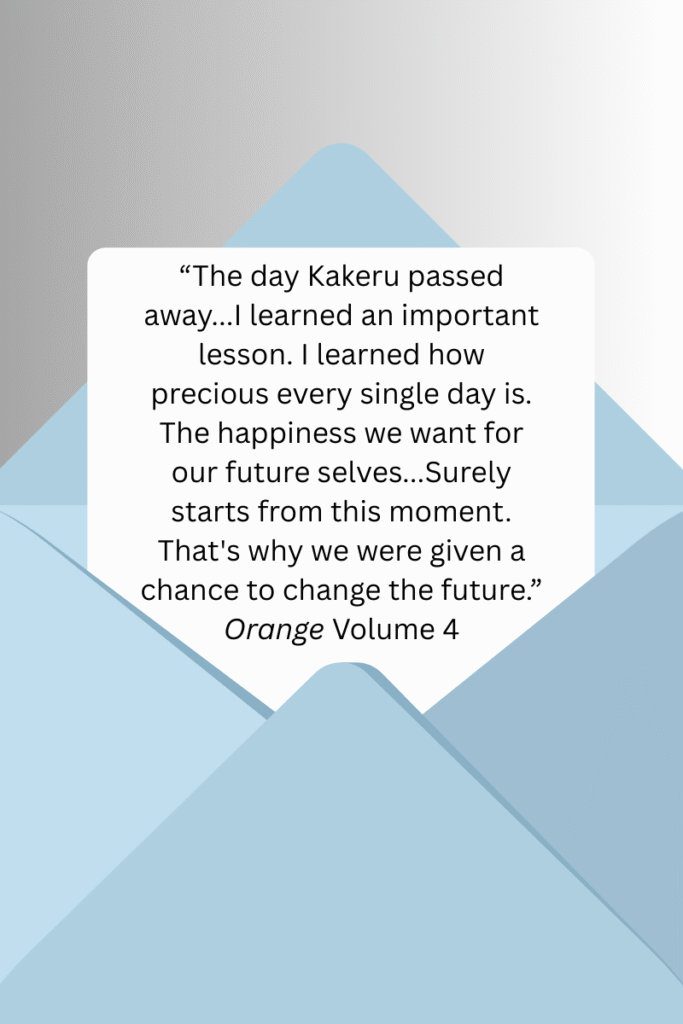
The title is a little perplexing. One of the reasons it’s called Orange is because, in Volume 1, Kakeru purchases Naho an orange juice and she drinks it when she is sad: “The orange juice was sweet, yet sour. The taste of sorrow.”
The only other mention of an orange happens in Volume 2 when Naho and her friends drink juice (she gets an orange juice).
The orange is a reoccurring symbol but honestly, I wish it was more prevalent.
For Further Reading: What to Read After Orange
This summer, I had the absolute honor and privilege of appearing in Finding God in Anime: Volume 3. Finding God in Anime is a series of devotionals written by otakus for otakus.
In Volume 2 of Finding God in Anime, E.N. Chaffin wrote a devotional titled “Every Life is Precious” connecting one of the major themes in Orange, the preciousness of life, to the Bible’s lessons on the topic (hint: every single life matters). I highly recommend checking out this devotional book (this is not sponsored—I’m actually not in this volume—and it’s very affordable, especially on the Kindle). It’s available here.
I have not read every devotional, but I love the heart that the creators, Moriah Jane and Laura A. Grace, have for Christ and reaching the otaku community.
And, of course, there are other sad manga out there, such as I Want to Eat Your Pancreas. I’ve written a full manga review, including a parent guide, on I Want to Eat Your Pancreas, and it’s available here.
For Further Viewing: What to Watch After Orange
After I finished watching the Orange anime for the first time, I watched Anohana: The Flower We Saw That Day. I haven’t reviewed this anime, either, and it’s been a year or two since I’ve seen it (I mention this because I don’t fully remember the content concerns) but it’s another sad anime about death and healing.
I personally liked Orange more, but it’s certainly another option.
There’s also an I Want to Eat Your Pancreas anime film, but I haven’t watched it yet.
Orange Review: Generalized Parent Guide of Volumes 1-5 by Ichigo Takano
I actually have detailed content guides for every volume of Orange. However, for this post, I have decided to summarize some of the main content concerns below. This is not everything, so check out my per volume reviews for more detailed content information: Orange Review Volume 1, Orange Review Volume 2, Orange Review Volume 3, Orange Review Volume 4, and Orange Review Volume 5.
Orange Review: Sex and Nudity
- The series is a romance series, so characters discuss crushes, feelings, and date one another.
- Characters wear short skirts throughout the series, and occasionally wear other revealing outfits like swimsuits, cheerleading outfits, or go shirtless (guys only).
- Characters hold hands and do other sweet, nonsexual things like this with the opposite sex.
- Words like “babe” and “hot” are used.
- Characters comment on the opposite sexes’ appearance and find them attractive without shirts/in cheerleader outfits/short shorts, etc.
- Guys go shirtless, and a female character pulls up the skirt of their friend in front of guys (she has shorts under her skirt).
- Some occasional innuendo.
- Occasional homosexual joke about two male close friends who are not dating.
- A character takes a bath in volume 3; not graphic.
- A character gets a kiss on the cheek from her crush.
- Characters discuss taking photos during sports day and later choose photos to keep. A guy selects a photo of his crush in a cheerleader outfit.
- A male character borrow’s his female friend’s clothes, including her skirt.
Orange Review: Violence and Gore/Frightening and Intense Scenes
- Suicide is both discussed and attempted.
- A character passes out unexpectedly.
- Friends bicker, argue, and occasionally “bonk” each other.
- Some shoving and slapping occur.
- A character is frequently bullied, and sometimes the bullying is physical.
- Characters get wounded while playing sports.
- Some bleeding.
Orange Review: Language
- Very occasional use of language like b*tch, d*mn, p*ssed, *ss/*sshole, h*ll, some blasphemous phrases, as well as other mild insults/phrases. For information on the language in an individual/specific volume, visit my review for each volume (linked above).
Orange Review: Spiritual Concerns
- Mention of spiritual language like coincidence, wish, etc.
- Characters pray, get fortunes, and visit shrines.
- A character considers what happens after death.
- Characters pray/ask for prayers (not to God).
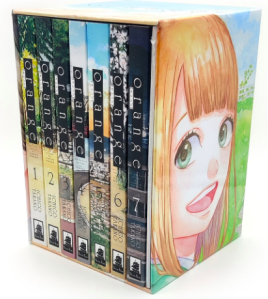
Photo of Orange Manga set from Crunchyroll Store under fair use for review/commentary. All rights belong to their respective owners.


3 Comments