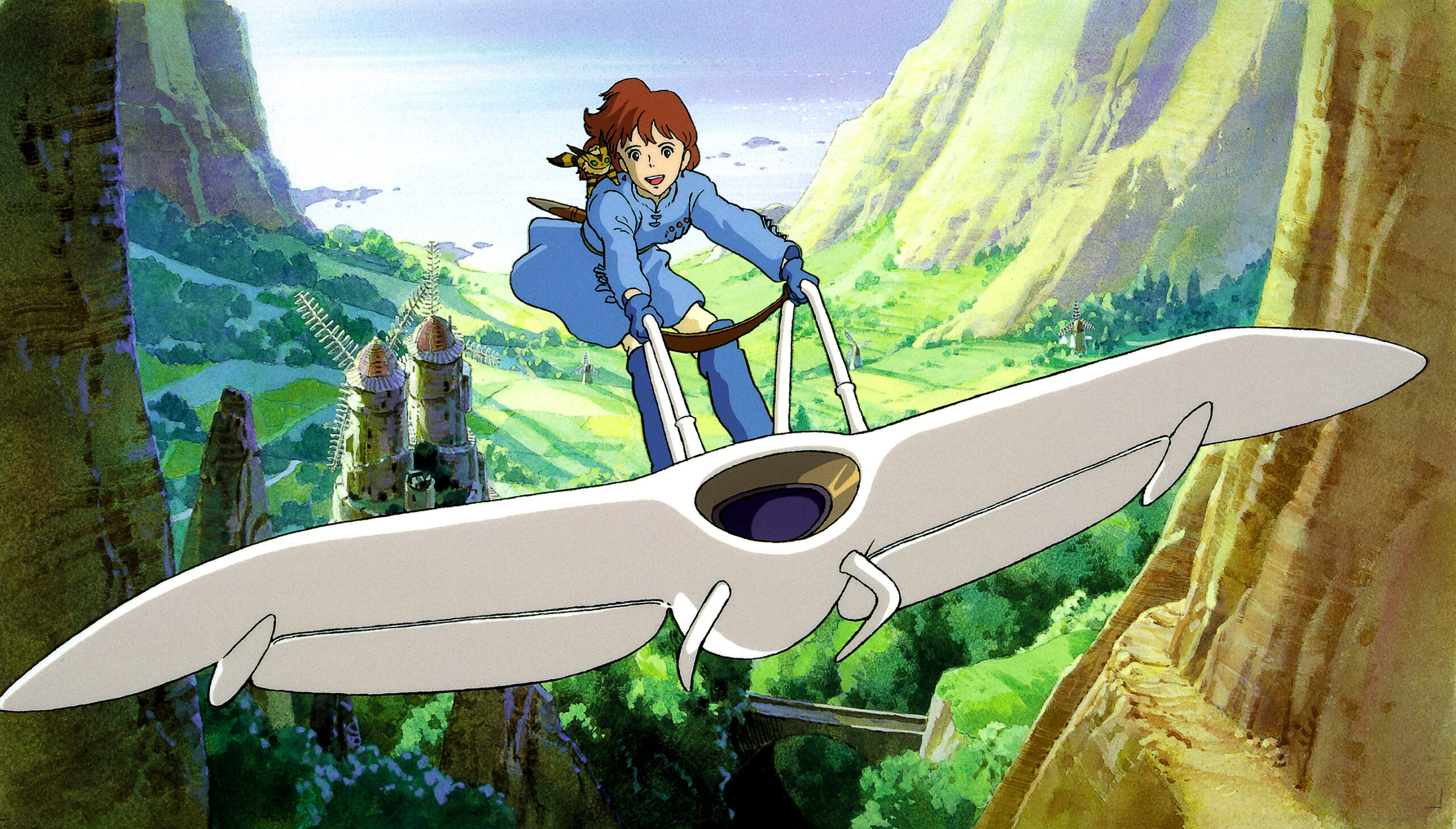
Nausicaä of the Valley of the Wind
In our review of Nausicaä of the Valley of the Wind, we will explore the (mostly) family-friendly Studio Ghibli anime film from a Christian perspective. Our review includes a parent guide.
Quick Facts
- Rating: PG for violence
- Year: 1984
- Director: Hayao Miyazaki
- Language/Version: Disney English Dub
- Genre: Sci-Fi / Dystopian / Fantasy
Quick Content Guide
Sex and Nudity: Practically none. Nausicaä opens her shirt, showing cleavage for a moment so her pet can go inside for safety. She unbuttons another girl’s shirt to check for wounds but quickly buttons it back up. Some affectionate touches.
Violence and Gore: Murder, wounds (including blood), plenty of fighting.
Frightening and Intense Scenes: Characters in danger, plenty of fighting. Nausicaä wounded. Multiple deaths.
Spirituality: Prophecy, fate, and other mythical ideas are present. The idea of evolution is mentioned.
Substance Abuse: None other than a toxic jungle/spores that poison people.
Language: “What the heck.” Some insults and unkind phrases.
See content guide below for more detail.
Age Recommendation: 11+ (Common Sense Media); 8 and up (us) with discernment and parental discretion/prescreening
See content guide below for more detail.
My Rating
Spoilers may appear throughout, but I am spoiler tagging any major Nausicaä spoilers.
Nausicaä of the Valley of the Wind Review: Synopsis
In a world where a toxic jungle threatens humanity and large bugs called Ohmus run free, Princess Nausicaä lives with her father in the Valley of the Wind. The valley protects its inhabitants from the toxic jungle, allowing them to live in peace under the leadership of Nausicaä’s father. However, when mysterious visitors from another kingdom, Tolmekia, arrive in the valley, they violently subdue Nausicaä’s people.
The Tolmekians plan to save the world from the threat of the jungle by using a legendary warrior. Their plan is risky, and not everyone is on board—plus, other people are after the legendary warrior too. What will become of the valley, and the world as a whole?
Nausicaä of the Valley of the Wind Christian Review
As I’ve mentioned time and time again, when people seek out kid-friendly anime suggestions, Studio Ghibli almost always shows up in the recommendations. In most cases, Studio Ghibli films are family-friendly for most (or all) ages, although a few deal with darker themes.
Nausicaä of the Valley of the Wind, also known as Kaze no tani no Naushika, is a sci-fi/dystopian film. Nausicaä‘s storyline is actually violent and somewhat dark, the stakes are high, and even murder appears, contrasting Nausicaä lighter Studio Ghibli films such as My Neighbor Totoro, Ponyo, Kiki’s Delivery Service, or The Secret World of Arrietty.
Of course, other Studio Ghibli films deal with darker themes and even violence, which is why parents need to be careful when navigating Studio Ghibli films.
Common Sense Media recommends Nausicaä of the Valley of the Wind for ages 11 and up, and that’s certainly a valid recommendation. I will explore the Nausicaä of the Valley of the Wind content from a Christian perspective in my parent guide at the bottom of this post.
The American Release of Nausicaä
Warriors of the Wind vs Nausicaä of the Valley of the Wind
There’s actually an interesting backstory regarding the Nausicaä of the Valley of the Wind release in the United States. It was originally cut significantly for American audiences and released as Warriors of the Wind.
According to Wikipedia and Gamerant, the changes were not acceptable to Studio Ghibli, and future American releases of Studio Ghibli films were not allowed to be cut.
But, why was Nausicaä cut in America and turned into Warriors of the Wind? There was concern about the marketability of the original film in the United States.
Disney later created an Nausicaä English dub and (via Buena Vista Home Entertainment) released a “more faithful English version of Nausicaä.“
Honestly, Warriors of the Wind seems to seriously miss what makes Nausicaä so special, so I’m glad that we eventually got the version we know and love today.
Christian Nausicaä of the Valley of the Wind Review: English Dub Cast
There are plenty of celebrity voice actors in the Nausicaä English dub.
Disney’s dubs of Studio Ghibli films often cast mainstream actors in the roles as opposed to hiring voice actors who make a career of anime dubbing. Sometimes, I’m not a huge fan of this choice, but I don’t recall having issues with Nausicaä’s dub, and honestly there are so many talented voice actors in it, including the fabulous Jodi Benson.
Nausicaä’s English dub stars Alison Lohman as the titular character. Supporting voices include Patrick Stewart as Lord Yupa, Uma Thurman as Kushana, and Shia LaBeouf as Asbel.
Other notable voices include Mark Hamill, Jodi Benson, Tress MacNeille, James Arnold Taylor, and Frank Welker.
A full list of the Nausicaä of the Valley of the Wind English dub cast is available here.
Nausicaä’s Character
Nausicaä, the protagonist, is the princess of the Valley of the Wind, and her people adore her. And it’s not hard to see why—she’s kindhearted, brave, and strong.
Nausicaä values all life—from the lives of her people to the lives of her enemies to even the lives of the insects who make life difficult for her people. As a child, she tried to protect an innocent insect from death. However, her people don’t think they can coexist with the insects, who often attack the humans.
*Spoiler* She even willingly invited Kushana, the princess of the Tolmekians, to escape a burning plane with her despite the fact that Kushana had recently taken Nausicaä hostage.
*Spoiler* But that’s not the only horrible thing Kushana and her people did to Nausicaä and her people. They invaded the Valley and murdered her bedridden father, too. Yet, Nausicaä has so much compassion that she saved Kushana from certain death.
But Nausicaä wasn’t always that way.
*Spoiler* In a moment of rage (right after she discovers her father has been murdered by the Tolmekians), she attacks her father’s murderers, killing multiple people in the process. It’s only due to the intervention of Lord Yupa—a treasured family friend—and his warnings that the Tolmekians will kill the people of the Valley—that she calms down enough to stop attacking the Tolmekians. But, his intervention wasn’t just verbal—it was physical, too. He steps in the middle of the fight, threatens her target himself, and takes a wound in his hand from Nausicaä. That’s serious commitment.
*Spoiler* After this, she becomes firmly pacifistic, regretting where her rage lead her, and calms her people down, determined to save as many lives as possible. She risks her life on multiple occasions, willingly stepping into danger, to save the lives of others.
*Spoiler* Nausicaä leaves revenge behind. Her choice echos Romans 12:19: “Do not take revenge, my dear friends, but leave room for God’s wrath, for it is written: ‘It is mine to avenge; I will repay,‘ says the Lord” (NIV). Nausicaä learns her lesson, and stops seeking revenge.
She even takes off her mask and inhales toxins in order to properly communicate with her people and give them instructions that will save their life.
Ultimately, Nausicaä is a solid character with strong morals.
Conflict in Nausicaä of the Valley of the Wind
Man Versus Man
One of the biggest conflicts in Nausicaä of the Valley of the Wind is not man versus nature—it’s actually man versus man. Nausicaä and her people live rather peacefully in their valley. There are certainly natural risks, but they’ve lived with these risks for a long time.
*Spoiler* The Tolmekians bring the Giant Warrior, a figure of legend who could be the solution to the toxicity of the jungle, to the Valley—but that’s not all the Tolmekians bring with them. They decide to make the valley their home base, kill Nausicaä’s father, and assert their dominance on the people of the valley—something they didn’t ask for or even cause.
The conflict comes to the valley out of the blue and the inhabitants become the victims of a war they didn’t ask to be a part of. Even the Pejitans, another group of humans, sets their sights on the valley.
*Spoiler* The Pejitans initially seem like decent people, but we quickly learn that they plan to eradicate Nausicaä’s home.
Man Versus Nature
Nature is at the center of Nausicaä. After man versus man, man versus nature would definitely be the secondary conflict in Nausicaä. The toxic jungle is a major concern for the humans in the world. Without masks, they would die.
Miyazaki certainly emphasizes pollution in Nausicaä, and Nausicaä isn’t the only Studio Ghibli film that emphasizes pollution (Ponyo, for example, has Fijimoto complaining about the pollution of the ocean).
Pollution is blamed on the humans, and there are certainly both environmental and ecological subtexts in Miyazaki’s narrative.
The warnings about the negative effects of pollution in Nausicaä do not overshadow the hope at the end of the film (when the world starts to return to a healthy state).
As Fandom summarizes:
The film ends with fragments of a future where people and insects live in peace with each other. The toxic jungle eventually becomes cleaner and the world is becoming normal again. The Valley itself begins to prosper and over time the land itself begins to grow again.
Though the toxic jungle is a major concern, it isn’t the only natural problem in Nausicaä.
The other problem is the Ohmus, large bug-like creatures that attack humans. They turn red when they’re angry and cause havoc for the humans. However, Nausicaä isn’t frightened of the Ohmus. From a young age, she showed a care of them and didn’t want them hurt.
*Spoiler* The rest of the humans don’t view the natural threats so lightly. The Pejitans capture an Ohmu baby to bait the adult Ohmus into the valley, and it’s Nausicaä who not only saves the baby but saves the others, too. The Ohmus even save her from certain death.
*Spoiler* Nausicaä’s kindness and care for all life, human and insect, saves the day.
Lack of Accountability in Nausicaä of the Valley of the Wind *Spoiler*
By the end of the film, it feels like there’s no accountability for the evil actions of others. The Tolmekians murdered the king of the Valley of the Wind, attacked Nausicaä’s people, harmed the Pejitans (and ultimately caused the death of the Pejite princess, too) and they don’t really face consequences.
The Pejitans, who cause just as much havoc, also don’t face many consequences. Of course, there are plenty of good Pejitans (Asbel, his sister Lastelle, their mother, and pretty much every surviving woman and child), but the Pejitans who caused havoc and did evil? No true consequences.
Where is the justice? Forgiveness is important, but these people caused so much chaos and death, and the leaders certainly deserve to face some sort of consequence. They don’t really have a city to live in anymore because it’s destroyed, but that’s about it.
So many innocent people died for naught.
Nausicaä values life and forgiveness, so perhaps the film is trying to echo Nausicaä’s worldview, an idea shared by others, too.
As Christians, we know that Christ did die on the cross for the sins of the world, so perhaps Nausicaä’s lack of justice is a reminder for us to forgive others for their trespasses and leave the justice to God. This is a beautiful reminder.
Magic and Spirituality in Nausicaä of the Valley of the Wind
Nausicaä of the Valley of the Wind doesn’t have magic, but the story does contain its own folklore and belief system. There’s fulfilled prophecy, mention of evolution, and even prayer to a god. The dialogue in the Disney English dub doesn’t specify what god Nausicaä prays to, but the subtitles mention a god of the wind. Either way, it’s clearly not the God of the Bible.
Obaba is a stereotypical old witch/spiritual woman which is a super common trope in fantasy films. At one point, she is in front of a cauldron, though the contents of said cauldron are unclear. No spells or potions seem to exist, and she even tastes the item in the cauldron, so it could be food—it just wasn’t clear to me what it actually was.
Obaba believes in a prophecy and speaks about people’s destiny/fates. Obaba can even sense rage in a rather spiritual sense.
She doesn’t have a ton of screen time in comparison to Nausicaä, but her screen time certainly involves spirituality.
The film uses these elements for lore purposes and story development.
Obaba and the King
Despite Obaba being a rather…peculiar character (and her spirituality is not something I condone), she does have her positive traits.
She is very close with the King of the Valley, Nausicaä’s father. We don’t get to know the king very well as he has very little screen time (even less than Obaba) but we do know that he cares a lot about his people. When the Tolmekians attack the Valley, the king tries to get Obaba to hide herself, which reveals his care for Obaba, and ultimately the people under his care. However, Obaba refuses to leave the king’s side, which shows immense loyalty.
FAQs for Nausicaä of the Valley of the Wind Christian Review
What is Nausicaä of the Valley of the Wind about?
Nausicaä of the Valley of the Wind follows Nausicaä, the princess of the Valley of the Wind, in a post-apocalyptic world where the air is filled with toxic spores. When her home is invaded by another country, she must save her people—and the environment.
Is Nausicaä of the Valley of the Wind family-friendly?
Overall, Nausicaä of the Valley of the Wind is family-friendly for older children and adults. Although rated PG, the film deals with death, murder, and war, contrasting it with more lighthearted Studio Ghibli films like Ponyo or The Secret World of Arrietty.
Can Christians watch Nausicaä of the Valley of the Wind?
Some Christians may be able to watch Nausicaä of the Valley of the Wind with discernment.
However, the film is not for everyone. Nausicaä contains dark themes such as war, death, and murder. The anime film also contains spiritual content that some Christians may want to stay away from.
If you do decide to watch it, be sure to watch it with a Christian lens and use wisdom and discernment.
Is there a sequel to Nausicaä of the Valley of the Wind?
No, there is not a sequel to Nausicaä of the Valley of the Wind.
However, the story is based on the manga by Hayao Miyazaki which does expand significantly upon the anime film, so there is more to Nausicaä’s story than the film covers.
What are some films like Nausicaä of the Valley of the Wind?
Other films like Nausicaä of the Valley of the Wind would be Ponyo (also deals a bit with environmentalism), The Secret World of Arrietty, and other Studio Ghibli films.
No two Studio Ghibli films are truly alike, but they do have some similarities.
What age is Nausicaä of the Valley of the Wind good for?
Nausicaä of the Valley of the Wind is rated PG. Personally, I’d recommend it for older kids, maybe 8 and up (at minimum), due to the more mature themes.
Additionally, the spiritual content may be off-putting to parents.
If your children are particularly sensitive to themes of war, destruction, murder, or characters in danger, you might want to wait until they are older. Common Sense Media, for example, rates the anime for ages 11+.
Conclusion: Nausicaä of the Valley of the Wind Review
Nausicaä of the Valley of the Wind is a Studio Ghibli film with a very strong female lead (who values life) and an interesting storyline. However, the spiritual concepts/mythology and mention of evolution may raise red flags for some Christian anime viewers, and understandably so.
Additionally, some of the themes are a bit darker than other Studio Ghibli films; Nausicaä deals with murder, death, war, and violence in a post-apocalyptic world where humans are trying to survive.
Can Christians watch Nausicaä of the Valley of the Wind? Yes (for mature Christians with discernment and wisdom).
Personally, I’d recommend younger kids stay away from the film as it might be a bit intense for them. My age recommendation would be 8 and up at minimum, but I recommend prescreening first since Common Sense Media recommends the anime film for ages 11+.
Nausicaä of the Valley of the Wind Content Guide
Some quotations may be stylistic; others may be direct quotes.
Sexual Content and Nudity
- Shadow figure shown in intro; no clothes. Not graphic. Shown on a few occasions.
- Nausicaä and Lord Yupa hug. His pouch moves; he has a little fox squirrel in it.
- Nausicaä’s outfit is short.
- Nausicaä saves a girl from the plane wreckage. She starts to unbutton her dress (likely to check for wounds).
- Lord Yupa holds Nausicaä to comfort her.
- Nausicaä opens her shirt to put her pet inside. Shows cleavage. Brief.
- Kushana shows us that she has no arm and claims that “whoever becomes her husband will see worse than that.”
- A girl takes off her dress and is shown in her undershirt. She does this so she can switch places with Nausicaä and help her escape.
- Asbel holding Nausicaä’s waist for support.
- A camera angle emphasizes Nausicaä’s breasts.
- Asbel picks Nausicaä up and spins her.
Language
- Old hag.
- Fools.
- Weasel.
- “You look lie a scared fox squirrel.”
- You savages.
- That monster.
- Shut up.
- What the heck.
- Idiot/idiots.
- What in the world.
- Thank God.
- Thank goodness.
- Good Lord.
- Beat the tar out of.
- This is suicide.
- Foolish.
- Cute.
- Don’t be stupid.
Violence/Gore
- Shooting, explosions, fire, etc occur throughout the anime film.
- Nausicaä finds a dead bug shell and takes off one of its eye lenses.
- Nausicaä carries a gun: shoots a signal, uses it to set a fire, etc.
- Gunshots occur on multiple occasions.
- Nausicaä stuns a bug with grenades and tells it to go back to the jungle.
- Offscreen, Lord Yupa saves a baby fox squirrel with his gun.
- A animal bites Nausicaä and draws blood. She keeps trying to calm it down and it calms down and licks where it bit her, and then becomes her pet.
- Bones are visible in the desert.
- Angry insects appear. Shooting.
- Tolmekian air ships arrive in the Valley. They brought tanks and weapons.
- *Spoiler* A group of Tolmekians come into the king’s chambers, and there is shooting. Nausicaä runs and sees her father taken out, lying on the floor.
- *Spoiler* Nausicaä attacks the Tolmekian because they killed her father. She is angry, and she takes out a lot of people. Lord Yupa steps in, stops Nausicaä’s sword with his hand and threatens the Tolmekian himself. Nausicaä’s sword is embedded in Lord Yupa’s hand and there is blood.
- Blood drips from a sword.
- Blood on the wall.
- Dead bodies and blood.
- A gun ship shoots the Tolmekians’ ship which is also carrying Nausicaä and her loved ones. Fire and explosions occur.
- A character points a gun at others.
- A character shoots a gun at the insects.
- Nausicaä’s gets mad and yells at the Pejitans. She pushes/slaps a guy’s hand away, grabs him and shakes him.
- Asbel stands up for Nausicaä, takes a gun from someone and shoots it, trying to use it to help Nausicaä against his own people. He gets knocked out and Nausicaä is captured.
- The villagers in the Valley attack the Tolmekians. Gunfire and stealing a tank occur.
- The Pejite ship is boarded by the Tolmekians (there was gunfire). Fighting with swords and guns. The Tolmekians want to kill all the Pejitans.
- Nausicaä is shot at.
- A character takes out a ship (this happens a lot actually).
- A character attacks his enemies with swords.
- *Spoiler* Nausicaä gets shot in two places. There is blood.
- An insect bleeds blue blood.
- People shoot at the insects.
- Nausicaä has a gun and threatens her enemies, and even shoots the gun.
- *Spoiler* The Giant Warrior attacks the insects before quickly dying.
- A character has “chosen the bloody path.”
Frightening Scenes
- Skulls and dead things shown.
- The insects, known as Ohmus, are often large and dangerous.
- The world appears dead and is consumed by a toxic jungle.
- Scary Giant Warriors shown in intro.
- Weapons appear and are used throughout the anime.
- Nausicaä has to save someone from an angry Ohmu.
- An airship crashes and burns. People die including a princess named Lastel who was wounded in the crash.
- The Tolmekians attack the Valley, destroy things, and cause panic.
- Obaba says not to touch the toxic jungle and offers a warning. There’s a dark flashback.
- A gunship attacks a group of ships that Nausicaä and her friends are on.
- There are explosions, gunfights, and ships are taken down and they burn.
- Nausicaä and her friends end up in a bug’s nest. Her friends thought they were going to die due to plane issues.
- A character almost gets eaten by bug and falls off a cliff. Nausicaä saves him. Both get attacked by the insect and they crash.
- Nausicaä gets knocked out and she and another character are stuck in quicksand. They sink.
- In a flashback, young Nausicaä tries to save a baby insect from death. There are creepy hands in said flashback, and poor Nausicaä isn’t able to save the bug.
- The spores infect trees in the Valley. The Valley’s people panic. Might be intense for some younger viewers.
- The entire city of Pejite is destroyed. Smoke and bugs shown.
- A Pejite ship gets attacked, so many innocents are in danger. Shooting occurs.
- A storm tears a ship apart.
- *Spoiler* Nausicaä and others crash. Nausicaä bleeds/is injured and the others are knocked out.
- *Spoiler* Nausicaä gets pushed into the acid lake. She screams in pain.
- The insects get very angry and threaten the humans’ lives.
- *Spoiler* Nausicaä gets flung in the air after putting herself in the path of the insect stampede.
- Destruction, crumbling buildings falling on people, etc. occur.
- *Spoiler* The Giant Warrior is very creepy/scary; he falls apart and eventually dies and turns into bones.
- *Spoiler* Nausicaä appears dead. Her people think she gave her life to save the Valley, but then the insects save her.
Spirituality/Magic/Mythological
- Mention of fate/destiny on multiple occasions.
- Humanlike character shown with wings.
- Nausicaä is good with her glider, and it’s mentioned that she “knows how to read the wind well.”
- Characters believe that “fair winds will favor” a new baby if a specific character names the child.
- Blessings.
- Obaba looks and acts like a witch, even using a cauldron like item (for food? potions? It’s unclear).
- Mention of Lord Yupa’s destiny: Finding the person who can “restore mankind’s connection with the earth” as well as “guiding the people to a land of purity.” Lord Yupa, however, desires to know if “mankind is fated to be swallowed up or if there’s hope.”
- Tapestry mentioning a prophecy/telling the story of a prophecy.
- Something in the wind…it’s a storm/ship.
- Mention of luck or related on one or more occasions.
- Some visions/flashbacks occur on multiple occasions.
- Mention of “Mankind is destined to go extinct.”
- Nausicaä prays to a god for protection (subtitles specify she is praying to the god of the wind, but she doesn’t say that).
- The wind stops blowing, and Obaba acts weird, asks to go outside (remember she’s spiritual/witchy in my opinion) and claims “the air is filled with anger.”
- Apparently, the Ohmus’ anger “reflects the anger of the earth” and when they aren’t angry anymore “the rage” has “left the atmosphere.”
- It’s a miracle.
- *Spoiler* Prophecy fulfilled.
- Insect charm mentioned/used.
- Nausicaä is apparently “bewitched by the insects.”
- Allegedly, “Trees evolved to purify the earth of all the pollution the humans made” and “The insects evolved to guard this place.”
- Characters hail their princess.
Cover Photo Credit: Still from Nausicaä of the Valley of the Wind Studio Ghibli Film from GKids Press. Under fair use for review/commentary/education/criticism. All rights retained by owners.

Whoever writes these reviews is a GENIUS! They are so detailed and helpful. I am not a big anime fan, but I have become moreso because of my daughter, Emma.
I watched the trailer for this and I am definitely interested in watching it, with the kind of anticipation I had before getting to see the Lord of the Rings or Hobbit movies. I hope to see it soon. It made me think of the 1980s when I was watching HeMan, Vultron, and GI Joe; as well as when I played Dragon’s Lair at the arcade.
The reviewer is so detailed, I am just blown away by its comprehensive nature. What a gifted writer.