Barbie and the Magic of the Pegasus Christian Review: A New Look At the Nostalgic Barbie Film
In this Barbie and the Magic of the Pegasus review, we will explore the film from a Christian perspective. We also provide a Barbie and the Magic of the Pegasus parent guide.
Quick Facts
- Date: 2005
- Rating: TV-Y
- Runtime: 1h 23m
- Starring: Kelly Sheridan, Mark Hildreth, and Kathleen Barr
Quick Parent Guide
- Language: Some mild insults, name-calling, and sarcasm.
- Sex and Nudity: None, just some romantic elements.
- Violence and Gore: Mild.
- Frightening and Intense Scenes: Mild.
- Spiritual Concerns: Magic and fantasy elements.
My Rating
For more information and the official trailer, click here to go to the IMDB page.
Synopsis: What is Barbie and the Magic of the Pegasus About?
In Barbie and the Magic of the Pegasus, Barbie stars as Annika, a princess who just wants to skate on the frozen lakes surrounding her home. After her overprotective parents ban her from doing so, she sneaks out, determined not to let them keep her locked away. What she doesn’t know is her parents are trying to protect her from the evil wizard Wenlock, who intends to make her his wife.
After Wenlock turns her parents into stone, it’s up to Annika and her new friends—a Pegasus named Brietta, a polar bear cub named Shiver, and a blacksmith named Aidan—to find the Wand of Light, which is their only hope to undo Wenlock’s spell. With only three days to defeat Wenlock, the fate of her family and kingdom rests in her hands.
Christian Review of Barbie and the Magic of the Pegasus: A Nostalgic Barbie Adventure
There’s something so nostalgic about popping a Barbie movie into your DVD player and being transported into another world for a few hours. It’s nostalgia and comfort wrapped into an hour or so of run time. Although the film is 20 years old, the hope and wonder of this film withstand the test of time.
Barbie and the Magic of the Pegasus isn’t my all time favorite Barbie movie, but it’s one of my favorites. The story is exciting, the pegasus riding is epic, and the prince figure, Aidan, is an unlikely hero with a redemptive backstory who helps Annika save the kingdom.
There’s plenty of magic—it’s literally in the title—but the story is focused on saving the ones you love, character growth, hope, and making things right with the people you’ve wronged.
As I’ve grown older, I realize that characters like Annika aren’t perfect. They have character flaws, which deserve some attention from a discernment viewpoint (especially from a parent’s perspective). Modeling good behavior is important when raising Godly children, and this shows through strong character arcs in this film. Both Annika and Aidan grow significantly from the start of the movie. Thankfully, at the the end of the film, both Annika and Aidan atone for their mistakes.
In my review of Barbie and the Magic of the Pegasus, we will explore the film from a Christian lens.
Barbie and the Magic of the Pegasus Cast
In terms of casting, you can’t beat the main actors. Kelly Sheridan, the voice of Barbie in (most) of the franchise’s films until 2015, stars as Princess Annika. Shiver, Annika’s mother, and The Cloud Queen are just three of the characters played by Kathleen Barr. Barr is another predominant voice actress in Barbie films. She often plays villains, like Eris and Laverna (from the two Mermaid Tale films and Fairytopia, respectively). In this film, she plays many good characters, showcasing the versatility of her range.
Mark Hildreth was one of the top Barbie prince voices in the early days of Barbie films. He has played characters like Stefan, Daniel, and Dominick from Barbie as Rapunzel, Barbie of Swan Lake, and Barbie as the Princess and the Pauper, respectively. In Magic of the Pegasus, he plays Aidan.
The Story’s Set-Up
The first part of the film introduces the characters and the conflict. Though Barbie is often kind, thoughtful, valiant, brave, and moral, she doesn’t always start that way. Annika, Barbie’s character in Barbie and the Magic of the Pegasus, starts out with many problematic character traits. The following section introduces Annika at the beginning of the story. (Thankfully, she becomes a better person as the film progresses).
Annika’s Disobedience and Attitude in Barbie and the Magic of the Pegasus
At the very beginning of the film, we discover that Annika sneaks out without permission often. She loves to skate, so she sneaks out to do so. This causes friction in her relationship with her parents and trouble for herself, her parents, and her kingdom.
Her disobedience makes it easy for Wenlock to find her, and he turns all the townspeople, and her family, into stone.
Annika’s actions are foolish, to be sure, but it’s more understandable in light of her age. She’s a teenager, so when her parents approach her after she sneaks out for ice skating, she dramatically accuses them of ruining her life and is very disrespectful while doing so.
The best case scenario would have been that her parents explained everything to Annika, so she understood why they were so protective. This could have avoided the entire Wenlock situation by guiding her towards caution because she understood the gravity of the situation. However, her actions are still wrong, and they lead to more consequences than just parental disapproval when Wenlock harms her people. As the plot progresses, Annika learns why her parents are so protective.
Making Things Right
At the end, she apologizes for what she said to her parents and for leaving the palace without permission. Her parents even admit their mistakes, realizing that they should have explained everything beforehand.
I appreciate this example because not only is Annika making things right with her parents, but her parents are admitting their mistakes, too.
Jesus Christ was the only perfect human. Sometimes, as adults, we can lose sight of the need to make things right with those who are younger than us or under our authority, and it’s a beautiful reminder that we all need to make things right when we mess up, regardless of whether we are children or parents.
Wenlock’s Womanizing: A Problematic Villain
Wenlock, as the antagonist, has many issues from a Christian perspective, but one of the biggest is his obsession with women. He calls Annika “gorgeous” and asks her where she has been hiding. He has married three times in the past, and wants to marry Annika at the beginning of the movie.
His main motivation is getting Annika as his wife, and unfortunately, he tries to coerce her into marriage by turning the entire village and her parents into stone. His desire to make Annika his fourth wife may cause some Christian parents to pause, but thankfully the film’s content stays within its age demographic.
At the end of the film, Wenlock’s first three wives give him a taste of his own medicine by ordering him around. However, 1 Peter 3:9 (NIV) says, “Do not repay evil with evil or insult with insult. On the contrary, repay evil with blessing, because to this you were called so that you may inherit a blessing.” Unfortunately, his three wives do not take this to heart, and instead seem more intent on revenge than forgiveness.
The Role of Magic in Barbie and the Magic of the Pegasus
Most Barbie movies involve magic in some capacity, and Barbie and the Magic of the Pegasus is no exception. Throughout the film, both heroes and villains use magic.
Examples of Magic in Barbie the Magic of the Pegasus
- Wenlock, a wizard, stole his staff from a sorcerer and uses it to turn Brietta into a pegasus, the townspeople and Annika’s parents into stone, a trader into a doormat, and his wives into ugly creatures. Magic helps him get what he wants, and he doesn’t hesitate to use it to hurt others.
- The sunrise and sunset are painted by three little girls who live with the Cloud Queen. It’s whimsical, and the girls try to halt the sunset as much as possible to give Annika more time.
- In order to save her family, Annika has to go after the “Wand of Light” which is created by a “measure of courage, a ring of love, and a gem of ice lit by hope’s eternal flame.” To get the measure of courage, Annika tricks Ollie, a giant troll-like creature, into giving them the chance to escape. She tries to manipulate him in order to escape, and it does work, but it leaves Ollie trapped with a caved-in house. Afterwards, the ribbon she used as a rope magically turns into the staff, the first part of the Wand of Light. For the second item, they get a special crystal, and for the last part, they use an item owned by Brietta. After the Wand of Light is assembled (Aidan physically creates it with his skills as a blacksmith), Annika uses it to turn Brietta back into a human.
- Annika tries to use the wand to destroy Wenlock, but she is unable to do so because the wand will not work when used in anger. Wenlock continues to use magic to fight the protagonists and cause havoc until eventually, Annika is able to use the wand to undo all of Wenlock’s magic.
Why Christians May be Wary
All this magic resembles fantasy magic, but the use of words like spell, wizard, sorcerer, and wand, among others, may make some Christians wary of the film, and that’s perfectly understandable.
The Wand of Light: “Good” vs. Evil Magic
Biblically, we know that there is no such thing as “good magic” or “light magic.” Magic is a sin, and it calls upon powers from the enemy in order to accomplish things, which is a definitive sin. When it comes to fictional portrayals of magic, however, Christians are split: some view it as a harmless plot device when it doesn’t resemble real world occultism, viewing it as a gray area issue; others avoid any representation of magic. It’s up to each family to decide, with the guidance of The Holy Spirit, what their family’s stance on fictional magic is.
In the movie, the Wand of Light is portrayed as the alternative to Wenlock’s evil magic. Annika is able to restore her sister to a human, but when she starts trying to order the Wand of Light to destroy Wenlock, it doesn’t work because cannot be used in anger.
So, the wand, in the context of the story, doesn’t work when you try to use it for evil.
As Christians, we know our power comes from The Holy Spirit, not ourselves. God is the source of all goodness and love. He doesn’t give us “magic” but He does assist us when we need it. Romans 8:26 (NIV) says, “In the same way, the Spirit helps us in our weakness. We do not know what we ought to pray for, but the Spirit himself intercedes for us through wordless groans.” When approaching magic in fictional stories like this one, it’s important to remind our children about what the Bible says about magic, and how we need to rely on God for our every need, not some false power stemmed from a desire to control things ourselves.
Aidan and The Prodigal Son Parallel
Believe it or not, Barbie movies can remind us of biblical parallels. In Barbie and the Magic of the Pegasus, Aidan’s story reminds me of The Prodigal Son.
Aidan, Annika’s love interest, once gambled his parents’ money, losing everything. Ashamed of his choice and unable to believe that they could forgive him for his mistake, he ran away.
When we first meet Aidan, he desires to make amends with his parents and follows Annika on her journey, hoping for a second chance.
At the end of the film, we see Aidan returning home, hoping to restore his relationship with his parents. His father embraces him, and Aidan apologizes to them. Aidan experiences his parents’ unconditional love, and restores their relationship.
Sound familiar? This echoes one of Jesus’ most famous parables.
The Prodigal Son: A Parable in Luke 15
Luke 15:11-32 details the story of The Prodigal Son. In the story, a son begs for his inheritance early (meaning before his father is dead). After his father grants the inheritance, the son leaves and spends it recklessly. After spending everything, he becomes hungry and realizes that his father’s servants have their needs met and makes a resolution: “I will set out and go back to my father and say to him: Father, I have sinned against heaven and against you. I am no longer worthy to be called your son; make me like one of your hired servants.’ So he got up and went to his father…” (Luke 15:18-20 NIV).
How does the father in the story respond? Here is his reaction in verses 20 through 24:
“But while he was still a long way off, his father saw him and was filled with compassion for him; he ran to his son, threw his arms around him and kissed him.
21 “The son said to him, ‘Father, I have sinned against heaven and against you. I am no longer worthy to be called your son.’
22 “But the father said to his servants, ‘Quick! Bring the best robe and put it on him. Put a ring on his finger and sandals on his feet. 23 Bring the fattened calf and kill it. Let’s have a feast and celebrate. 24 For this son of mine was dead and is alive again; he was lost and is found.’ So they began to celebrate. (Luke 15:20-24 NIV).
The prodigal son’s father embraces him, forgives him, welcomes him as his son, celebrating his homecoming with a huge party. The prodigal son represents those of us who stray away from our Heavenly Father, and the father in the story represents God our Father, a God filled with forgiveness and love. When we return to Him, He welcomes us, even if we’ve made mistakes.
Reflections on the Parallel
I’m not sure if Mattel intentionally paralleled the prodigal son or not, but regardless, it’s a great parallel and reminds me of our Heavenly Father who loves us unconditionally.
Also, although Annika didn’t squander her inheritance, she still harmed her relationship with her parents: she snuck out, accused them of ruining her life, and indirectly caused them to be turned to stone.
However, she acknowledges that she messed up and desires a second chance. Aidan understood this intimately—his own story of reconciliation is the reason he helps her seek the Wand of Light. Of course, at the end of the film, Annika makes things right with her parents and they welcomed her back. Annika is forgiven and loved.
Sacrifice and Heroism in Barbie and the Magic of the Pegasus
Throughout Barbie and the Magic of the Pegasus, characters make sacrifices for others. After Wenlock turns Annika’s family into stone, Brietta comes and saves her, which is a very risky move considering Wenlock is a powerful wizard and the one who turned her into a pegasus in the first place. However, her family is important to her, and she flies Annika to safety.
Annika is also sacrificial; she dives headfirst into unknown danger in order to save Shiver, nearly becoming stew in the process.
Then, we have the sacrifice of treasured possessions. When a trader refuses to share essential information (unless he gets a bribe), Annika willingly exchanges her ice skates—arguably very special to her, as they make it possible to do her favorite pastime. She exchanges them not just because she needs information, but also to save Aidan from giving up his sword, which is what the trader was initially eying. Aidan made the sword himself, and Annika willingly sacrificed her skates so Aidan could keep it.
However, after the protagonists get most of the items for the Wand of Light, it’s up to Aidan to put it together, and to do that, he needs a ring of love, which he plans to make out of his sword. This time Brietta steps in, and instead of letting him use his sword, she offers her crown—the only connection she has to her former life as a human princess, which makes it very precious to her.
Aidan’s Heroism and the Role of Male Characters
This brings us to an important point. Unlike a lot of modern Barbie films where the focus is on girl power and the male characters are rather ineffectual, Barbie and the Magic of the Pegasus isn’t like that. The heroines are capable and brave; Aidan is heroic and competent. Aidan is Annika’s companion for the majority of her adventure to find the Wand of Light and even fights a griffin in order to protect Annika and give her the chance to stop Wenlock.
It’s refreshing to have a strong male lead because modern Barbie movies often portray Barbie’s male counterpart as ignorant, incapable, dumb, and relatively useless. Sometimes Barbie even saves him. Not that girls cannot help their spouses or boyfriends, but when I watch a Barbie movie, I want him to be heroic and capable of protecting the woman he loves. And thankfully, Aidan is one of those treasured early Barbie princes who is actually capable.
After Wenlock buries Annika under an avalanche of snow, Aidan appears. He had left the party officially but somehow comes back at the right moment.
Oddly enough, Brietta stands around and doesn’t help them unbury her. Is it because she isn’t used to being human yet? Because she’s a princess? I don’t know, but it strikes me as odd, because if my sister were buried under snow and the time was ticking, we’d need all the help we could get to save her.
After Aidan saves Annika, he holds her and regrets leaving her. He stays by her side and helps her save her family.
Because of Aidan and Brietta (and a bit of help from Wenlock’s three wives), Annika is able to stop Wenlock and achieve her goals. It’s refreshing to have a competent male character.
The Theme of Hope in Barbie and the Magic of the Pegasus
One prominent truth in Barbie and the Magic of the Pegasus is that there is always hope. Just as the sun rises and is a symbol of hope, no matter what, Annika knows that there is hope.
Annika holds onto hope regardless of how difficult things become; she refuses to quit, even when it’s hard. At the end of the film, Brietta acknowledges that Annika never gave up hope.
Later, Aidan says he almost lost hope, and then acknowledges Annika’s role in his own hope.
As believers, we have hope of eternal life, and hold fast to this hope. Romans 8:23-25 (NLT) reminds us:
And we believers also groan, even though we have the Holy Spirit within us as a foretaste of future glory, for we long for our bodies to be released from sin and suffering. We, too, wait with eager hope for the day when God will give us our full rights as his adopted children, including the new bodies he has promised us. We were given this hope when we were saved. (If we already have something, we don’t need to hope for it. But if we look forward to something we don’t yet have, we must wait patiently and confidently.)
We have hope because of Christ’s sacrifice on the cross for us.
Possibly the Worst Animal Sidekick: Shiver
Barbie films always seem to need a sidekick animal, and one of the worst ones is, without a doubt, Shiver. Though she’s cute, she’s not only useless but causes more issues. When Annika and Aidan are in the ice caverns getting gems, they know that they cannot take anything from greed, only what they need. Both take one, and are fine. Shiver, on the other hand, is obsessed with shiny things and tries to take them, causing the caverns to collapse.
She also falls into Ollie’s soup pot, and although it turns out okay in the end and helps them get the measure of courage, she still got herself into danger.
I don’t understand why Annika needed to take the bear cub with her. Granted, she did find Shiver alone in a snowdrift earlier that day, so maybe she feared the cub would starve on its own. However, Shiver doesn’t really contribute; she is extra cargo weight, causes problems, and is plain annoying.
All in all, Annika could have easily left the cub at the palace, but instead, the viewers are subjected to the bear tagging alone the entire time.
FAQs About Barbie and the Magic of the Pegasus
Where can I watch Barbie and the Magic of the Pegasus full movie?
You can watch Barbie and the Magic of the Pegasus full movie (as of November 2025) by purchasing the DVD. You can also rent or buy it digitally on a service like Apple or Amazon. Here’s a list of where Barbie and the Magic of the Pegasus is currently available.
What are some similar movies to Barbie and the Magic of the Pegasus?
Is Barbie and the Magic of the Pegasus safe for Christians?
Barbie and the Magic of the Pegasus can be safe for Christian families, with discernment. I hesitate to give a blanket yes or no on whether Barbie: Magic of the Pegasus is safe for Christians. My goal is to give you the resources and knowledge necessary to make an informed decision for your family.
Conclusion: A Christian Perspective on Barbie and the Magic of the Pegasus
Although Barbie and the Magic of the Pegasus emphasizes virtues like kindness, hope, forgiveness, perseverance, and sacrifice, the film also features values that may cause Christian parents to pause, such as their portrayal of magic, use of fantasy creatures like pegasi and griffins, and Annika’s disobedient and disrespectful behavior at the beginning of the film.
Of course, Annika makes things right by the end (as do other characters) but the presence of these elements might cause some parents to avoid this film. For others, it might offer a great opportunity to teach their children to think critically about the content of the film and teach them the tools necessary to stand firm in their beliefs. There are definitely faith-based lessons in Barbie movies, but they’re often surface level.
Either way, it’s important that parents follow the conviction of The Holy Spirit and ensure they watch out for their children and the potential messages their kids may be exposed to.
Christian Parent Guide for Barbie and the Magic of the Pegasus
Violence, Gore, and Frightening/Intense Scenes in Barbie and the Magic of the Pegasus
- Annika’s parents grow concerned when Annika brings home a polar bear cub, Shiver, because they worry the bear might have germs or hurt her.
- Wenlock turns people into stone, including innocent townspeople and Annika’s parents.
- A trader tells a story where a man buried a gem and protected a chest with magic, then turned to ashes.
- Annika nearly falls, but Aidan saves her.
- Ollie (a giant) tries to make stew with Annika and Shiver as the main course, but he ends up destroying his house instead.
- Shiver falls off Brietta, and Aidan saves her
- Wenlock pursues Brietta and Annika and both girls fall to the ground. Brietta is hurt and Wenlock buries Annika with snow.
- Aidan fights Wenlock’s pet griffin with his sword. During the battle, he falls off a cliff and the griffin knocks him down.
Romance in Barbie and the Magic of the Pegasus
- Wenlock is a womanizer; he has been married three times before and desires to marry Annika. He calls her gorgeous, finds her the most beautiful girl in the land, and the women he married before were each more beautiful than the woman he married before her.
- Shiver has a crush on Aidan and is clearly enthralled with him throughout the film.
- Brietta says Aidan is cute, and Annika says she didn’t notice.
- A trader asks if Annika and Aidan are going to get married.
- Aidan holds Annika and rides with her on her Pegasus.
- Aidan puts his arm around Annika.
- Annika and Aidan ice skate together as a couple.
Language in Barbie and the Magic of the Pegasus
- Characters use sarcasm and mild insults. For example, Aidan says, “Only fools come to the forbidden forest,” and Annika replies, “And yet, you’re here.”
- A character says “good luck.”
- Annika calls Ollie “scrawny,” “weak,” “puny,” “a weakling,” and “skinny,” then questions his status as a giant.
- Annika calls Aidan a “mule.”
- Aidan calls Shiver “fuzzball.”
- “Odd little man.”
- A character says “a fool called Aidan.”
- “Slow poke.”
- “Worthless trinket.”
- “Tyrant.”
- “Fool/foolish” is used a few times.
Spiritual Concerns in Barbie and the Magic of the Pegasus
- Wenlock uses magic to turn people into stone; he says “petrify” and then turns them into stone.
- Wenlock says that he stole his wand from a “powerful sorcerer.”
- Wenlock is a wizard.
- Several characters ride on pegasi.
- A group of three little girls create the sunrise and sunset with magical paintbrushes.
- Wenlock turns Brietta into a pegasus.
- Rayla, the Cloud Queen, says that she “has no powers over Wenlock.”
- Wenlock turns the trader into a door mat.
- The measure of courage (a ribbon) turns into a staff.
- Annika uses the Wand of Light against Wenlock.
- A character says “good luck.”
Other Concerns in Barbie and the Magic of the Pegasus
- Aidan gambles away his parent’s money.
- Shiver shows regard and desire for shiny things, even if they don’t belong to her.
- A trader sells stolen goods.
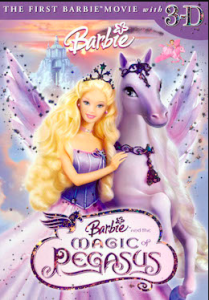
Image credit: DVD cover of Magic of the Pegasus. Used under fair use for commentary, criticism, education, and review. Source: Wikipedia. All rights retained by their owners.